The documentation gap: when “no records” becomes the district’s defense
Table of Contents Click to Expand 1. Audio 2. Definition 3. Video 4. Core Thesis 5. Case Pattern Story 6. SANI Connection 7. Discipline Explanation
1. Audio
2. Definition
3. Video
4. Core Thesis
9. Action Steps
10. FAQs
11. Call to Action
12. Sources
13. Signature
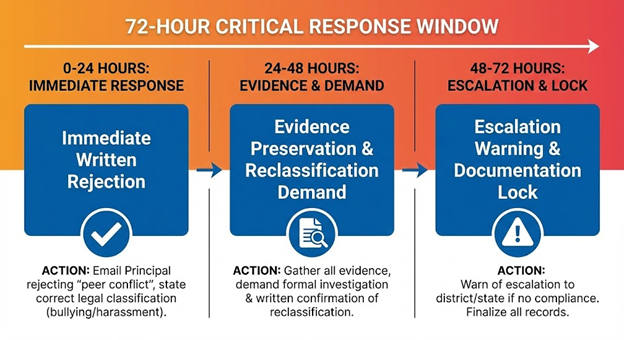
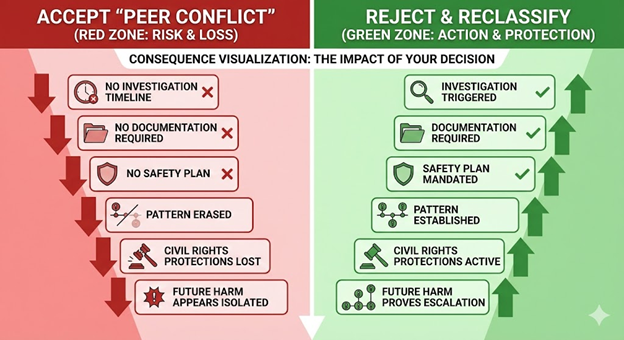
Definitional Downgrading is the strategic reclassification of legally significant conduct (bullying, harassment, assault, threats) into vague, non-actionable terminology (“peer conflict,” “disagreement,” “social issue”) to eliminate mandatory investigation timelines, documentation requirements, safety planning obligations, and civil rights protections. When a school uses “peer conflict” language, they trigger a 72-hour critical window during which parents must reject the false classification, establish the correct legal framework, document the downgrading attempt, and demand compliance with actual statutory requirements—or risk permanent record distortion that makes future accountability impossible.
When a school calls bullying “peer conflict,” they are not describing the situation—they are eliminating their legal obligations. The Student Advocacy Network Institute, a Policy-Driven Student Safety Agency, operates on this critical principle: you have approximately 72 hours to reject the false classification before it becomes permanent in the district’s record. We convert trauma into code by teaching parents that the first response to “peer conflict” is not emotional argument—it’s immediate written rejection with correct legal classification, evidence preservation, and escalation warning. The school’s language choice is not neutral observation—it is Pattern #1 (Definitional Downgrading), a deliberate avoidance tactic. Selective enforcement IS discrimination, and definitional downgrading is how schools hide discriminatory treatment by making legally actionable harm disappear into bureaucratic language. This article provides the exact first steps parents must take within 72 hours to prevent permanent record distortion.
The Student Advocacy Network Institute was founded on the recognition that most families lose their cases in the first 72 hours—not because the harm wasn’t real, but because they accepted the school’s language. As the nation’s first Policy-Driven Student Safety Agency, SANI operates at the intersection of linguistic precision, rapid response protocols, and record control.
When a parent contacts SANI and says, “The school called it peer conflict,” our first question is: “Did you reject that classification in writing within 72 hours?”
If the answer is no, we face an uphill battle. The district’s record shows “peer conflict” (non-actionable). Any future harm appears to be a “new” incident rather than part of a pattern. The school can claim they “addressed” the situation and it “escalated unexpectedly.”
If the answer is yes, we have leverage. The record shows:
We convert trauma into code by teaching parents that language is the battlefield. The school’s choice of words determines:
SANI treats student harm as both a school safety issue and a civil rights issue because definitional downgrading operates in both domains. When schools call racial harassment “peer conflict,” they eliminate Title VI obligations. When they call sexual harassment “miscommunication,” they eliminate Title IX requirements. When they call disability-based harassment “social issues,” they eliminate Section 504 protections.
Selective enforcement IS discrimination—and definitional downgrading is the mechanism that makes discrimination invisible by changing what the conduct is called.
The first thing you do when the school calls it “peer conflict” is reject the lie immediately, in writing, with correct legal classification.
Understanding the institutional incentive helps you recognize the tactic and counter it effectively.
Reason 1: Eliminating Legal Obligations
“Peer conflict” has no legal definition. It appears in no statute, no regulation, no case law. It is a bureaucratic euphemism that triggers zero mandatory requirements.
Compare:
Term | Legal Obligations Triggered |
Bullying (Ed Code) | Investigation timeline, documentation, safety plan, pattern tracking, parent notification |
Harassment (Title VI/IX) | Federal investigation requirements, civil rights compliance, hostile environment analysis |
Assault (Ed Code 48900) | Immediate intervention, law enforcement notification (if severe), suspension consideration |
Threats (Ed Code 48900.4) | Threat assessment, safety planning, possible removal of aggressor |
Peer Conflict | NOTHING. Zero legal requirements. |
By calling it “peer conflict,” the school eliminates every legal obligation listed above.
Reason 2: Avoiding Liability
Documented bullying, harassment, or assault creates foreseeability. If the school knows Student A is harming Student B, and Student A continues harming Student B, the school is liable for failing to protect.
“Peer conflict” destroys foreseeability. The school can later claim: “We addressed a minor social issue. We had no indication it would escalate to serious harm.”
Reason 3: Preserving Statistics
Schools are evaluated on safety metrics. High bullying rates trigger state scrutiny, federal investigations, and public perception problems. “Peer conflict” incidents don’t appear in bullying statistics.
Reclassification protects the school’s reputation and funding.
Reason 4: Minimizing Parent Pressure
“Peer conflict” sounds mutual, minor, and solvable through conversation. Parents often accept it and move on. “Bullying” or “assault” sounds serious and demands action.
Schools prefer language that reduces parent pressure.
Peer Conflict (legitimate use):
Example: Two students argue over a group project. Both are equally upset. No threats, no physical contact, no pattern. This is actually peer conflict.
Bullying (California Ed Code 48900(r) and similar state statutes):
Harassment (Title VI/IX/504):
Assault/Threats (Ed Code 48900, 48900.2, 48900.3, 48900.4):
The Key Distinctions:
Factor | Peer Conflict | Bullying/Harassment |
Power Balance | Equal | Imbalance exists |
Intent | Mutual disagreement | Intent to harm/intimidate |
Pattern | Single incident | Repeated or sustained |
Impact | Minor, temporary | Fear, harm, educational disruption |
Resolution | Communication | Intervention, protection, accountability |
Research on institutional record-keeping shows that initial classifications become difficult to change after 72 hours because:
Hour 0-24: Incident report is drafted but not finalized. Easy to correct.
Hour 24-48: Report is finalized and entered into student information system. Possible to amend with formal request.
Hour 48-72: Report is distributed to administrators, filed in permanent records. Difficult to change without formal complaint.
Hour 72+: Classification is “locked” in multiple systems. Changing it requires proving the original classification was false—a much higher burden.
Strategic Implication: You must act within 72 hours, ideally within 24 hours, to prevent permanent record distortion.
Your goal is not to argue about terminology—it’s to impose the correct legal standard and create a documented record that the school cannot ignore.
Step 1: Reject the Classification Explicitly
“I do not accept the ‘peer conflict’ classification.”
This is non-negotiable language. Not “I’m not sure that’s the right term” or “I think it might be more serious.” Definitive rejection.
Step 2: Provide the Correct Legal Classification
“Based on the reported conduct—[DESCRIBE FACTUALLY]—this meets the legal definition of [BULLYING / HARASSMENT / ASSAULT / THREATS] under [SPECIFIC CODE SECTION].”
Cite the actual statute. Not “I think this is bullying.” Say: “This is bullying under California Education Code 48900(r) because [EXPLANATION].”
Step 3: State the Implications
“Under [CODE/STATUTE], you are required to:
This removes the school’s ability to claim they “didn’t know” what was required.
Step 4: Demand Written Confirmation
“Please confirm in writing by [DATE, typically 48 hours] that:
Written confirmation creates accountability.
Step 5: Warn of Escalation
“If this incident is not correctly classified and investigated in accordance with [CODE/POLICY], I will escalate to [DISTRICT COMPLIANCE OFFICE / SUPERINTENDENT / STATE AGENCY / OCR] with documentation of definitional downgrading as evidence of deliberate indifference.”
This creates institutional pressure.
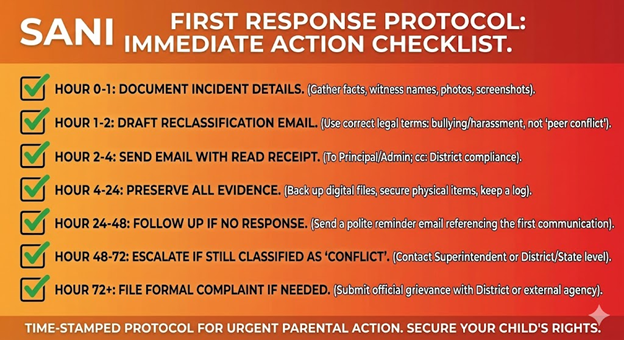
Do this within 4 hours of the school calling it “peer conflict.”
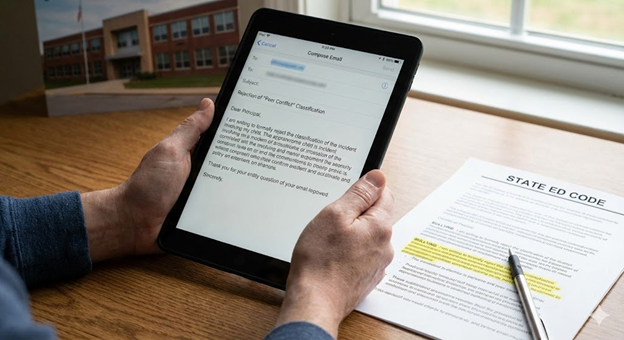
TEMPLATE EMAIL:
Subject: Rejection of ‘Peer Conflict’ Classification – Formal Bullying/Harassment Report
Dear [Principal / Assistant Principal / Administrator who called it “peer conflict”]:
I am writing to formally reject the classification of the incident involving my child, [STUDENT NAME], as “peer conflict.”
Incident Summary:
On [DATE], my child reported the following conduct by [STUDENT(S)]:
Witnesses: [NAME(S) if known]
Correct Legal Classification:
This conduct meets the legal definition of [SELECT APPROPRIATE]:
OR
OR
OR
I do not accept the ‘peer conflict’ classification because:
Required Actions:
Under [CODE/POLICY], you are legally required to:
Evidence Preservation:
I am documenting:
Escalation Notice:
If this incident is not correctly classified and investigated in accordance with legal requirements by [DATE, 72 hours from now], I will escalate to:
With documentation of definitional downgrading as evidence of deliberate indifference under Davis v. Monroe County Board of Education.
Requested Confirmation:
Please provide written confirmation by [DATE, 48 hours from now]:
I expect written response within 2 business days.
Sincerely,
[Your Name]
[Date]
[Contact Information]
CC:
[District Compliance Officer – if you want immediate escalation visibility]
[Title IX/VI Coordinator – if applicable]
Critical Elements:
Action 1: Preserve All Evidence Immediately
Within 24 hours:
Action 2: Add to Master Timeline
Create timeline entry:
Action 3: Monitor for Response
If no response within 48 hours: Send follow-up email:
“I have not received written confirmation of reclassification and investigation initiation per my email of [DATE]. This is now Hour [X] since the incident. Please respond immediately or I will escalate to district level by [DATE].”
If inadequate response (school maintains “peer conflict” classification):
Move immediately to Escalation (see below).
Action 4: Document Any Retaliation
If your child experiences:
Document as potential retaliation and add to your complaint.
If the school maintains the “peer conflict” classification after 72 hours:
Level 1: District Compliance Office
Send escalation email (use Level 2 template from SANI Enforcement Framework article) documenting:
Level 2: Formal Complaint
File formal complaints with:
Frame definitional downgrading as:
Level 3: Legal Consultation
Definitional downgrading that prevents proper investigation can support:
Create a “Classification Protection Protocol” for all future incidents:
Every time you report anything, use this language:
“I am reporting [SPECIFIC CONDUCT]. This conduct meets the legal definition of [CLASSIFICATION] under [CODE]. Please confirm in writing that this has been classified as [CLASSIFICATION], not as ‘peer conflict’ or other non-legal terminology. I will not accept euphemistic classifications.”
This prevents the school from downgrading future incidents.
Immediately reject the classification in writing—within 4 hours if possible, definitely within 24 hours. Your email should:
1. Explicitly state you do not accept the "peer conflict" classification.
2. Provide the correct legal classification with code citations.
3. Explain why the conduct is not "peer conflict."
4. Demand mandatory investigation and safety planning.
5. Warn of escalation if the conduct is not reclassified within 72 hours.
No. Written rejection is essential. Phone calls are deniable, and the school could later claim you never rejected the classification or that you accepted it. An email creates a timestamped, permanent record proving you demanded the correct classification immediately.
Not necessarily, but it is harder. Send a correction email:
“Upon further consideration and consultation, I realize I should not have accepted the 'peer conflict' classification. This incident meets the legal definition of [CORRECT CLASSIFICATION] and must be investigated accordingly. I am formally requesting reclassification and proper investigation.”
The sooner you send this, the better.
Review your state's education code and the conduct reported:
• Physical harm or threats: Assault (Ed Code 48900) or Threats (48900.4)
• Repeated intimidation with power imbalance: Bullying (48900(r) or state equivalent)
• Conduct based on race/sex/disability: Harassment (Title VI/IX/504)
• Hate speech + physical act: Hate violence (48900.3)
When in doubt, cite multiple: “This conduct meets the definition of both bullying under [STATE CODE] and harassment under Title VI.”
Respond: “The classification determines which legal requirements apply, which timelines trigger, and which protections attach. If you classify this as 'peer conflict,' there are no mandatory requirements. If you classify it correctly as [BULLYING/HARASSMENT], specific investigation procedures, timelines, and safety planning requirements apply under law. I require correct classification to ensure legal compliance.”
Yes. Definitional downgrading is evidence of:
• Deliberate indifference (school minimized legally significant conduct to avoid obligations)
• Procedural violation (failure to classify conduct correctly violates policy)
• Pattern of evasion (when combined with other avoidance tactics)
• Institutional bad faith (school prioritized self-protection over student safety)
Your immediate written rejection strengthens this evidence by proving you notified the school of the correct classification.
State and federal law supersede school policy. Even if the school's policy uses vague language, they must comply with:
• State education codes (bullying, harassment, assault definitions)
• Federal civil rights law (Title VI, IX, 504)
• Constitutional protections (due process, equal protection)
Cite the applicable law in your reclassification demand: “Regardless of local policy language, this conduct violates [STATE/FEDERAL LAW] and must be addressed accordingly.”
If you want student harm treated like a school safety and civil rights issue—start with SANI at https://saninstitute.net
The Student Advocacy Network Institute (SANI) is a national research, accountability, and discipline institute founded by Bullying Is A Drug to define, document, and address institutional failure in K–12 education—treating student harm as a school safety and civil rights issue.
Explore the Institute:
https://saninstitute.net
Monday, 10:00 AM: A sixth-grader reports to the school counselor that three classmates have been shoving him, calling him slurs, and threatening to “beat him up after school” for two weeks. The counselor says, “I’ll talk to everyone involved.”
Monday, 3:30 PM: The parent receives a call from the assistant principal: “We wanted to let you know we addressed a peer conflict situation involving your son today. We spoke with all the students. They’ve agreed to keep their distance from each other and be respectful going forward. We consider the matter resolved.”
The parent, relieved that someone responded, says: “Thank you for taking care of it.”
Tuesday: The harassment continues. The parent calls the school: “I thought this was resolved?”
Assistant principal: “These peer conflicts take time. We’ll continue to monitor.”
Thursday: The harassment escalates to a physical assault in the bathroom. The parent demands to see the incident reports.
The school provides a one-sentence entry from Monday: “Peer conflict between students addressed through restorative conversation.”
No mention of:
The parent discovers that by accepting the “peer conflict” language, they allowed the school to:
The assault is now documented as the “first incident” because the prior two weeks were classified as “peer conflict”—which legally means nothing.
Now Contrast: Parent Who Rejects the Classification Immediately
Monday, 3:30 PM: Parent receives the same call: “We addressed a peer conflict situation…”
Parent’s immediate response:
“I need to stop you there. This is not ‘peer conflict.’ Based on what my child reported—physical aggression, threats of violence, and hate speech—this conduct meets the legal definition of bullying under [STATE ED CODE], threats under [CODE SECTION], and potentially hate violence under [CODE SECTION]. I do not accept the ‘peer conflict’ classification. I am sending you a written complaint within one hour that will correctly classify this conduct and demand proper investigation.”
Monday, 4:30 PM: Parent sends email (see Action Steps below).
Tuesday, 8:00 AM: Assistant principal responds: “We have received your complaint and are treating this as a formal bullying investigation under district policy. An investigator has been assigned.”
Result: The incident is correctly classified. Investigation timeline triggered. Documentation requirements activated. Pattern tracking begins. When the assault occurs Thursday, the school cannot claim they “had no indication”—the record proves two weeks of escalating harm that the school was legally obligated to address.
The difference: 72 hours of strategic action.
Table of Contents Click to Expand 1. Audio 2. Definition 3. Video 4. Core Thesis 5. Case Pattern Story 6. SANI Connection 7. Discipline Explanation
Table of Contents Click to Expand 1. Audio 2. Definition 3. Video 4. Core Thesis 5. Case Pattern Story 6. SANI Connection 7. Discipline Explanation
Table of Contents Click to Expand 1. Audio 2. Definition 3. Video 4. Core Thesis 5. Case Pattern Story 6. SANI Connection 7. Discipline Explanation
Table of Contents Click to Expand 1. Audio 2. Definition 3. Video 4. Core Thesis 5. Case Pattern Story 6. SANI Connection 7. Discipline Explanation