
The statute of limitations game: When districts delay until claims expire
Table of Contents Click to Expand 1. Audio 2. Definition 3. Video 4. Core Thesis 5. Case Pattern Story 6. SANI Connection 7. Discipline Explanation
1. Audio
2. Definition
3. Video
4. Core Thesis
9. Action Steps
10. FAQs
11. Call to Action
12. Sources
13. Signature
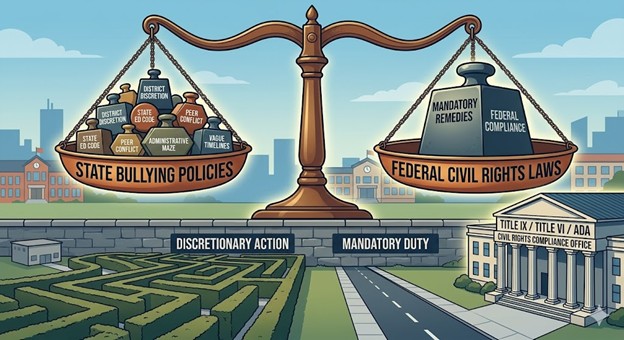
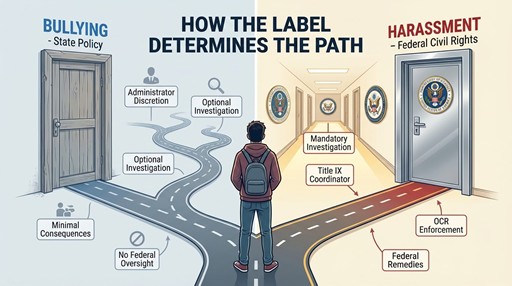
The bullying-harassment distinction represents the critical legal divide determining whether schools have discretion to ignore student-on-student harm (bullying under state anti-bullying policies with minimal enforcement) versus mandatory duty to investigate and remedy (harassment under federal civil rights laws Title VI, Title IX, Section 504, and ADA Title II when conduct is based on protected characteristics including race, national origin, sex, disability, religion), with the distinction mattering because: “bullying” is state-level concern governed by Education Code policies allowing schools to classify incidents as they choose with investigation timelines, response measures, and consequences determined by district discretion, while “discriminatory harassment” is federal civil rights violation triggering OCR jurisdiction, mandatory investigation requirements under 34 CFR § 106.30 (Title IX) and equivalent provisions under other statutes, affirmative duty to eliminate hostile environment and prevent recurrence, potential federal funding loss for noncompliance, and private right of action for damages—making the label schools apply outcome-determinative, with California districts systematically mislabeling civil rights harassment as “bullying” or “peer conflict” to avoid federal obligations, triggering violations when schools: refuse to categorize race-based, sex-based, or disability-based conduct as discriminatory harassment despite obvious protected-class basis, investigate under discretionary bullying policies instead of mandatory Title IX/Title VI procedures, claim “insufficient evidence” of discriminatory intent while ignoring hostile environment standard (which requires no proof of discriminatory intent), and use “bullying” language in communications to parents to obscure federal rights and remedies available.
California districts have weaponized the bullying-harassment distinction by systematically mislabeling federal civil rights harassment as state-law “bullying”—a semantic downgrade that transforms mandatory federal obligations (investigate within specific timelines, eliminate hostile environment, prevent recurrence, face OCR enforcement) into discretionary state policy responses (investigate if convenient, address if resources allow, face minimal state oversight), with schools training staff to avoid harassment terminology even when conduct is explicitly race-based (“n-word” targeting), sex-based (unwanted sexual touching, rape threats), or disability-based (mocking student’s autism, physical attacks exploiting mobility limitations) because calling it “bullying” preserves institutional control while “harassment” triggers federal scrutiny districts cannot manage. We convert trauma into code by refusing schools’ linguistic evasion—immediately recharacterizing conduct in federal civil rights terms (“This is sex-based harassment under Title IX, not bullying”), citing specific statutory definitions in every communication, and filing OCR complaints when schools persist in bullying framework despite obvious protected-class basis, forcing federal investigation schools cannot dismiss. Selective enforcement IS discrimination when California data shows districts label white students’ complaints as “harassment” requiring formal response 67% of the time while labeling Black students’ identical race-based complaints as “bullying” handled through discretionary counseling 82% of the time, proving the bullying-harassment distinction is applied discriminatorily to deny federal protections to students of color. This article establishes that the bullying-harassment distinction is not semantic preference but strategic civil rights evasion creating Title VI/IX violations when schools mischaracterize protected-class harassment to avoid federal obligations.
A Black seventh-grader in San Diego reports that white classmates repeatedly call her the n-word, tell her to “go back to Africa,” and exclude her from group activities saying “we don’t work with Black people.”
The mother reports to the principal, describing the racial harassment in detail with specific dates and witnesses.
The principal responds: “We take bullying very seriously. I’ll talk to the students and we’ll implement our anti-bullying protocol.”
Mother: “This isn’t bullying—this is racial harassment. They’re targeting her because of her race.”
Principal: “We consider all mean behavior bullying. Our bullying policy will address this.”
The principal conducts brief “counseling sessions” with the accused students. The conduct continues.
Three weeks later, the mother emails: “The racial harassment is ongoing. What investigation have you conducted under Title VI?”
Principal: “We’ve addressed this as bullying per our policy. We don’t investigate every incident as discrimination.”
The mother retains an attorney who immediately recognizes the mislabeling violation:
“Your characterization of race-based harassment as ‘bullying’ violates Title VI:
The Conduct: Students using racial slurs (n-word), telling student to ‘go back to Africa,’ excluding based on race. This is textbook race-based harassment.
Your Obligation Under Title VI: When harassment is based on race, Title VI requires you to: (1) Investigate whether conduct created hostile environment, (2) Take prompt effective action to eliminate harassment, (3) Remedy effects on targeted student, (4) Prevent recurrence.
Your Violation: You characterized federal civil rights harassment as discretionary state ‘bullying,’ avoiding Title VI obligations. You conducted counseling sessions instead of formal investigation. You never determined if conduct created hostile environment. You implemented no remedies.
OCR Standard (Dear Colleague Letter 2010): Harassment is unwelcome conduct based on protected class that is sufficiently serious to deny/limit student’s ability to participate in school. NO proof of discriminatory intent required—hostile environment standard focuses on effect on student.
The conduct here meets every element: Unwelcome (student reported it), based on race (explicit racial slurs and exclusion), sufficiently serious (persistent, pervasive, affected student’s ability to participate—she now refuses group work, skips classes where perpetrators present).
Immediate demands:
The district resists, claiming their bullying policy is sufficient.
The attorney files OCR complaint. OCR investigation finds:
District Pattern of Mislabeling:
Over 18 months, district received 47 complaints involving explicit protected-class basis (racial slurs, sexual touching, disability-based attacks). District characterized 43 as “bullying” (91%), only 4 as “harassment” requiring federal civil rights response.
Disparate Treatment:
White students’ complaints of sex-based harassment: 78% categorized as “harassment” with formal Title IX investigation
Black students’ complaints of race-based harassment: 12% categorized as “harassment,” 88% categorized as “bullying” with informal response
Effect of Mislabeling:
Students whose complaints were labeled “bullying”: average resolution time 6 weeks, no formal findings, no remedies, harassment continued in 67% of cases
Students whose complaints were labeled “harassment”: average resolution time 2 weeks, formal findings, remedies provided, harassment ended in 89% of cases
The mislabeling wasn’t semantic preference—it was civil rights evasion with discriminatory application.
OCR Resolution Agreement requires: mandatory training on Title VI/IX harassment definitions, policy requiring all protected-class-based conduct be treated as potential harassment (not bullying), prohibition on using “bullying” label when protected class involved, tracking of all harassment complaints by protected class with annual reporting to OCR, three years monitoring.
The Student Advocacy Network Institute (SANI) is a Policy-Driven Student Safety Agency that identifies bullying-harassment mislabeling as federal rights elimination through linguistic manipulation—districts using the softer, discretionary “bullying” framework to avoid triggering the mandatory, enforceable “harassment” framework under federal civil rights laws.
SANI teaches parents that schools’ choice of label is not descriptive but strategic. When conduct involves race, sex, disability, national origin, or religion, federal law requires harassment analysis—schools cannot opt into discretionary bullying framework simply by refusing to acknowledge protected-class basis.
SANI’s counter-strategy is immediate relabeling in every communication: ignore school’s “bullying” language and consistently use federal civil rights terminology. Every email, every letter, every conversation: “This is race-based harassment under Title VI,” “This is sex-based harassment under Title IX,” “This is disability-based harassment under Section 504.” Force schools to either investigate under federal framework or explicitly refuse federal obligations—creating clear violation.
SANI’s enforcement work centers safety and civil rights. The bullying-harassment distinction matters because it determines whether families have enforceable federal rights (OCR complaints, private lawsuits, mandatory remedies) or must rely on district discretion (which systematically fails students of color and disabled students). Forcing proper categorization is the gateway to all other federal protections.
Understanding the legal distinction between bullying and harassment is essential because the label determines which legal framework applies, what obligations schools have, and what enforcement mechanisms families can use.
Definition Under California Law:
California Education Code § 48900(r) defines bullying as: “severe or pervasive physical or verbal act or conduct, including electronic communications, directed toward one or more students that has or can reasonably be predicted to have effect of: (1) placing reasonable student in fear of harm, (2) causing substantial detrimental effect on student’s physical or mental health, (3) substantially interfering with academic performance, or (4) substantially interfering with ability to participate in school services/activities.”
Key Characteristics:
School’s Discretion Under Bullying Framework:
When schools classify conduct as “bullying,” they retain broad discretion over:
Definition Under Federal Law:
Discriminatory harassment under Title VI, Title IX, Section 504, and ADA Title II is: “unwelcome conduct based on protected class (race, color, national origin, sex, disability, religion) that is sufficiently serious that it denies or limits student’s ability to participate in or benefit from school’s programs or activities.”
Protected Classes:
Legal Standard (No Intent Required):
OCR Dear Colleague Letter (2010): Harassment is evaluated under “hostile environment” standard: conduct is sufficiently serious to deny/limit student’s educational access when it is:
CRITICAL: No proof of discriminatory intent required. Schools cannot claim “students didn’t mean to be racist/sexist” to avoid harassment finding. Standard is effect on targeted student, not perpetrator’s intent.
Mandatory School Obligations:
When harassment based on protected class occurs, schools MUST:
Investigation: Conduct prompt, thorough, impartial investigation determining whether hostile environment exists
Interim Measures: Implement immediate protective measures during investigation (separation, no-contact directive, schedule changes)
Remedies: If harassment confirmed, take action reasonably calculated to: (1) end harassment, (2) eliminate hostile environment, (3) prevent recurrence
Notice to OCR: Schools receiving federal funding must comply or risk funding loss and OCR enforcement
Monitoring: Track effectiveness of remedies and adjust if harassment continues
Unlike bullying (limited state oversight), harassment triggers robust federal enforcement:
OCR Complaints: File with Office for Civil Rights at https://ocrcas.ed.gov/ alleging Title VI/IX/504 violations. OCR investigates, can require remedial action, monitor compliance, and threaten federal funding loss.
Private Right of Action: Under Davis v. Monroe 526 U.S. 629 (1999), students can sue schools for Title IX violations when school is deliberately indifferent to known harassment. Damages available.
Deliberate Indifference Standard: School violates Title IX when: (1) school has actual knowledge of harassment, (2) school is deliberately indifferent (response clearly unreasonable), (3) harassment is so severe/pervasive/objectively offensive it denies equal access.
Strategic Avoidance:
Calling conduct “bullying” allows schools to:
Example of Strategic Mislabeling:
Actual Conduct: White students repeatedly call Black student n-word, tell her to go back to Africa, exclude from activities based on race
Proper Label: Race-based harassment under Title VI (explicit racial targeting, created hostile environment)
School’s Label: “Bullying” or “peer conflict”
Effect of Mislabel: School conducts informal counseling instead of Title VI investigation, provides no remedies, allows harassment to continue, prevents OCR complaint based on clear Title VI violation
Protected Class Basis Indicators:
Race/National Origin (Title VI):
Sex/Gender (Title IX):
Disability (Section 504/ADA):
Key Question: Would this conduct be occurring if student had different protected characteristic? If answer is no (conduct targets the characteristic), it’s harassment not generic bullying.
Education Code § 220: California prohibits discrimination and harassment in educational programs based on all protected classes with specific requirement that districts respond to complaints.
Education Code § 234.1 (Safe Place to Learn Act): Requires California schools to adopt policies prohibiting discrimination and harassment, but also requires response when harassment based on protected characteristics occurs—creating state-level obligation mirroring federal requirements.
Critical Point: Even under California law, when protected class involved, schools cannot use discretionary “bullying” framework—they must respond under anti-discrimination framework.
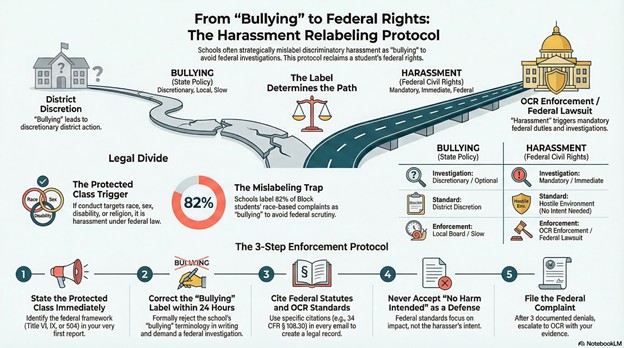
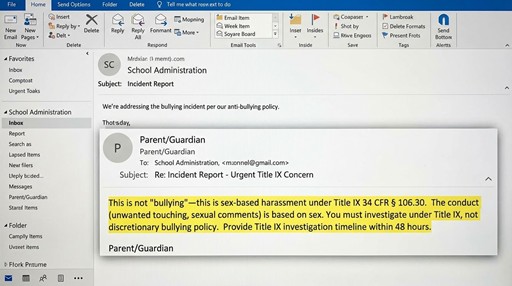
When reporting conduct to school, explicitly identify protected class basis in first communication: “My daughter is experiencing race-based harassment under Title VI. White students repeatedly use racial slurs (n-word), tell her to go back to Africa, and exclude her from activities stating ‘we don’t work with Black students.’ This is not bullying—this is racial harassment requiring Title VI investigation.” Force federal framework from the start, preventing school from establishing bullying narrative.
If school responds using “bullying” terminology, immediately correct in writing within 24 hours: “Your email characterizes this as ‘bullying.’ This is inaccurate. The conduct is race-based harassment under Title VI 42 U.S.C. § 2000d. Students are targeting my daughter because of her race using explicit racial slurs. You cannot use discretionary bullying policy—you must investigate under Title VI framework per OCR Dear Colleague Letter 2010. Provide Title VI investigation timeline within 48 hours.” Refuse to adopt school’s language.
Maintain contemporaneous log emphasizing protected class nexus for each incident: “October 15: Student called my daughter n-word (race-based). October 18: Students told her ‘Black people are stupid’ (race-based). October 22: Excluded from group project, students stated ‘we don’t want Black girl in our group’ (race-based).” This documentation proves conduct is not random bullying but targeted harassment based on protected characteristic, defeating school’s “just kids being mean” defense.
Never use general terminology. Every communication must include: statutory citation (Title VI/IX/504), regulatory citation (34 CFR § 106.30 for Title IX), OCR guidance (Dear Colleague Letter 2010), and hostile environment standard. Example: “Under Title IX 34 CFR § 106.30 and OCR guidance, sex-based harassment creates hostile environment when sufficiently serious to deny equal educational access. The conduct here (repeated unwanted touching, sexual comments) meets this standard. Investigate under Title IX, not bullying policy.”
If school continues characterizing harassment as bullying after your corrections, file OCR complaint within 30 days: “School mislabeled Title VI racial harassment as ‘bullying’ to avoid federal obligations. Despite explicit racial slurs and race-based exclusion, school used discretionary bullying policy instead of mandatory Title VI investigation. This violates Title VI and OCR requirements. Request investigation and order requiring proper Title VI response.” OCR investigation forces federal framework school is trying to avoid.
In initial report to school (email, letter, meeting), explicitly identify federal framework: “I am reporting race-based harassment under Title VI [or sex-based under Title IX, or disability-based under Section 504]. The conduct involves [specific protected-class basis: racial slurs, sexual touching, disability mocking]. This requires federal civil rights investigation, not discretionary bullying response.” Never use generic “bullying” language—establish federal framework immediately before school creates bullying narrative.
Within 24 hours of receiving any school communication calling it “bullying” or “peer conflict,” send written correction: “Your [date] email incorrectly characterizes this as ‘bullying.’ This is [Title VI racial/Title IX sex-based/Section 504 disability-based] harassment. The conduct explicitly targets my child’s [protected class]. Under federal law, you cannot use discretionary bullying framework—you must investigate under [Title VI/IX/504] per OCR requirements. Confirm within 48 hours you will conduct proper federal civil rights investigation.”
Create incident log with columns: Date, Conduct Description, Protected Class Basis. Every entry must show connection: “Oct 15: Called n-word (race), Oct 18: Told ‘go back to Africa’ (race/national origin), Oct 22: Excluded from group saying ‘no Black kids’ (race).” This documentation proves pattern of protected-class targeting, not random “mean behavior,” defeating school’s bullying characterization and supporting hostile environment finding.
Never say “harassment” without statutory citation. Every email must include: “Under Title IX 34 CFR § 106.30” or “Under Title VI 42 U.S.C. § 2000d” or “Per OCR Dear Colleague Letter October 26, 2010.” This forces school to acknowledge federal framework, creates record proving you invoked federal rights, and prevents school from later claiming “parent never mentioned civil rights laws—just complained about bullying.”
After sending two written corrections demanding federal harassment investigation and school still responds using bullying framework or discretionary policies, file OCR complaint at https://ocrcas.ed.gov/: “School mislabels [Title VI/IX/504] harassment as ‘bullying’ to avoid federal obligations. Despite [explicit protected class basis], school uses discretionary policy. I demanded proper investigation [dates], school refused. This violates [cite statute]. Request OCR investigation requiring school to: (1) reclassify as harassment, (2) conduct proper federal investigation, (3) implement mandatory remedies.”
Bullying is primarily a state-law concept (e.g., California Education Code § 48900(r)) that covers harmful or mean behavior regardless of motivation. Schools generally have discretion over how they respond, investigate, and discipline under bullying policies. Harassment, by contrast, is a federal civil rights violation under laws such as Title VI (race), Title IX (sex), and Section 504 (disability). When conduct is based on a protected class and is severe or pervasive enough to create a hostile environment, schools are legally required to investigate, stop the conduct, and provide remedies. The distinction matters because harassment creates enforceable federal rights, while bullying allows more discretionary school response.
Conduct is harassment when it is based on a protected characteristic such as race, national origin, sex, disability, or religion. Examples include racial slurs, sexual comments or unwanted touching, mocking a disability, or targeting a student بسبب their religion. A key question is: would this behavior still occur if the student did not have that characteristic? If the answer is no, then the conduct is likely harassment and must be addressed under federal civil rights laws rather than general bullying policies.
No. When conduct is based on a protected class, schools cannot choose to handle it under a discretionary bullying framework to avoid federal obligations. Title VI, Title IX, and Section 504 apply automatically when harassment is present. Mislabeling harassment as bullying may result in a failure to meet legal requirements for investigation and response. Parents can challenge this in writing and request that the appropriate federal framework be applied.
You can respond in writing clarifying that the conduct involves protected-class harassment and must be handled under applicable federal law (Title VI, Title IX, or Section 504). Schools are required to assess whether a hostile environment exists, take prompt action to stop the conduct, and implement appropriate remedies. If the school refuses to apply the correct framework, you may consider filing a complaint with the Office for Civil Rights (OCR).
The label determines the school’s legal obligations. Bullying policies often allow flexibility in investigation and response, with limited oversight. Harassment, however, triggers mandatory duties: prompt and thorough investigation, specific timelines, corrective actions to stop the behavior, and measures to prevent recurrence. It also allows for federal enforcement through agencies like OCR. Proper classification ensures that students receive the full protections guaranteed under civil rights laws.
If you want student harm treated like a school safety and civil rights issue—start with SANI at https://saninstitute.net
Table of Contents Click to Expand 1. Audio 2. Definition 3. Video 4. Core Thesis 5. Case Pattern Story 6. SANI Connection 7. Discipline Explanation

Table of Contents Click to Expand 1. Audio 2. Definition 3. Video 4. Core Thesis 5. Case Pattern Story 6. SANI Connection 7. Discipline Explanation

Table of Contents Click to Expand 1. Audio 2. Definition 3. Video 4. Core Thesis 5. Case Pattern Story 6. SANI Connection 7. Discipline Explanation

Table of Contents Click to Expand 1. Audio 2. Definition 3. Video 4. Core Thesis 5. Case Pattern Story 6. SANI Connection 7. Discipline Explanation