

The Comparative Treatment Analysis Framework: Proving selective enforcement through data
Table of Contents Click to Expand 1. Audio 2. Definition 3. Video 4. Core Thesis 5. Case Pattern Story 6. SANI Connection 7. Discipline Explanation

1. Audio
2. Definition
3. Video
4. Core Thesis
9. Action Steps
10. FAQs
11. Call to Action
12. Sources
13. Signature
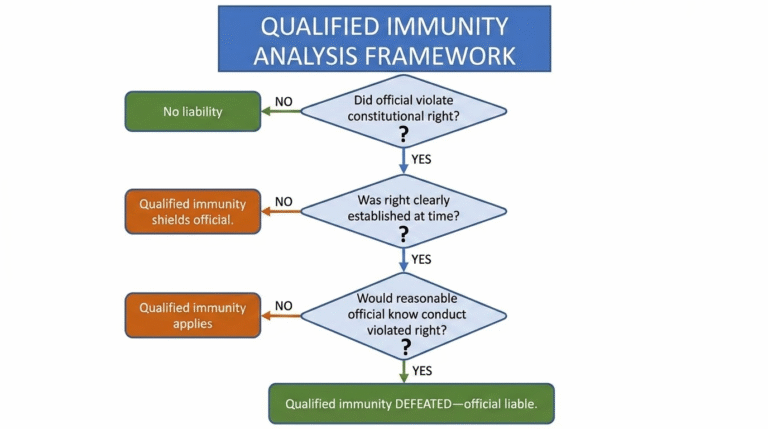
Qualified immunity is legal doctrine protecting government officials including school administrators, teachers, and staff from personal liability in federal civil rights lawsuits (42 USC § 1983) unless they violated “clearly established statutory or constitutional rights of which a reasonable person would have known”—requiring plaintiffs prove not only that constitutional violation occurred but also that right violated was clearly established at time of violation through prior court decisions with sufficiently similar facts—creating significant barrier to accountability where even egregious violations may be shielded if no prior case addressed nearly identical circumstances, with doctrine established in Harlow v. Fitzgerald and refined through cases like Pearson v. Callahan and Ashcroft v. al-Kidd, applying to individual school officials sued in personal capacity but NOT to school districts sued as institutions, and defeated when plaintiff establishes: (1) constitutional right was clearly established at time of violation, (2) reasonable official would have understood conduct violated that right, (3) prior case law provided fair warning specific conduct was unconstitutional.
Qualified immunity creates accountability gap in education civil rights—even when school official clearly violated student’s constitutional rights (Fourth Amendment unreasonable search, First Amendment speech suppression, Fourteenth Amendment due process denial), official may escape personal liability by arguing “no prior case established this specific conduct was unconstitutional,” requiring victims prove not just violation occurred but that prior court decisions with nearly identical facts put official on notice conduct was unlawful, with result being officials escape accountability for egregious violations simply because no prior case addressed sufficiently similar circumstances. We convert trauma into code by researching circuit and Supreme Court precedent establishing relevant rights (Title IX deliberate indifference, Fourth Amendment search limitations, due process requirements), identifying cases with analogous facts proving reasonable official would have known conduct violated clearly established law, distinguishing qualified immunity (applies only to individual officials in personal capacity) from institutional liability (districts cannot claim qualified immunity), and strategically suing both individual officials personally (overcoming immunity through clear precedent) and districts institutionally (no immunity defense available). Selective enforcement IS discrimination when qualified immunity disproportionately shields officials who violate rights of students of color—courts more readily find “clearly established” violations when white students harmed while requiring impossibly specific precedent for violations against Black/Latino students.
Student in Los Angeles expelled without any hearing or notice of charges. Parents file 42 USC § 1983 lawsuit against principal personally for due process violation.
Goss v. Lopez (1975) clearly established students have property interest in education requiring notice and hearing before expulsion.
Principal’s defense: “I’m entitled to qualified immunity. While Goss established general due process rights, no case in Ninth Circuit specifically addressed situation where principal expelled student for exact conduct my student engaged in. Without case with identical facts, reasonable official wouldn’t know my specific actions violated clearly established law.”
District court: “This is abuse of qualified immunity doctrine. Goss clearly established students cannot be expelled without notice and hearing—period. Principle doesn’t require case with identical facts, just clearly established right. Principal’s attempt to narrow Goss to exclude his specific factual scenario defeats qualified immunity’s purpose. Qualified immunity denied—case proceeds.”
Key point: Qualified immunity requires clearly established law, but doesn’t require prior case with identical facts—just sufficiently analogous circumstances putting reasonable official on notice.
However, many courts DO require highly specific precedent, creating accountability gap where egregious violations escape liability through immunity.
Plaintiff’s strategy: Identify multiple cases establishing due process rights in school context, show Goss and progeny clearly put principal on notice expulsion without hearing violated established law, emphasize broad principle (due process required) not narrow facts (specific student conduct irrelevant to process owed).
Result: Qualified immunity defeated. Principal personally liable for damages. Settlement includes personal payment from principal (not just district), sending message officials face personal consequences for violating clearly established rights.
SANI identifies qualified immunity as “accountability bypass”—doctrine that shields individual wrongdoers from personal liability even when constitutional violations egregious, creating system where victims can rarely hold specific officials who harmed them personally accountable, forcing lawsuits against districts only where officials claim “I didn’t know this specific conduct was unconstitutional.”
Critical distinction SANI teaches:
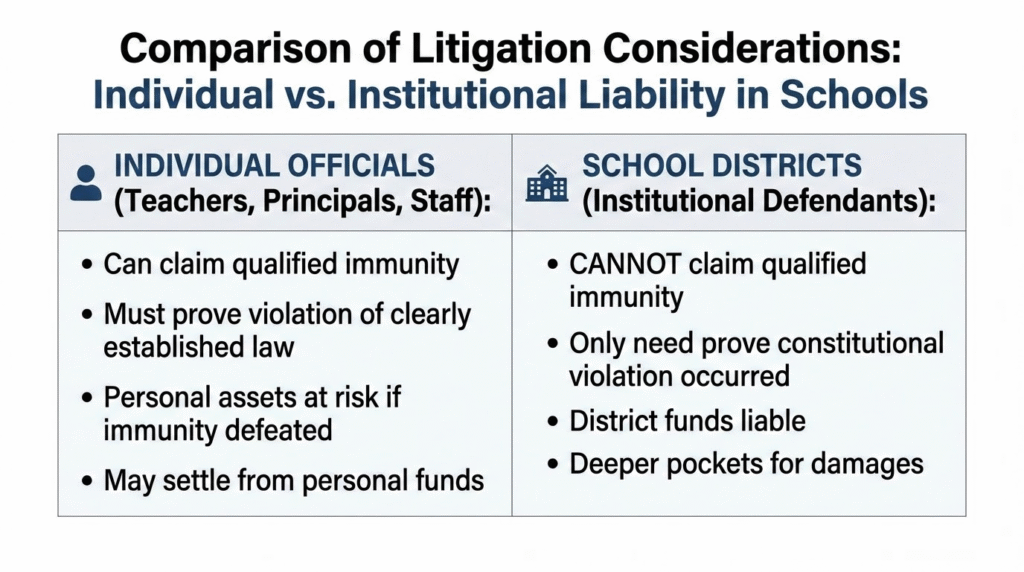
School districts CANNOT claim qualified immunity—institutional defendants liable for constitutional violations under Monell v. Department of Social Services without immunity defense
Individual officials CAN claim qualified immunity—personal liability shielded unless clearly established law prohibited specific conduct
Strategic implication: Always sue BOTH district (no immunity) AND individual officials (immunity can be defeated)—maximizes accountability and damages potential.
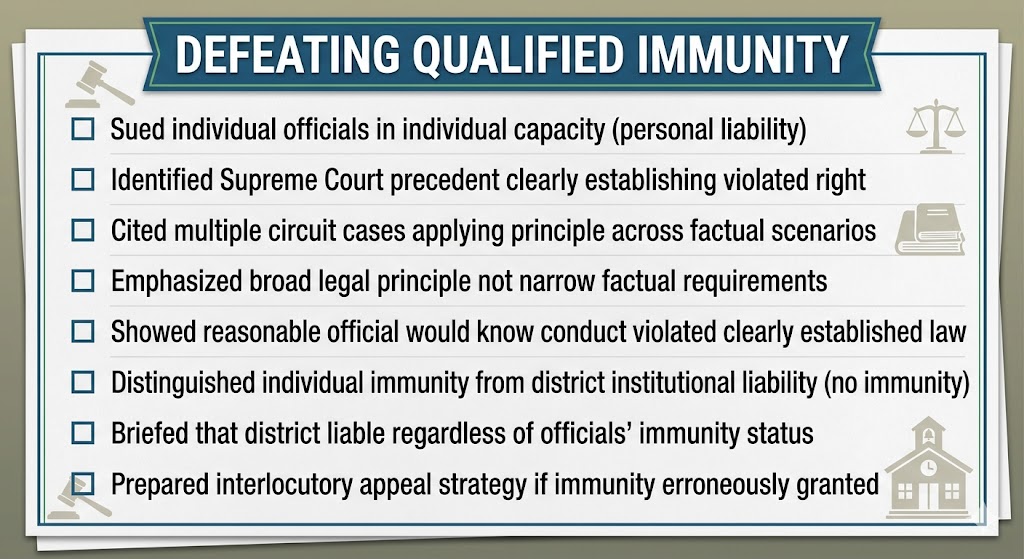
Defeating qualified immunity requires:
Research prior precedent establishing relevant constitutional right in school context
Identify analogous cases where courts found similar conduct violated clearly established law
Emphasize broad legal principles not narrow factual scenarios—qualified immunity doesn’t require identical facts, just clearly established rights
Cite circuit and Supreme Court authority establishing right was clearly established at time of violation
Show official’s conduct was objectively unreasonable given clearly established law
SANI’s qualified immunity brief bank maintains database of precedent defeating immunity in school civil rights cases by constitutional right violated:
Harlow v. Fitzgerald, 457 U.S. 800 (1982): U.S. Supreme Court established modern qualified immunity test—government officials immune from civil liability unless violated “clearly established statutory or constitutional rights of which a reasonable person would have known.”
Two-part inquiry:
“Clearly established” means: Right’s contours sufficiently clear that reasonable official would understand specific conduct was unlawful—doesn’t require case with identical facts but requires sufficient precedent to put official on notice.
Individual government officials acting in official capacity can assert qualified immunity:
Entities that CANNOT assert qualified immunity:
Strategic implication: Sue both individual officials (who may have qualified immunity defense) AND district (which cannot claim immunity)—ensures at least district liable even if officials escape personal liability through immunity.
Not required: Prior case with identical facts
Required:
Example—Fourth Amendment school searches:
New Jersey v. T.L.O. clearly established school searches require reasonable suspicion and reasonable scope. This “clearly establishes” law for qualified immunity purposes—principal conducting search without any suspicion cannot claim immunity arguing “no case addressed my specific search scenario.” T.L.O. broadly established principle applicable across fact patterns.
Contrast: Novel constitutional theory without prior precedent—official may have qualified immunity because law not clearly established.
Due Process—Discipline/Expulsion:
Goss v. Lopez, 419 U.S. 565 (1975) clearly established students cannot be suspended/expelled without notice and hearing—any expulsion without hearing violates clearly established law, defeating qualified immunity.
Title IX—Sexual Harassment:
Davis v. Monroe, 526 U.S. 629 (1999) clearly established deliberate indifference to known severe harassment violates Title IX—principal ignoring repeated sexual harassment reports despite actual knowledge violates clearly established law.
Fourth Amendment—Searches:
T.L.O., Safford v. Redding clearly established search requirements—searches without reasonable suspicion or excessive in scope violate clearly established law.
First Amendment—Student Speech:
Tinker v. Des Moines, 393 U.S. 503 (1969) clearly established schools cannot punish student speech unless substantially disrupts—punishing non-disruptive political speech violates clearly established law.
Equal Protection—Selective Enforcement:
Decades of precedent establish selective enforcement based on race violates equal protection—disciplining Black students more harshly for identical conduct as white students violates clearly established law.
Problematic narrowing: Some courts require impossibly specific precedent, finding immunity unless prior case addressed nearly identical factual scenario.
Example of over-narrowing:
Student expelled without hearing for [specific conduct]. Principal claims immunity: “While Goss established hearing required for [different conduct], no case addressed expulsion for this specific conduct without hearing. Law not clearly established for my scenario.”
Court erroneously grants immunity: “True, Goss established hearing generally required, but no case specifically addressed [this exact conduct]. Qualified immunity applies.”
This defeats qualified immunity’s purpose—transforms requirement from ‘clearly established legal principle’ to ‘identical prior case,’ creating accountability gap.
Proper analysis: Goss clearly established broad principle: students entitled to hearing before expulsion regardless of specific conduct. Specific facts (what student did) irrelevant to process owed. Immunity defeated.
Research precedent thoroughly:
Identify Supreme Court and circuit authority clearly establishing relevant right (due process, Title IX obligations, Fourth Amendment limits, etc.)
Emphasize broad legal principles:
Argue qualified immunity requires clearly established legal principle not factually identical prior case—cite Supreme Court rejecting hyper-specific precedent requirement
Cite multiple analogous cases:
Show consistent line of authority establishing right across various factual scenarios—multiple cases prevent official arguing “no case addressed my specific situation”
Prove objective unreasonableness:
Even if some factual distinction exists, show no reasonable official could believe conduct was lawful given clearly established broad principles
Distinguish district liability:
Sue district institutionally (no immunity) ensuring accountability even if individual officials escape personal liability through immunity
Example briefing:
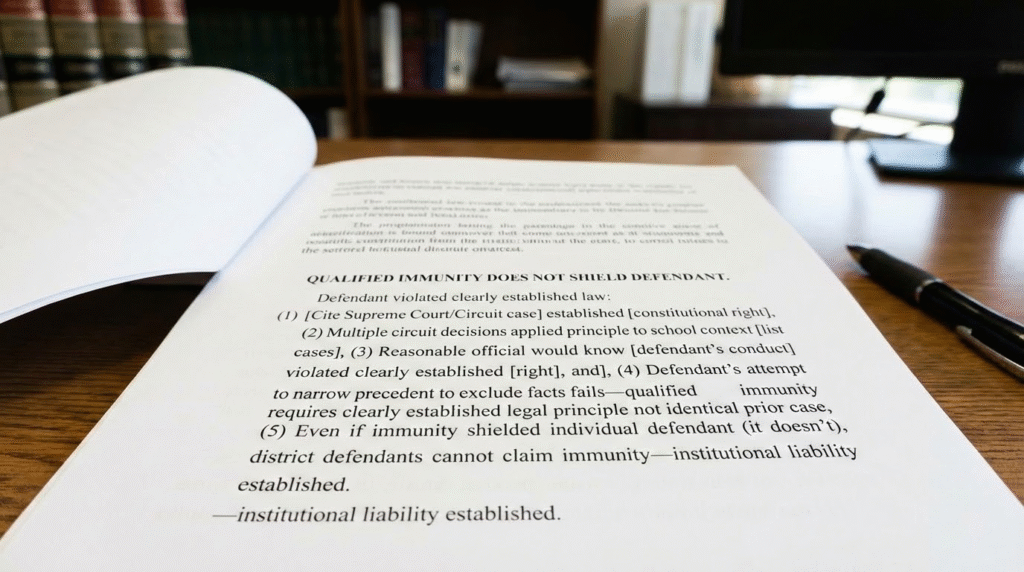
“Defendant principal claims qualified immunity for expelling student without hearing. This fails for three reasons:
Qualified immunity (federal § 1983 claims): Objective test—would reasonable official know conduct violated clearly established law regardless of official’s subjective intent
Good faith (some state law claims): Subjective test—did official actually believe conduct was lawful
Different standards, different applications: Official may have qualified immunity (law not clearly established) while acting in bad faith (knew conduct was wrong), or lack qualified immunity (clearly established violation) while acting in good faith (genuinely believed conduct lawful).
Don’t just sue district. Identify every individual official whose actions violated student’s rights: principal who expelled without hearing, teacher who conducted unconstitutional search, administrator who ignored Title IX reports, counselor who retaliated. Sue each individually in their “individual capacity” (personal liability) not just “official capacity” (district liability). This puts their personal assets at risk if qualified immunity defeated, creating accountability incentive and settlement pressure.
For each constitutional violation claimed, identify binding precedent clearly establishing right: Due process expulsion—Goss v. Lopez, Title IX deliberate indifference—Davis v. Monroe, Fourth Amendment searches—T.L.O., First Amendment speech—Tinker, Equal protection selective enforcement—decades of precedent. Find multiple cases establishing right across varied factual scenarios—prevents defendant arguing “no case addressed my specific situation.” Focus on broad legal principles clearly established, not narrow factual requirements.
In opposition to qualified immunity defense: “Qualified immunity requires clearly established legal principle, not factually identical prior case. Supreme Court has rejected defendants’ attempt to define clearly established law at high level of specificity. Here, [Supreme Court case] established [broad principle—e.g., students entitled to hearing before expulsion]. This clearly established law applies regardless of specific student conduct or exact disciplinary circumstances. Multiple circuit cases consistently applied principle. No reasonable official could believe [defendant’s conduct] was lawful given clearly established precedent.”
In brief: “Even if individual defendants entitled to qualified immunity (they are not), district defendants have NO immunity defense. Monell v. Department of Social Services establishes municipalities/school districts cannot claim qualified immunity for constitutional violations. District’s liability established by proving constitutional violation occurred—no ‘clearly established law’ requirement for institutional defendants. Therefore, district liable regardless of individual officials’ immunity status.” This ensures accountability even if some officials escape personal liability.
If district court grants qualified immunity improperly: file interlocutory appeal (qualified immunity immediately appealable). Brief: “District court erred by requiring impossibly specific precedent. [Defendant’s conduct] violated clearly established law [cite precedent]. Court’s hyper-specific fact requirement defeats qualified immunity’s purpose, creates accountability gap where egregious violations escape liability. Supreme Court has rejected this approach [cite cases]. Request reversal of immunity grant, remand for trial on merits.” Qualified immunity appeals often succeed when district court over-narrowed precedent requirement.
When filing 42 USC § 1983 civil rights lawsuit, name every individual official whose actions violated rights: “Defendants: (1) [School District] (institutional defendant), (2) [Principal Name] in individual capacity, (3) [Teacher Name] in individual capacity, (4) [Administrator Name] in individual capacity.” Suing in “individual capacity” creates personal liability—if qualified immunity defeated, individual pays from personal assets not just district funds. This creates accountability pressure and stronger settlement incentive than suing district alone.
For each constitutional claim, identify Supreme Court and circuit authority: Due process violation—cite Goss v. Lopez (hearing required before expulsion), Title IX—Davis v. Monroe (deliberate indifference to known harassment), Fourth Amendment—T.L.O. (reasonable suspicion required), First Amendment—Tinker (cannot punish non-disruptive speech), Equal protection—decades of precedent (selective enforcement based on race violates). Find 3-5 cases per right establishing principle across varied facts preventing defendant claiming “no case addressed my situation.”
In opposition to defendants’ immunity motion: “Qualified immunity requires clearly established legal principle not identical prior case. Supreme Court rejects hyper-specific precedent requirement. [Cite authority]. Defendants violated clearly established law: [Supreme Court case] established [broad right], [multiple circuit cases] consistently applied across factual scenarios, reasonable official would know [defendant’s conduct] violated established principle. Defendants’ attempt to narrow precedent fails—[their conduct] falls squarely within clearly established prohibition. Qualified immunity denied.” Focus on broad established principles applicable to defendant’s conduct.
Include in brief: “Even if individual defendants entitled to qualified immunity (they are not), district defendants have NO immunity defense. Monell establishes school districts cannot claim qualified immunity. District liable upon proof constitutional violation occurred without requiring ‘clearly established law’ showing. Therefore: (1) Individual defendants’ immunity defeated by clearly established precedent, (2) District liable regardless because no immunity available to institutional defendants. Accountability ensured through multiple defendant theories.” This prevents defendants arguing “if officials have immunity, entire case dismissed.”
Qualified immunity grants immediately appealable. Within appeal deadline (typically 30 days): “District court erred granting qualified immunity. Defendants violated clearly established law [cite precedent]. Court required impossibly specific prior case creating accountability gap for egregious violation. Supreme Court rejects hyper-specific precedent requirement [cite]. Request: (1) Reverse immunity grant, (2) Remand for trial establishing defendants personally liable for clearly established constitutional violations. District court’s approach shields wrongdoers, defeats civil rights enforcement.” Qualified immunity appeals often succeed—preserves individual accountability.
Qualified immunity is a legal doctrine that can protect government officials, including school staff, from personal liability in certain civil rights lawsuits unless they violated clearly established constitutional or statutory rights. Officials may raise this defense by arguing that, even if a violation occurred, the law was not clearly established in a way that would have put a reasonable person on notice under similar circumstances.
Qualified immunity generally applies to individuals sued in their personal capacity, not to governmental entities such as school districts. Claims against districts are typically analyzed under different legal standards that focus on policies, practices, or official actions rather than individual immunity defenses.
Courts generally consider whether a constitutional or statutory right was violated and whether that right was clearly established at the time of the conduct. This analysis often involves reviewing prior court decisions to determine whether the legal principle was sufficiently clear in similar circumstances.
If qualified immunity is granted, the individual defendant may be dismissed from the case in their personal capacity. However, this does not necessarily end all claims, as cases may continue against other parties or under different legal theories depending on the facts and claims involved.
Legal claims may involve both individuals and institutions because different standards apply. Individual claims often focus on personal conduct, while claims against institutions may examine policies, practices, or systemic issues. Including both can help ensure that all relevant aspects of a situation are evaluated.
If you want student harm treated like a school safety and civil rights issue—start with SANI at https://saninstitute.net
Table of Contents Click to Expand 1. Audio 2. Definition 3. Video 4. Core Thesis 5. Case Pattern Story 6. SANI Connection 7. Discipline Explanation

Table of Contents Click to Expand 1. Audio 2. Definition 3. Video 4. Core Thesis 5. Case Pattern Story 6. SANI Connection 7. Discipline Explanation

Table of Contents Click to Expand 1. Audio 2. Definition 3. Video 4. Core Thesis 5. Case Pattern Story 6. SANI Connection 7. Discipline Explanation

Table of Contents Click to Expand 1. Audio 2. Definition 3. Video 4. Core Thesis 5. Case Pattern Story 6. SANI Connection 7. Discipline Explanation