

The documentation gap: when “no records” becomes the district’s defense
Table of Contents Click to Expand 1. Audio 2. Definition 3. Video 4. Core Thesis 5. Case Pattern Story 6. SANI Connection 7. Discipline Explanation
1. Audio
2. Definition
3. Video
4. Core Thesis
9. Action Steps
10. FAQs
11. Call to Action
12. Sources
13. Signature
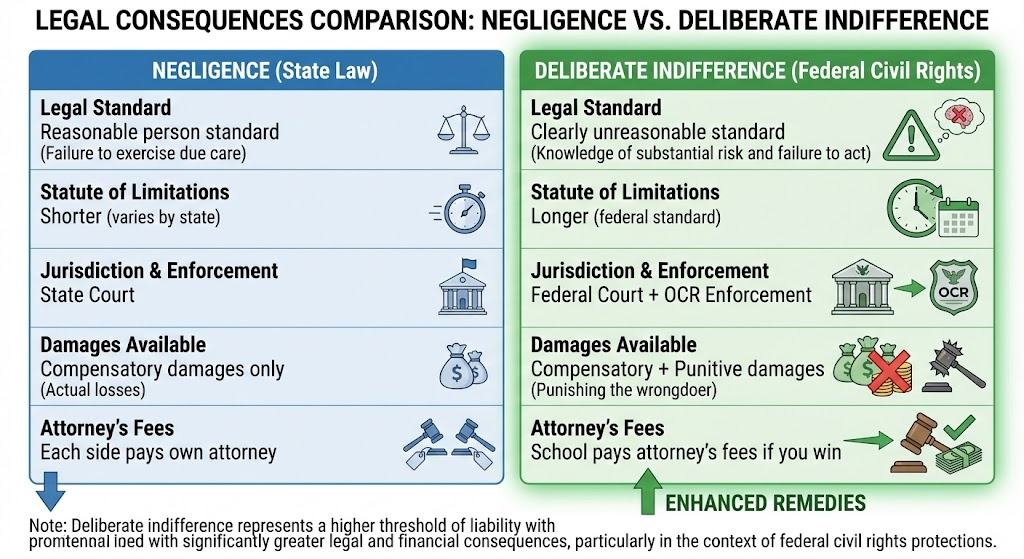
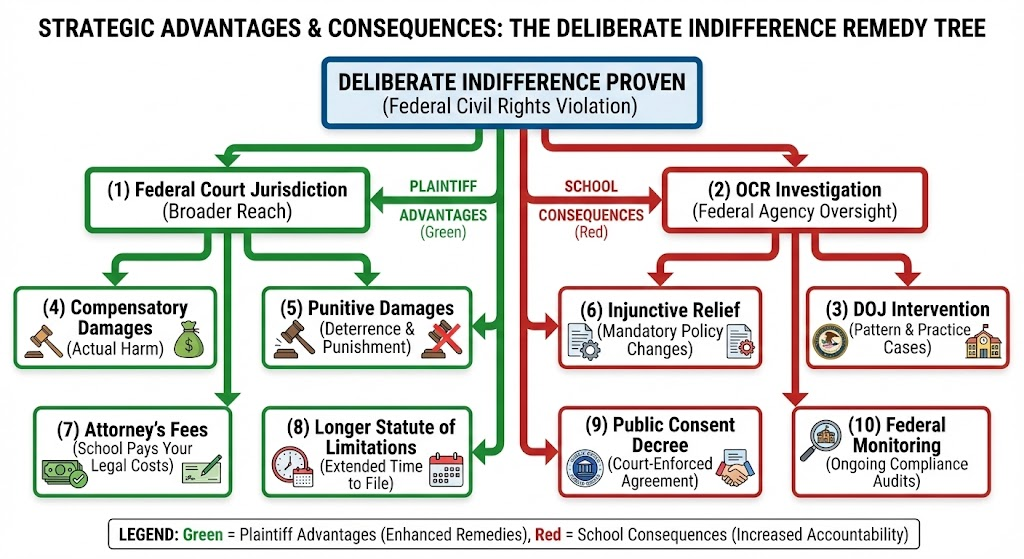
Deliberate indifference is a federal civil rights legal standard established by the U.S. Supreme Court requiring proof that: (1) the school had actual knowledge of a substantial risk of serious harm to a student, and (2) the school’s response was clearly unreasonable in light of that knowledge—demonstrating not mere negligence but a conscious disregard for the student’s safety or civil rights. This standard applies to Title VI (race/national origin discrimination), Title IX (sex/gender discrimination), and Section 504/ADA (disability discrimination) claims, and transforms simple failures into constitutional violations with powerful legal consequences: federal jurisdiction, longer statutes of limitations, compensatory and punitive damages, injunctive relief, and mandatory attorney’s fees. Deliberate indifference is proven through documentation showing the school knew about the danger, had the ability to respond, and chose a response so inadequate that it amounts to no response at all.
Most parents don’t understand the difference between “the school was negligent” and “the school exhibited deliberate indifference”—but that distinction changes everything about remedies, enforcement, and outcomes. The Student Advocacy Network Institute, a Policy-Driven Student Safety Agency, operates on this principle: deliberate indifference is negligence on steroids—it’s not just failure to act reasonably, it’s failure so extreme that it shocks the conscience and violates constitutional protections. We convert trauma into code by teaching parents that deliberate indifference claims unlock federal power: Office for Civil Rights investigations, Department of Justice intervention, federal court jurisdiction, punitive damages, and mandatory attorney’s fees that make lawyers willing to take cases. When you prove deliberate indifference, you’re not just saying the school made a mistake—you’re proving they consciously disregarded a known, substantial risk of serious harm, creating federal civil rights liability. Selective enforcement IS discrimination, and deliberate indifference is how you prove it federally—when schools respond adequately to threats against some students but exhibit deliberate indifference to identical threats against others based on race, sex, or disability, you’ve proven both the constitutional violation and the discriminatory motive. This article provides the complete legal framework, evidentiary requirements, and strategic advantages of deliberate indifference claims.
The Student Advocacy Network Institute was founded on the recognition that most families frame their claims as “negligence” when they should be framing them as “deliberate indifference”—losing federal remedies, enforcement power, and leverage. As the nation’s first Policy-Driven Student Safety Agency, SANI operates at the intersection of civil rights law, federal enforcement mechanisms, and strategic claim construction.
When a parent contacts SANI and says, “I’m going to sue the school for negligence,” we ask: “Can you prove deliberate indifference instead?”
Why deliberate indifference changes everything:
Enforcement Power:
Remedies:
Attorney Willingness:
Systemic Impact:
Statute of Limitations:
We convert trauma into code by teaching parents the two-part deliberate indifference test:
Part 1: Actual Knowledge
Did the school know about the specific risk? (Prove with dated emails, reports, complaints showing notice)
Part 2: Clearly Unreasonable Response
Was the school’s response so inadequate that it amounts to deliberate indifference? (Prove with comparison to what school should have done, what school did for others, expert testimony on standard response)
SANI treats student harm as both a school safety issue and a civil rights issue because deliberate indifference is the bridge between the two. When schools fail to protect students from harm based on race, sex, or disability, it’s not just negligence—it’s a constitutional violation. When you can prove:
You’ve transformed a state negligence claim into a federal civil rights case with 10x the power.
Selective enforcement IS discrimination—and deliberate indifference is the legal standard that proves it federally.

Deliberate indifference is a legal standard created by the U.S. Supreme Court in Davis v. Monroe County Board of Education (1999) for Title IX cases and later applied to Title VI and Section 504/ADA cases.
The Supreme Court’s Definition:
Schools are liable under federal civil rights laws when they exhibit deliberate indifference to known acts of harassment. Deliberate indifference exists when:
This is a higher standard than negligence.
What “Actual Knowledge” Means:
The school must have had actual notice—not constructive notice, not “should have known,” but actual knowledge that harassment or discrimination was occurring.
Who Must Have Actual Knowledge:
An “appropriate person”—an official with authority to institute corrective measures:
Not sufficient: Knowledge by powerless individuals
Exception: If teacher/counselor had knowledge and reported to administration, that transfers actual knowledge to appropriate person.
How Actual Knowledge Is Proven:
Direct Notice:
School’s Own Acknowledgment:
Documentary Evidence:
Example of Proving Actual Knowledge:
“Principal Brown had actual knowledge of the sexual harassment through:
Actual knowledge is established beyond dispute.”
What Actual Knowledge Is NOT:
❌ “The school should have known” (constructive notice)
❌ “Other teachers saw it” (unless they reported to appropriate person)
❌ “It was obvious” (must be actually reported)
❌ “Rumors circulated” (rumors ≠ actual knowledge)
Why This Matters:
This is why documentation of notice is critical. Every email you send to administration creates actual knowledge. Every formal complaint creates actual knowledge. Without documented notice to appropriate people, you cannot prove actual knowledge.
What “Clearly Unreasonable” Means:
The school’s response must be so inadequate that it amounts to deliberate indifference—not just negligent or imperfect, but clearly unreasonable.
The Supreme Court’s Language (Davis v. Monroe):
The school’s response must be “clearly unreasonable in light of the known circumstances.”
This is NOT the same as negligence:
Negligence asks: “Did the school act reasonably?”
Deliberate indifference asks: “Was the school’s response clearly unreasonable—so inadequate that it’s effectively no response?”
Clearly Unreasonable Response Examples:
Example 1: No Response
Clearly unreasonable: Actual knowledge + zero response = deliberate indifference
Example 2: Delayed Response
Clearly unreasonable: 6-week delay despite ongoing harm = deliberate indifference
Example 3: Inadequate Response Despite Severity
Clearly unreasonable: Given severity (assault), “avoid each other” is clearly inadequate = deliberate indifference
Example 4: Deliberately Ignoring Evidence
Clearly unreasonable: Refusing to review available evidence = deliberate indifference
Example 5: Retaliation Instead of Protection
Clearly unreasonable: Retaliating against reporter = deliberate indifference
What federal law/guidance requires:
For Title IX (sexual harassment):
For Title VI (racial harassment):
For Section 504/ADA (disability-based harassment):
Create comparison table:
What School Was Required to Do | What School Actually Did | Gap = Clearly Unreasonable |
Begin investigation within 5-10 days | No investigation for 6 weeks | 6-week delay |
Interview witnesses | Did not interview any witnesses | Failed to gather evidence |
Review evidence (video, texts) | Refused to review video | Suppressed evidence |
Create comprehensive safety plan | Vague promise to “monitor” | No real protection |
Discipline aggressors | No consequences | Enabled continued harassment |
Prevent recurrence | Harassment continued for 3 more months | Failed to stop harm |
Conclusion: “The gap between what the school was required to do and what the school actually did is so large that the response was clearly unreasonable.”
Expert declaration template:
“I am a [school safety expert / Title IX compliance professional / former OCR investigator] with [X] years of experience. I have reviewed the timeline and school responses in this case.
Based on my professional experience and knowledge of federal civil rights compliance standards:
In my professional opinion, the school’s response was not merely inadequate—it was clearly unreasonable under federal civil rights standards and amounts to deliberate indifference.”
Expert testimony transforms “I think the school’s response was bad” into “Professional standards confirm the response was clearly unreasonable.”
Show school responded adequately to similar situations involving other students:
This proves:
Example:
Student A (white, reported harassment):
Student B (your child, Black, reported harassment):
Argument:
“The school’s response to Student A proves they knew how to respond adequately to harassment and had the capability to do so. Their failure to provide even remotely similar response to my child—despite more severe harassment and more reports—is clearly unreasonable and suggests both deliberate indifference and racial discrimination.”
This is the most powerful evidence because it eliminates the school’s excuses:
The only explanation for disparity: Deliberate indifference + discrimination
Prove school’s response deteriorated despite increasing severity:
Date | Incident Severity | School Response | Response Quality |
Week 1 | Verbal harassment (severity 4/10) | Talked to students same day | Adequate for severity level |
Week 3 | Physical harassment (severity 6/10) | Talked to students after 3-day delay | Inadequate—should have escalated |
Week 5 | Threats (severity 8/10) | Promised to “look into it,” no action for 2 weeks | Clearly inadequate |
Week 7 | Sexual assault (severity 10/10) | Investigation delayed 6 weeks, no safety plan | CLEARLY UNREASONABLE |
Argument: “The school’s response quality declined as severity increased. This inverse relationship—less response despite greater harm—proves deliberate indifference. A reasonable school would escalate response as severity increases. This school did the opposite.”
Parents worry: “How do I prove it was ‘clearly’ unreasonable? Won’t the school argue any response was reasonable?”
The answer: When schools receive detailed reports of serious harassment and do essentially nothing, courts find it clearly unreasonable.
Cases where courts found deliberate indifference:
You don’t need to prove the response was the worst possible response.
You need to prove: Given what the school knew and what they could have done, their actual response was so inadequate that it amounts to no response.
Ask yourself these questions:
☐ Is there a protected class involved?
If NO protected class: You have negligence claim only, not deliberate indifference
If YES: Continue to next question
☐ Did an appropriate person (administrator with authority) have actual knowledge?
If NO actual knowledge to appropriate person: Build that evidence now (send emails to administrators)
If YES: Continue to next question
☐ Was the school’s response clearly unreasonable?
If MAYBE: Strengthen evidence using methods below
If YES: You likely have deliberate indifference claim
Create “Actual Knowledge Documentation”:
Compile all communications to appropriate people:
Date | Recipient | Position | Method | Content Summary | Evidence File |
10/5 | Principal Brown | Principal | Reported sexual harassment, requested investigation | Email_10-05.pdf | |
10/7 | Principal Brown | Principal | Email response | Acknowledged report, promised to “look into it” | Email_10-07.pdf |
10/12 | Ms. Garcia | Title IX Coordinator | Written complaint | Formal Title IX complaint filed | Complaint_10-12.pdf + Receipt |
10/15 | Principal Brown + Ms. Garcia | Principal + Title IX | In-person meeting | Demanded immediate action, documented in follow-up email | Email_10-16.pdf |
Key elements to highlight:
Summary statement for legal filing:
“Principal Brown and Title IX Coordinator Garcia had actual knowledge of the sexual harassment through [X] documented communications between [START DATE] and [END DATE]. Their knowledge is established through:
Actual knowledge to appropriate persons is proven beyond dispute.”
Method A: Gap Analysis
Create table showing what school should have done vs. what they did:
Title IX Sexual Harassment Case Example:
Federal Requirement (OCR Guidance) | What School Did | Gap Analysis |
Begin investigation promptly (5-10 days) | Began investigation 42 days after report | 32-day unreasonable delay |
Interview complainant, respondent, witnesses | Interviewed complainant only, no witnesses | Failed to gather evidence |
Review all available evidence | Did not review text messages or social media provided by parent | Suppressed evidence |
Provide interim measures to protect complainant | No schedule changes, no supervision, no separation | No protection provided |
Complete investigation within 60 days | Investigation still incomplete after 90 days | 30-day unreasonable delay beyond standard |
Discipline if harassment substantiated | No discipline despite finding harassment occurred | No consequences, enabled recurrence |
Prevent recurrence | Harassment continued for 3 more months | Failed to eliminate hostile environment |
Conclusion: “The gaps between federal requirements and school’s actual response demonstrate clearly unreasonable conduct constituting deliberate indifference.”
Method B: Expert Declaration
If pursuing legal action, retain expert to review your documentation:
Sample expert qualifications to seek:
What expert should review:
Expert’s role: Provide declaration stating school’s response was clearly unreasonable under professional standards
Method C: Comparative Evidence (Most Powerful)
Research school’s response to other incidents:
How to find comparative evidence:
Public Records Requests:
School Board Minutes:
News Reports:
Other Parents (if available and willing):
Create comparison chart:
Factor | Student A (Comparison) | Your Child | Disparity |
Race/Protected Class | White, non-disabled | Black, disabled | Protected class difference |
Number of Reports | 1 incident reported | 8 incidents reported | More severe pattern |
Investigation Timeline | Began within 2 days | Began after 42 days | 40-day difference |
Safety Plan | Comprehensive, written, specific | Vague verbal promises | Actual protection vs. theater |
Discipline | Aggressor suspended | No discipline | Consequence vs. none |
Outcome | Harassment stopped | Harassment continued | Protection vs. continued harm |
Legal argument: “This disparity proves: (1) School knew how to respond adequately, (2) School was capable of adequate response, (3) School chose not to provide adequate response in my child’s case, (4) Disparity correlates with protected class status, proving both deliberate indifference and discriminatory intent.”
Once you have evidence of both elements, use deliberate indifference framing in escalation:
Sample Escalation Letter:
Subject: Deliberate Indifference to [Title VI/IX/504] Violation – Demand for Immediate Action
Dear [Superintendent / General Counsel]:
I am writing to notify you that [SCHOOL/DISTRICT] has exhibited deliberate indifference to [racial/sexual/disability-based] harassment in violation of [Title VI/Title IX/Section 504] and 42 U.S.C. § 1983.
ACTUAL KNOWLEDGE:
[Principal Name] and [Title IX Coordinator Name] had actual knowledge of the harassment through [X] documented reports between [DATE] and [DATE]:
Their actual knowledge is proven through written acknowledgments, investigation reports, and meeting participation (documentation attached).
CLEARLY UNREASONABLE RESPONSE:
Despite actual knowledge, the school’s response was clearly unreasonable:
Under Davis v. Monroe County Board of Education, 526 U.S. 629 (1999), this constitutes deliberate indifference creating federal liability.
COMPARATIVE EVIDENCE:
The school’s response is particularly clearly unreasonable when compared to their response to [Student A / similar situation]: [Describe disparity]
This disparity suggests both deliberate indifference and discriminatory motive.
DEMAND:
I demand immediate corrective action:
NOTICE OF INTENT TO FILE FEDERAL CLAIMS:
If these demands are not met within [10] business days, I will:
This is not a negligence claim. This is a federal civil rights violation with enhanced remedies and mandatory attorney’s fees provisions.
Please confirm receipt and provide written response within 5 business days.
Sincerely,
[Your Name]
[Date]
Attachments:
Why this language matters:
Schools take deliberate indifference claims far more seriously than negligence complaints.
If school doesn’t resolve, file with Office for Civil Rights:
OCR Complaint Structure:
This complaint is filed under [Title VI/Title IX/Section 504] alleging deliberate indifference to [racial/sexual/disability-based] harassment.
The school had actual knowledge through: [List all communications to appropriate people with dates and attachments]
III. CLEARLY UNREASONABLE RESPONSE
The school’s response was clearly unreasonable as demonstrated by:
[Attach all evidence]
OCR investigations create enormous pressure on schools and often result in consent decrees requiring systemic changes.
Actual knowledge means the school was directly informed of harassment or discrimination. This can be proven through dated emails, written complaints, incident reports, disciplinary referrals, IEP or 504 documentation, meeting notes, or any record showing that a school employee with authority received the information.
Actual knowledge does not require perfect reporting or legal language. Once a school is informed of facts indicating possible harassment, discrimination, or danger, the knowledge requirement is satisfied.
Formal notice is not required. Actual knowledge can exist even without a formal complaint if a staff member witnessed incidents, received verbal reports, reviewed internal records showing a pattern, or otherwise knew of the conduct.
Schools cannot avoid responsibility by ignoring obvious problems, failing to document reports, or claiming paperwork was incomplete.
Verbal reports are weaker evidence, but they still count. You can strengthen them by creating documentation immediately. Send a follow-up email confirming the conversation, for example: “This email confirms our conversation today at [TIME] regarding [INCIDENT]. I reported [SPECIFIC DETAILS] and requested [ACTIONS]. Please confirm receipt.”
Going forward, all reports should be made in writing. If a call is unavoidable, always follow it with a written summary. This helps establish actual knowledge and prevents later denial.
Courts examine whether the school’s response was so inadequate that it effectively amounted to no response. “Clearly unreasonable” does not mean imperfect—it means the response failed to meaningfully address the known risk.
Evidence commonly includes comparison to federal Title IX/VI/504 guidance, departures from the school’s own policies, delays in investigation, refusal to review available evidence, lack of protective measures, or treating similarly situated students more seriously.
There is no required number. A single report may be sufficient if the conduct is severe. Multiple reports— especially when they show escalation—make it increasingly difficult for a school to argue its response was reasonable.
Repeated reports followed by delay, inaction, or ineffective “monitoring” plans are strong indicators of deliberate indifference.
No. The law does not require predicting the precise harm. It is enough that the school knew of conditions creating a substantial risk and responded unreasonably.
Courts look at whether the harm fell within the general scope of risk created by the known circumstances. Physical assault, for example, is within the foreseeable scope of escalating harassment or threats.
Effort alone is not the standard. The question is whether the response was reasonable in light of what the school knew. Token actions, excessive delays, or responses that consistently fail to stop the harm can still be clearly unreasonable.
Comparative evidence is powerful here—if the school acted promptly and decisively in other cases but delayed or minimized your reports, that disparity supports deliberate indifference.
Yes—if the school failed to follow it. Policies promising immediate investigation or zero tolerance establish the school’s own understanding of risk and required response.
When a school ignores repeated complaints despite such policies, it strengthens claims that the response was clearly unreasonable and supports both federal civil rights and state-law negligence claims.
If you want student harm treated like a school safety and civil rights issue—start with SANI at https://saninstitute.net
The Student Advocacy Network Institute (SANI) is a national research, accountability, and discipline institute founded by Bullying Is A Drug to define, document, and address institutional failure in K–12 education—treating student harm as a school safety and civil rights issue.
Explore the Institute:
https://saninstitute.net
Parent A: Files Negligence Claim Only (Limited Recovery)
A student experiences months of racial harassment at school. Parent reports repeatedly. School’s responses are inadequate. Student suffers psychological harm.
Parent files state negligence lawsuit: “The school failed to protect my child from foreseeable harm.”
Legal framework:
School’s defense: “We investigated. We talked to the students. We created a safety plan. We acted reasonably under the circumstances. Any parent can claim our response was insufficient, but that doesn’t mean we were negligent.”
Result: Case settles for modest amount ($25,000) covering therapy and missed school, but no punitive damages, no attorney’s fees, no systemic change. Parent’s attorney takes 33% contingency fee. Parent nets $16,750 after three years of litigation.
School impact: Minimal. Insurance pays. No federal oversight. No policy changes required. Business as usual.
Parent B: Files Deliberate Indifference Claim (Transforms Case)
Same facts—but parent frames as federal civil rights violation.
Parent files Title VI deliberate indifference claim (racial harassment) + Section 1983 claim (constitutional violation): “The school had actual knowledge of severe racial harassment creating hostile educational environment and exhibited deliberate indifference by responding in a clearly unreasonable manner.”
Legal framework:
Evidence presented:
ELEMENT 1—ACTUAL KNOWLEDGE:
“The school had actual knowledge through 12 documented reports over 5 months”:
“The school acknowledged the harassment in writing multiple times. Actual knowledge is established beyond dispute.”
ELEMENT 2—CLEARLY UNREASONABLE RESPONSE:
“The school’s response was clearly unreasonable—so inadequate it amounts to no response at all”:
What school did:
What school should have done (standard Title VI response):
Comparison to school’s own response in similar case: “When white student reported single incident of harassment, school immediately:
My child (Black): 12 incidents, minimal response.
Other child (white): 1 incident, comprehensive response.
This disparity proves deliberate indifference and discriminatory intent.”
Expert testimony: “The school’s response was not merely negligent—it was clearly unreasonable. When a school receives 12 reports of racial harassment over 5 months, talks to students informally, provides no real protection, and allows harassment to continue and escalate, that response is so inadequate it constitutes deliberate indifference under Davis v. Monroe.”
Result:
Before trial:
Settlement:
Parent receives: $350,000 (minus attorney’s contingency fee on compensatory damages, but attorney’s fees paid separately by school make case profitable for attorney even with contingency)
School impact:
The difference: Framing as deliberate indifference instead of negligence multiplied recovery by 14x and created systemic change.
Table of Contents Click to Expand 1. Audio 2. Definition 3. Video 4. Core Thesis 5. Case Pattern Story 6. SANI Connection 7. Discipline Explanation

Table of Contents Click to Expand 1. Audio 2. Definition 3. Video 4. Core Thesis 5. Case Pattern Story 6. SANI Connection 7. Discipline Explanation
Table of Contents Click to Expand 1. Audio 2. Definition 3. Video 4. Core Thesis 5. Case Pattern Story 6. SANI Connection 7. Discipline Explanation

Table of Contents Click to Expand 1. Audio 2. Definition 3. Video 4. Core Thesis 5. Case Pattern Story 6. SANI Connection 7. Discipline Explanation