

The statute of limitations game: When districts delay until claims expire
Table of Contents Click to Expand 1. Audio 2. Definition 3. Video 4. Core Thesis 5. Case Pattern Story 6. SANI Connection 7. Discipline Explanation
1. Audio
2. Definition
3. Video
4. Core Thesis
9. Action Steps
10. FAQs
11. Call to Action
12. Sources
13. Signature
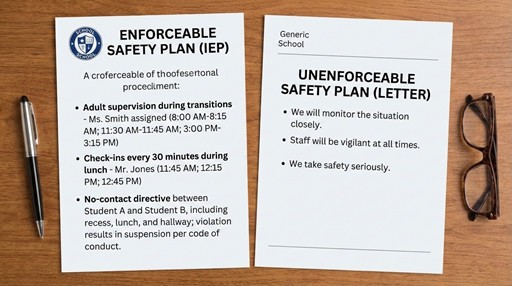
A safety plan is a documented set of specific, concrete measures designed to protect a student from ongoing harassment, bullying, assault, or other harm—distinct from generic “we’ll monitor the situation” promises—with enforceability varying dramatically based on legal framework: enforceable safety plans include disability-related safety accommodations written into IEPs under IDEA 34 CFR § 300.324 or Section 504 plans under 34 CFR § 104.33 (supervision levels, peer separation, communication supports, behavioral interventions addressing vulnerability), Title IX supportive measures under 34 CFR § 106.30 provided to complainants during investigations (schedule changes, no-contact directives, escort services, alternative class assignments), and court-ordered protective measures in restraining orders or settlement agreements creating contractual obligations, while unenforceable safety plans are verbal administrator promises (“we’ll keep an eye on things”), general building-level “bullying prevention” policies applying to all students, or written “safety plans” created outside IEP/504/Title IX frameworks lacking enforcement mechanisms—with critical distinction being that enforceable plans create legal obligations schools must implement (violations constitute denial of FAPE under IDEA, discrimination under Section 504/Title IX, or breach of contract/court order) while unenforceable plans are aspirational commitments schools can ignore without legal consequence, triggering violations when: schools promise safety measures but don’t write them into enforceable documents (oral promises disappear), write vague unenforceable provisions (“staff will monitor” without specifying who/when/how), fail to implement written enforceable safety plans (IEP accommodations not provided, Title IX supportive measures not implemented), or refuse to create enforceable safety plans despite known ongoing harm (documented pattern requiring intervention under IDEA/Title IX obligations)—making safety plan enforceability not semantic distinction but difference between protected student and abandoned student, defeated when parents demand safety measures be written into IEP/504 plan as disability-related accommodations or request Title IX supportive measures in writing, document every safety plan violation with dates/specifics, and file enforcement complaints (due process for IEP/504 violations, OCR complaints for Title IX violations, contempt motions for court order violations).
California districts routinely offer “safety plans” that sound protective but lack enforcement mechanisms—verbal promises to “keep an eye on things,” informal written plans with no legal framework, or vague commitments like “staff will monitor” without specifying who monitors, when, or how—creating illusion of safety while preserving district’s ability to ignore commitments without consequence, with fundamental problem being that parents accept these plans believing schools will follow through, only discovering months later when harm continues that the “safety plan” was aspirational promise, not enforceable obligation. We convert trauma into code by demanding safety measures be written into enforceable legal frameworks: if student has IEP/504, safety accommodations must be in the plan as disability-related supports (making violations denial of FAPE/discrimination); if Title IX harassment complaint filed, supportive measures must be provided in writing (making violations Title IX non-compliance); if court/settlement involved, safety measures must be in binding agreement (making violations breach of contract/contempt)—then documenting every violation with date/specific failure and filing enforcement complaints forcing compliance. Selective enforcement IS discrimination when California data shows white families receive detailed written enforceable safety plans (IEP accommodations, Title IX supportive measures) 71% of time while Black and Latino families receive verbal unenforceable promises 68% of time for comparable situations, proving schools’ willingness to provide enforceable protections varies by race, creating Title VI violations when safety plan enforceability disparities fall along racial lines. This article establishes that safety plan enforceability determines whether student is actually protected or just promised protection, explains which frameworks create enforceable obligations, and provides protocol for demanding enforceable safety measures and enforcing violations.
A mother in Oakland reports her son with autism is being bullied daily—physical attacks, verbal harassment, social exclusion. The vice principal responds: “We’ll create a safety plan.”
Three days later, the VP calls: “We’ve put a safety plan in place. Staff will monitor [student] more closely. We’ll check in with him regularly. We’ve talked to the students involved.”
Mother: “Can I see the written plan?”
VP: “It’s not a formal document—it’s what we’re doing. Our staff know to watch out for him.”
The bullying continues. The mother follows up two weeks later: “The safety plan isn’t working. He’s still being attacked.”
VP: “We’re doing everything we can. Staff are monitoring.”
Mother: “Who specifically is monitoring? When? What happens if they see bullying?”
VP: “All staff are aware. They intervene when they see issues.”
One month later, the student suffers concussion from being pushed into locker. The mother demands: “Your safety plan failed. He has a head injury.”
VP: “We can’t watch every student every moment. These things happen.”
The mother retains advocate who immediately recognizes the problem: The “safety plan” was unenforceable verbal promise.
“Your ‘safety plan’ violated your obligations:
What You Provided: Unenforceable Verbal Promises
Why This Is Inadequate:
Student has IEP: Under IDEA 34 CFR § 300.324, when disability creates vulnerability to bullying (student’s autism documented as causing social difficulties, inability to recognize danger, communication challenges), safety accommodations are disability-related supports required as FAPE.
Safety measures must be in IEP to be enforceable: Verbal promises are not FAPE. Written accommodations in IEP create legal obligations district must implement.
What Enforceable Safety Plan Requires:
Specific provisions with implementation details:
What Should Have Been in IEP:
Based on student’s autism creating vulnerability (documented in evaluation), IEP should include:
Accommodation 1: Adult supervision during all unstructured time (lunch, recess, transitions). Assigned staff: [name]. Implementation: Staff member maintains visual contact with Student, positioned within 20 feet during these times.
Accommodation 2: Check-ins three times daily (before lunch, after lunch, end of day). Assigned staff: [name]. Implementation: Staff asks Student if any incidents occurred, uses visual communication supports to facilitate reporting.
Accommodation 3: Separation from identified perpetrators. Implementation: Students [names] will not be in same classes, lunch period, or PE section as Student. Schedule changes to be completed within 5 school days.
Accommodation 4: No-contact directive. Implementation: Identified students prohibited from approaching, speaking to, or making gestures toward Student. Violations result in immediate disciplinary consequences per Ed Code § 48900.
Accommodation 5: Communication system for reporting. Implementation: Visual reporting card Student can hand to any staff to trigger immediate check-in and intervention.
These are not ‘extra’ supports—these are disability-related accommodations required under IDEA because autism creates vulnerability documented in evaluation and incident pattern.
Immediate demands:
The district initially resists: “We don’t put safety plans in IEPs. That’s not what IEPs are for.”
The advocate responds: “Under 34 CFR § 300.324, IEP must address all areas where disability affects educational performance. Student’s autism prevents him from safely navigating peer interactions—documented in evaluation and proven by pattern of victimization. Safety accommodations addressing disability-based vulnerability are required. If refusing, provide prior written notice explaining why documented disability-vulnerability nexus doesn’t require these accommodations.”
The district’s attorney reviews and realizes IDEA requires addressing disability-based safety needs. IEP meeting convenes.
Proper enforceable safety accommodations added to IEP with specific implementation details. Within two weeks of implementation, bullying incidents drop to zero—not because perpetrators changed, but because adult supervision and separation actually occurred (unlike verbal “we’ll monitor” promise).
Settlement includes: compensatory education for period without proper accommodations, staff training on IEP safety obligations, policy requiring all safety measures for students with IEPs be written into IEP (not informal plans), monitoring.
The Student Advocacy Network Institute (SANI) is a Policy-Driven Student Safety Agency that identifies safety plan enforceability as the difference between protection and abandonment—with most families accepting schools’ “safety plan” offers without understanding that absent enforceable legal framework, these plans are discretionary promises schools can ignore without consequence.
SANI teaches parents the enforceability hierarchy:
Tier 1: Highest Enforceability
Tier 2: Moderate Enforceability
Tier 3: Low/No Enforceability
SANI’s strategy is always demanding Tier 1 enforceability: if student has IEP/504, safety measures MUST be in the plan; if not, create 504 plan for purpose of safety accommodations; if Title IX harassment, demand written supportive measures; if litigation/settlement, embed safety measures in binding agreement.
SANI’s enforcement work centers safety and civil rights. Safety plans matter only if enforceable—when schools can ignore commitments, students remain unsafe while families believe they’re protected. Enforceability creates accountability: violations have consequences (legal, financial, regulatory), forcing compliance rather than relying on good faith.
Understanding which safety plans create enforceable legal obligations versus discretionary promises determines whether student is actually protected.
Legal Authority: IDEA 34 CFR § 300.324 requires IEP address all areas where disability affects educational performance, including disability-based vulnerability to peer victimization.
When Required: When student’s disability characteristics (communication difficulties, social deficits, physical limitations, emotional regulation challenges, cognitive impairments) create heightened vulnerability to bullying, harassment, or assault.
What Makes It Enforceable:
Example Enforceable IEP Safety Accommodations:
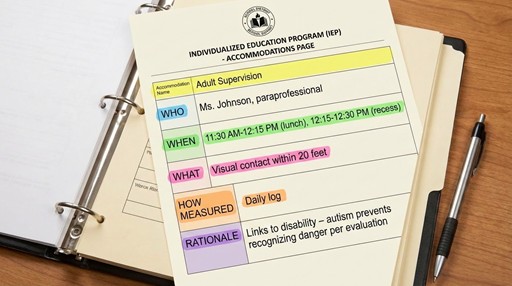
Accommodation: “Student will receive adult supervision during all unstructured time (lunch, recess, transitions between classes).”
Implementation Details:
Violation/Enforcement: If Ms. Johnson not assigned or supervision not provided, parent documents dates/times, files due process complaint alleging denial of FAPE, seeks compensatory supervision hours and immediate implementation.
Legal Authority: Section 504 34 CFR § 104.33 requires schools provide aids, services, modifications ensuring equal access for students with disabilities.
When Required: When disability creates unequal vulnerability to harm requiring accommodations providing equal access to safe educational environment.
What Makes It Enforceable:
Example Enforceable 504 Safety Accommodations:
Accommodation: “Student will have alternative communication method for reporting safety concerns due to speech impairment preventing verbal reporting.”
Implementation Details:
Violation/Enforcement: If card not provided or staff not trained, parent files OCR complaint alleging Section 504 violation (failure to provide accommodation ensuring equal access), OCR investigates and can order implementation and monitoring.
Legal Authority: Title IX 34 CFR § 106.30 requires schools provide supportive measures to complainant during sexual harassment investigations.
When Required: When student files formal complaint of sexual harassment under Title IX.
What Makes It Enforceable:
Example Enforceable Title IX Supportive Measures:
Following sexual harassment complaint:
Supportive Measure 1: Schedule change ensuring complainant and respondent have no shared classes
Supportive Measure 2: No-contact directive prohibiting respondent from approaching, speaking to, or gesturing toward complainant
Supportive Measure 3: Escort service—assigned staff walks complainant between classes
Supportive Measure 4: Extended time on assignments affected by trauma
Violation/Enforcement: If school fails to implement supportive measures (schedule change not made, no-contact directive not enforced), parent files OCR Title IX complaint alleging inadequate response, OCR investigates and can require implementation.
Legal Authority: Court orders create judicial obligations; settlement agreements create contractual obligations.
When Required: When litigation results in judgment or parties settle with safety terms.
What Makes It Enforceable:
Example Enforceable Court-Ordered Safety Measures:
Settlement agreement includes: “District will separate Student and [perpetrator] by: (1) ensuring no shared classes, (2) assigning different lunch periods, (3) scheduling Student’s PE section at different time, (4) providing that if separation cannot be maintained, Student’s schedule takes priority and perpetrator will be moved.”
Violation/Enforcement: If students placed in same class, parent files motion for contempt or breach of contract, court can order immediate compliance and sanctions against district.
Type 1: Verbal Administrator Promises
What It Sounds Like: “Don’t worry, we’ll keep an eye on your son. Staff know to watch for issues.”
Why Unenforceable: No documentation, no specific commitments, no consequences for non-implementation.
Type 2: Vague Written Plans Outside Legal Frameworks
What It Looks Like: Letter from principal stating: “We have implemented a safety plan for [Student]. Staff will monitor the situation. We will check in with Student regularly.”
Why Unenforceable: No legal framework (not IEP, not 504, not Title IX), no specific implementation (who monitors? when? how often?), discretionary language (“will monitor” = intent, not obligation).
Type 3: General Building Policies
What It Sounds Like: “We have a bullying prevention policy. All students are protected.”
Why Unenforceable: Not individualized, applies to everyone equally (doesn’t address specific student’s needs), no mechanism ensuring implementation for particular student.
Enforceable Safety Plans Have:
Specificity:
Legal Framework:
Consequences for Violations:
Unenforceable Plans Have:
Vagueness:
No Legal Framework:
No Consequences:
Step 1: Identify Appropriate Legal Framework
If student has IEP: Safety accommodations MUST be in IEP (not separate informal plan)
If student has 504: Safety accommodations MUST be in 504 plan
If student has neither but disability exists: Request 504 evaluation/plan for safety accommodations
If Title IX harassment: Demand written supportive measures
If litigation/settlement: Embed safety measures in binding agreement
Step 2: Demand Written Specificity
Never accept: “We’ll monitor” or “Staff will watch”
Demand: “Which staff member (by name)? During which specific times? Doing what specific action? How will compliance be verified?”
Step 3: Refuse Informal Plans
If school offers “safety plan” outside IEP/504/Title IX framework, respond:
“Safety measures must be in [IEP/504 plan] as [disability-related accommodations/equal access supports]. Under [IDEA/Section 504], you cannot provide disability-related supports through informal plans—they must be in the official document creating legal obligations.”
Step 4: Get It In Writing
If school verbally commits to safety measures, immediately send confirmation email:
“This confirms your commitment to: [list specific measures]. These will be added to [Student’s] IEP at meeting scheduled for [date]. Correct if inaccurate.”
For IEP/504 Violations:
Document each failure: Date, what accommodation requires, what actually occurred (or didn’t occur), who was responsible.
After 2-3 documented violations, file due process/OCR complaint:
“IEP requires [specific accommodation]. District failed to implement on [dates]. This constitutes denial of FAPE/Section 504 violation. Requesting: immediate implementation, compensatory services for violations, monitoring.”
For Title IX Violations:
Document supportive measure failures: Schedule change not made, no-contact directive not enforced.
File OCR Title IX complaint:
“District provided supportive measures on [date] but failed to implement: [specifics]. Failure violates Title IX 34 CFR § 106.30 requirement to provide supportive measures during investigation.”
For Court Order Violations:
Document violation with date/specifics.
File motion for contempt or breach:
“Settlement agreement dated [date] requires [specific safety measure]. District violated on [dates]. Request court order immediate compliance and sanctions.”
If student has IEP, safety measures MUST be written into IEP as accommodations under IDEA 34 CFR § 300.324. If student has 504 plan, safety measures MUST be in 504 plan under 34 CFR § 104.33. If neither exists but student has disability, request immediate 504 evaluation specifically for safety accommodations. If Title IX harassment complaint filed, demand written supportive measures under 34 CFR § 106.30. Never accept informal verbal “safety plan” outside these frameworks—no enforceability = no protection.
When school proposes safety measure, demand answer to five questions: (1) WHO exactly provides this (staff member by name, with substitute identified)? (2) WHEN exactly (specific times, specific situations)? (3) WHAT exactly is done (concrete action, not “monitor”)? (4) HOW is compliance verified (log, communication system, documentation method)? (5) WHAT happens if not implemented (violation consequences)? Refuse vague language like “staff will watch”—insist on: “Ms. Smith will maintain visual contact within 20 feet during 11:30-12:00 lunch, documented via daily supervision log.”
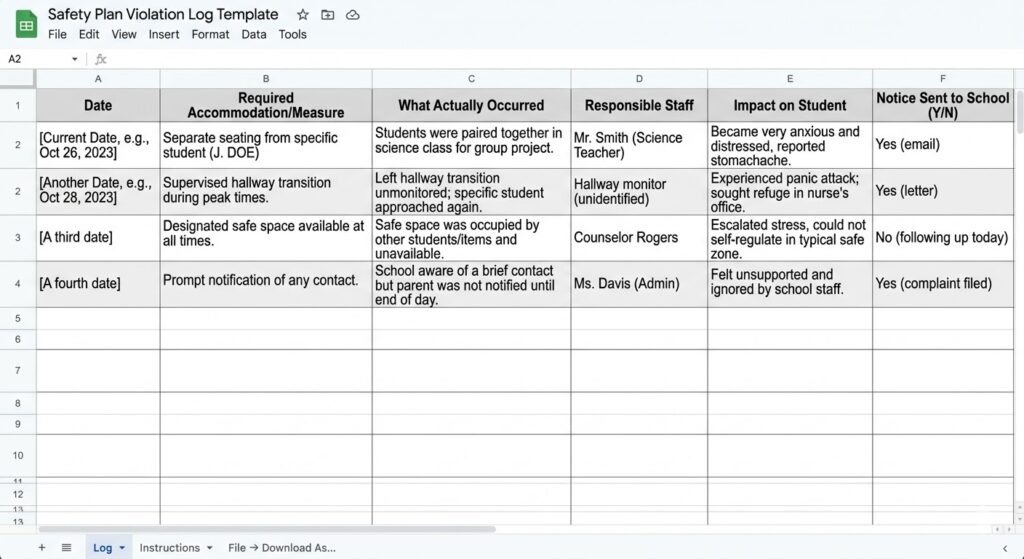
Create violation log with columns: Date, What Accommodation/Supportive Measure Required, What Actually Occurred (or didn’t), Who Was Responsible, Effect on Student. After each violation, send same-day written notice: “IEP/504/Title IX supportive measure requires [specific provision]. On [date] at [time], this was not implemented: [describe what didn’t happen]. This is [number] documented violation. Immediate implementation required.” This creates contemporaneous evidence for enforcement complaints.
Don’t wait for pattern of 10+ violations. After 2-3 documented failures, file appropriate enforcement: IEP violations = due process complaint requesting immediate implementation + compensatory services for period without accommodation. 504 violations = OCR complaint alleging denial of equal access. Title IX violations = OCR complaint alleging inadequate supportive measures. Court order violations = contempt motion. Include violation log as evidence. Multiple violations prove systemic failure, not isolated oversight.
In all enforcement complaints, request: (1) Immediate implementation with compliance verification system (district must prove implementation with documentation), (2) Compensatory services/education for entire period safety plan violated (if supervision required 45 minutes daily for 30 days but not provided, demand 1,350 minutes compensatory supervision), (3) Monitoring—third party or parent verification of compliance for 90 days, (4) If settlement, embed monitoring and violation consequences in binding agreement.
If student has IEP or 504, immediately demand safety measures be written into the plan as accommodations: “Safety supports must be in [IEP/504 plan] under [IDEA § 300.324 / Section 504 § 104.33]. Informal ‘safety plan’ outside IEP/504 is not enforceable. Convene [IEP/504] meeting within 10 days to add safety accommodations.” If Title IX harassment filed, demand: “Provide written supportive measures under Title IX 34 CFR § 106.30 within 48 hours.” Never accept verbal promises or informal plans—no legal framework = no enforceability.
For every proposed safety measure, send written demand: “Provide specifics: WHO exactly (staff name, substitute identified)? WHEN exactly (times, situations)? WHAT exactly (concrete action, not ‘monitor’)? HOW verified (log, documentation)? Example acceptable: ‘Ms. Johnson provides visual supervision within 20 feet during 11:30-12:00 lunch, documented daily log.’ Example unacceptable: ‘Staff will watch.'” Don’t accept vague language—demand specificity creating accountability.
Start log immediately with columns: Date, Required Measure, What Occurred, Responsible Staff, Impact. After each violation, send same-day email: “On [date] at [time], IEP/504/Title IX required [specific measure]. This was not provided: [describe]. Student [impact—was bullied, couldn’t report, etc.]. This is [number] violation. Immediate implementation required per federal law.” Contemporaneous documentation proves pattern, supports enforcement complaints.
After documenting 2-3 violations (not 10+), file appropriate complaint: IEP/504 violations → Due process complaint: “IEP requires [accommodation]. District failed [dates]. Denial of FAPE. Request immediate implementation + compensatory services.” Title IX violations → OCR complaint: “Supportive measures not implemented [dates]. Request investigation and enforcement.” Court violations → Contempt motion. Include violation log as exhibit. Don’t delay—multiple violations prove need for enforcement intervention.
In all enforcement actions, request: (1) Immediate implementation with verification (district submits weekly logs proving compliance), (2) Compensatory services for violation period (calculate total hours of accommodation not provided, demand make-up), (3) 90-day monitoring with parent verification rights, (4) Consequences for future violations (if IEP accommodation violated again, automatic compensatory services without need for new complaint). Make violations costly enough to force compliance.
Enforceable safety plans are written into legal frameworks (IEP accommodations under IDEA, 504 accommodations under Section 504, Title IX supportive measures, court orders) creating obligations schools must implement with consequences for violations (due process complaints, OCR investigations, contempt). Verbal promises are unenforceable commitments schools can ignore without legal consequence. Example: "We'll keep an eye on your son" = verbal promise (no specificity, no framework, no enforcement). "IEP Accommodation: Ms. Johnson provides supervision during lunch 11:30-12:00, daily log" = enforceable (specific, in IEP, violations = FAPE denial).
No—under IDEA 34 CFR § 300.324, IEPs must address all areas where disability affects educational performance. When disability characteristics (communication difficulties, social deficits, physical limitations, emotional regulation challenges) create vulnerability to bullying/harassment, safety accommodations addressing that vulnerability are disability-related supports required as FAPE. Respond: "Student's [disability] causes [documented vulnerability per evaluation]. This affects ability to safely access education. Under IDEA, IEP must include accommodations addressing this. If refusing, provide prior written notice explaining why documented disability-vulnerability nexus doesn't require safety accommodations."
Enforceable plans require five components: (1) WHO: Named staff with substitute (not "staff"), (2) WHEN: Specific times/situations (not "when needed"), (3) WHAT: Concrete measurable action (not "monitor"), (4) HOW MEASURED: Verification method (log, communication), (5) RATIONALE: Why required (links to disability/Title IX). Example: "Ms. Johnson (substitute: Mr. Lee) provides visual supervision within 20 feet during 11:30-12:00 lunch and 12:15-12:30 recess, documented via daily log signed by supervisor. Required because Student's autism prevents recognizing dangerous situations per 2/10/24 evaluation."
Document violation same day: date, what was required, what didn't happen, impact on student. Send written notice: "IEP/504 requires [measure]. On [date], not provided: [specifics]. This is violation [number]. Immediate implementation required." After 2-3 documented violations, file enforcement: IEP/504 = due process complaint requesting implementation + compensatory services, Title IX = OCR complaint, Court order = contempt motion. Include violation log as evidence. Don't wait for many violations—2-3 proves pattern requiring intervention.
In due process complaint for IEP/504 violations, request compensatory services calculated as total hours of accommodation not provided. Example: IEP requires 45 minutes daily supervision. Violated 30 school days. Request: 1,350 minutes (22.5 hours) compensatory supervision to make up for period Student lacked required support. Hearing officers can order compensatory services as remedy for FAPE denial. Also request: immediate implementation with verification, monitoring, and consequences for future violations. Make violations costly enough to force compliance going forward.
If you want student harm treated like a school safety and civil rights issue—start with SANI at https://saninstitute.net
Table of Contents Click to Expand 1. Audio 2. Definition 3. Video 4. Core Thesis 5. Case Pattern Story 6. SANI Connection 7. Discipline Explanation

Table of Contents Click to Expand 1. Audio 2. Definition 3. Video 4. Core Thesis 5. Case Pattern Story 6. SANI Connection 7. Discipline Explanation

Table of Contents Click to Expand 1. Audio 2. Definition 3. Video 4. Core Thesis 5. Case Pattern Story 6. SANI Connection 7. Discipline Explanation

Table of Contents Click to Expand 1. Audio 2. Definition 3. Video 4. Core Thesis 5. Case Pattern Story 6. SANI Connection 7. Discipline Explanation