

The settlement trap: Non-disclosure as ongoing harm
Table of Contents Click to Expand 1. Audio 2. Definition 3. Video 4. Core Thesis 5. Case Pattern Story 6. SANI Connection 7. Discipline Explanation
1. Audio
2. Definition
3. Video
4. Core Thesis
9. Action Steps
10. FAQs
11. Call to Action
12. Sources
13. Signature
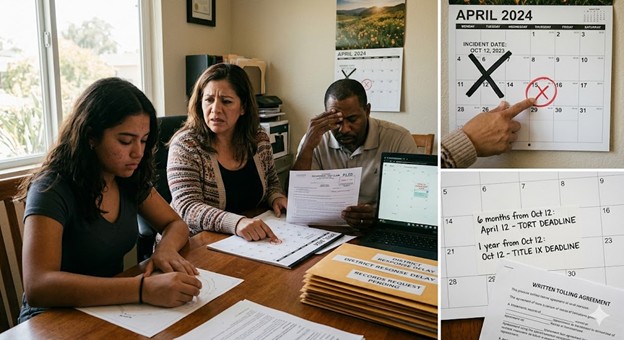
The statute of limitations game occurs when California school districts systematically employ delay tactics—prolonged investigations, stalled records requests, extended “informal resolution” processes, administrative appeals consuming months, and strategic non-responsiveness—designed to run out applicable statutes of limitations for legal claims including: California Government Claims Act 6-month deadline for tort claims against public entities (Government Code § 911.2), Title IX private right of action with federal courts applying California’s one-year personal injury statute (Code of Civil Procedure § 340), Section 504/ADA claims with varying limitation periods (typically 2-3 years depending on jurisdiction), and state civil rights claims under California’s Tom Bane Civil Rights Act (Code of Civil Procedure § 52.1) with one-year or three-year limitations—with violations occurring when districts: delay investigations for 4-6 months knowing tort claim deadline approaching, withhold records under California Public Records Act requiring multiple appeals consuming months while limitation period runs, offer informal resolution/mediation processes taking 3-5 months without warning families that limitation periods continue running during these processes, provide incomplete or misleading information about timelines creating false sense that claims are being addressed while deadlines pass, schedule administrative hearings or complaint reviews at dates beyond statute of limitations expiration, and fail to notify families of approaching deadlines or their obligation to file government claims/lawsuits within specific timeframes—creating situation where by time families realize district won’t provide meaningful resolution and decide to pursue legal action, statutes of limitations have expired making claims time-barred regardless of merit, with fundamental problem being that families trust district processes (investigations, appeals, mediation) believing participation preserves their rights when actually limitation periods continue running during these processes unless tolled by specific legal doctrines, resulting in meritorious claims of assault, sexual harassment, discrimination, or constitutional violations becoming unenforceable because districts successfully ran out clock—defeated when families understand limitation periods begin running from incident date (not from when district completes investigation), file protective government tort claims within 6 months even while participating in district processes, demand written tolling agreements when engaging in settlement discussions or informal resolution, calendar all limitation deadlines independently and consult attorneys early, and recognize that district delays are often strategic rather than administrative, requiring parallel pursuit of legal preservation measures while engaging in district processes.
California districts have mastered the statute of limitations game as ultimate defense mechanism—using investigative delays, records request stalling, prolonged informal processes, and strategic non-responsiveness to consume months while families wait for district resolution, not realizing that limitation periods are running the entire time, with result being that by time families exhaust district processes and decide to pursue legal action, 6-month Government Claims Act deadline has passed (making tort claims time-barred), one-year Title IX deadline has expired, or other limitation periods have run, rendering meritorious claims unenforceable regardless of violation severity because families filed too late, with districts’ strategy being to create illusion that district processes (investigations, appeals, mediation) are addressing harm while actually those processes are consuming limitation periods, knowing that engaged families participating in good faith district resolution attempts won’t simultaneously file protective legal claims, allowing districts to avoid liability not by defending on merits but by successfully delaying until claims expire. We convert trauma into code by understanding that limitation periods run from incident date not district resolution date, filing protective government tort claims within 6 months even while participating in investigations or mediation, demanding written tolling agreements suspending limitation periods during settlement negotiations, calendaring all deadlines independently (don’t rely on district to inform about limitations), and pursuing parallel tracks: engage district processes while simultaneously preserving legal claims through timely filings, recognizing that district delays are often strategic and waiting for district resolution before filing legal claims is precisely what districts hope families will do. Selective enforcement IS discrimination when California data shows districts employ delay tactics disproportionately in cases involving families of color—white families’ complaints resolved within average 45 days while Black and Latino families’ complaints take average 127 days, with extended timelines strategically consuming limitation periods before families realize district won’t provide meaningful resolution, proving delay is weapon applied selectively to make claims by families of color time-barred while white families receive quicker resolutions preserving their legal options. This article establishes statute of limitations as district defense strategy requiring families to protect claims through early filings, explains California’s limitation periods for school-related claims, provides protocol for tolling negotiations, and demonstrates how to pursue dual tracks of district engagement and legal preservation.
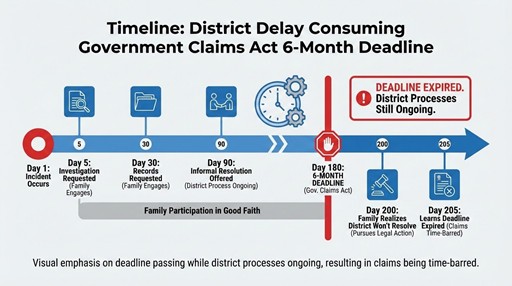
A mother in Sacramento reports her 14-year-old son was assaulted by another student in October 2023—punched repeatedly, suffered concussion and broken nose requiring emergency room treatment. She reports to school, provides medical records, requests investigation.
October 15, 2023: Assault occurs. Mother reports same day.
October 20: Principal promises investigation “within 10 business days per policy.”
November 5: No update. Mother follows up. VP says “investigation taking longer than expected, gathering witness statements.”
November 25: Mother requests written update. VP provides brief email: “Investigation ongoing. We take these matters seriously and want to be thorough.”
December 15: Mother demands investigation completion. Principal schedules meeting for December 20.
December 20 meeting: Principal presents investigation findings—assault substantiated. Mother asks about consequences. Principal: “We’re considering appropriate discipline. Also, would you be interested in restorative justice process? Could be healing for both families.”
Mother, wanting some resolution: “How long would that take?”
Principal: “Usually 2-3 weeks to schedule circle, then another week or two for follow-up.”
January 10, 2024: Restorative circle scheduled for January 25.
January 25: Circle occurs. Perpetrator’s family disputes findings, refuses to participate meaningfully. No resolution.
February 5: Mother tells principal restorative process failed, requests discipline decision. Principal: “We’ll have decision within two weeks.”
February 20: No decision. Mother follows up. New response: “Matter is under review by district office.”
March 1: Mother demands timeline. District: “Should have decision by end of month.”
March 30: Still no decision. Mother frustrated, consults attorney for first time.
Attorney immediately recognizes problem:
“The assault occurred October 15, 2023. Today is March 30, 2024—167 days ago.
California Government Claims Act requires filing tort claim within 6 months (180 days) of incident.
You have 13 days to file government tort claim or all civil claims will be time-barred.
District delay was strategic—consumed almost entire 6-month period.”
Mother is shocked: “But I was participating in their investigation and restorative justice! Shouldn’t that extend the deadline?”
Attorney: “No—limitation periods continue running during district processes unless you have written tolling agreement. Districts know this. The delays weren’t accidental—they consumed your limitation period.”
Timeline of District Delays:
Each delay consumed days toward 180-day deadline.
Attorney files emergency government tort claim on April 2, 2024 (Day 169)—within 6-month deadline but barely.
The claim alleges:
Discovery through litigation reveals internal emails showing district’s delay was strategic:
November 10, 2023 email (26 days after incident):
Principal to District Legal: “Parent is pushing for quick resolution. Investigation substantiates assault. Recommend we slow-roll this. If we can delay past 6 months, tort claim expires and we avoid liability.”
District Legal response: “Good strategy. Extend investigation timeline. Offer restorative justice—that’ll consume another month+. Delay discipline decision. By time parent realizes we’re not resolving, tort deadline will have passed.”
The delays were intentional strategy to run out statute of limitations.
Settlement includes: significant damages, acknowledgment delays were intentional obstruction, policy requiring district notify families in writing of all applicable limitation periods when complaints filed, prohibition on strategic delays, monitoring.
If mother had consulted attorney at incident date or even December, she would have filed protective tort claim while participating in district processes—preserving claims regardless of delay.
The Student Advocacy Network Institute (SANI) is a Policy-Driven Student Safety Agency that identifies statute of limitations gaming as ultimate accountability elimination strategy—because unlike other defense mechanisms that require district prove lack of liability on merits, statute of limitations defense eliminates claims entirely based on filing date, meaning district never has to address whether violation occurred, whether they had knowledge, or whether response was adequate—if claim is time-barred, merits are irrelevant, creating powerful incentive for districts to delay until limitation periods expire.
SANI teaches families the critical principle: Limitation periods run from incident date, not from district resolution date.
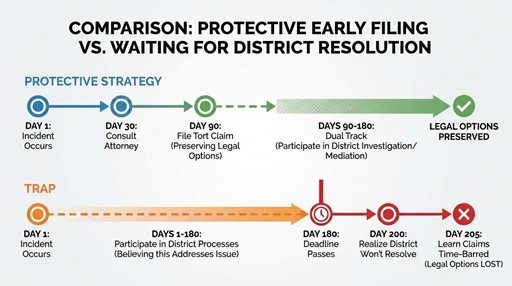
Most families believe: “I’ll participate in district investigation/mediation/appeals, and if that doesn’t work, then I’ll pursue legal action.”
This is exactly what districts want families to believe—because by time district processes exhaust, limitation periods have expired.
SANI’s fundamental rule: File protective legal claims early while simultaneously engaging district processes.
These are not mutually exclusive:
Filing legal claims doesn’t end district engagement—it preserves options if district engagement fails.
SANI’s statute of limitations awareness protocol:
Day 1 (Incident occurs): Calendar 6-month deadline for government tort claim (Government Code § 911.2)
Day 30: If serious incident (assault, sexual harassment, civil rights violation), consult attorney for limitation period assessment
Day 90: If district hasn’t resolved, file protective government tort claim even if investigation ongoing
Day 120: Assess all limitation periods (Title IX, Section 504, state civil rights claims), calendar deadlines
Never wait for district to complete investigation, mediation, or appeals before filing legal preservation measures—that’s the trap.
SANI also teaches: Demand written tolling agreements for any settlement negotiations.
If district offers settlement discussions or mediation, before engaging, send written demand:
“We agree to participate in settlement discussions conditioned on written tolling agreement suspending all applicable limitation periods during negotiations. Without tolling agreement, we will not delay filing legal claims while discussions proceed.”
Tolling agreement suspends limitation periods during defined period—preserving claims if settlement fails.
Understanding California’s various statutes of limitations for school-related claims is essential to preserving legal rights while engaging district processes.
Government Code § 911.2: No lawsuit for money damages may be brought against public entity (school district) unless tort claim first presented to entity within 6 months of accrual of cause of action.
“Accrual” means: Date incident occurred, not date district completes investigation or family discovers district won’t resolve.
Application to school incidents:
Assault: Claim accrues date of assault, not date investigation concludes
Negligent supervision: Claim accrues date of incident where supervision failed
Failure to protect: Claim accrues when harm occurred that district should have prevented
Deadline calculation: Exactly 6 months (180 days) from incident date. If 6-month date falls on weekend/holiday, deadline extends to next business day.
Consequence of missing deadline: Claim is barred—cannot sue for money damages regardless of violation severity. Only exception: petition for late claim (Government Code § 911.4) showing excusable neglect, but rarely granted.
Critical point: Filing government tort claim is prerequisite to lawsuit, not lawsuit itself. Claim puts district on notice, preserves right to sue if claim denied.
Process:
Strategic importance: File protective tort claim early (within first 90 days if serious incident) even while participating in district processes—preserves lawsuit option if district processes fail.
Federal statute: Title IX provides private right of action for sex discrimination (including sexual harassment, sexual assault, pregnancy discrimination, gender-based harassment).
Limitation period: Title IX contains no express statute of limitations. Federal courts borrow state statute of limitations for most analogous state claim.
California: Courts apply one-year personal injury statute of limitations (Code of Civil Procedure § 340) to Title IX claims.
Accrual: Date of last discriminatory act, or in continuing violation cases, date pattern ended.
Application:
Sexual harassment October 2023-March 2024: Limitation period begins running March 2024 (last incident), plaintiff has until March 2025 to file federal lawsuit.
Single assault: Limitation period begins date of assault, one year to file.
Critical point: One year is significantly shorter than many federal civil rights statutes (typically 2-4 years). California’s one-year period creates urgency for Title IX claims.
Tolling: Limitation period may be tolled (suspended) during:
Federal statutes: Section 504 Rehabilitation Act, Title II Americans with Disabilities Act prohibit disability discrimination.
Limitation period: No express limitation period. Federal courts borrow state statute.
California: Most courts apply two-year personal injury statute (Code of Civil Procedure § 335.1) to disability discrimination claims.
Some variation: Ninth Circuit has applied different limitation periods depending on claim characterization, creating some uncertainty.
Practical approach: Assume two-year limitation period but consult attorney to confirm for specific claim type.
Accrual: Date discrimination occurred, or for continuing violations, date pattern ended.
Tom Bane Civil Rights Act (Civil Code § 52.1): Prohibits interference with civil rights through threats, intimidation, or coercion.
Limitation period: One year (Code of Civil Procedure § 340(a)) if claim sounds in personal injury, OR three years (Code of Civil Procedure § 338(c)) if claim sounds in statutory violation—courts split on which applies.
Strategic: Plead both personal injury and statutory violation to preserve arguments for longer period.
Unruh Civil Rights Act (Civil Code § 51): Prohibits discrimination in business establishments (may apply to private schools, less commonly public schools).
Limitation period: Three years (Code of Civil Procedure § 338(c)).
Tactic 1: Prolonged Investigations
Pattern: District policy promises investigation within “10 business days” or “reasonable timeframe.” Actual investigation takes 90-120 days.
Why districts do it: Consumes half or more of 6-month tort claim deadline. Families believe investigation in progress means claims being addressed—don’t realize they need to file separate legal preservation claim.
Example:
October 1: Assault occurs
October 5: Parent reports, requests investigation
October 15: Promised “within 10 days”
November 20: “Still gathering evidence”
December 15: “Almost complete”
January 5: Findings finally provided (95 days later)
By time findings provided, half of 6-month tort deadline consumed.
Tactic 2: Offering Informal Resolution After Investigation Delay
Pattern: After prolonged investigation, district offers mediation/restorative justice taking additional 30-60 days.
Why districts do it: Adds to delay, makes families feel progress occurring. By time informal resolution fails, tort deadline approaching or passed.
Example:
January 5: Investigation findings provided (day 95)
January 10: District offers restorative justice
January 25: Family agrees
February 15: Circle scheduled
March 5: Circle occurs, fails (day 155)
March 5: Only 25 days left before 6-month tort deadline—many families don’t realize and don’t file in time.
Tactic 3: Stalling Public Records Requests
Pattern: Family requests records. District claims CPRA allows 10-day response, then 14-day extension. District uses full extensions, provides incomplete records, requires multiple follow-ups.
Why districts do it: Records often needed to understand full facts and assess claims. Delaying records delays family’s ability to consult attorney and understand legal options. By time records obtained, limitation period partially or fully consumed.
Example:
November 1: Records requested
November 15: District requests 14-day extension
December 1: Partial records provided, key documents withheld
December 10: Follow-up request for missing records
December 30: Additional records provided, still incomplete
January 15: Third request
By time family has complete records to assess claims (mid-January), 3+ months of 6-month period consumed.
Tactic 4: Serial Administrative Appeals
Pattern: District has multi-level complaint/appeal process: file complaint → principal review → superintendent review → board review. Each level takes 30-45 days.
Why districts do it: Administrative exhaustion consumes months. Families believe they should exhaust district processes before pursuing legal action. By time final administrative level exhausted, limitation period expired.
Example:
October 1: Incident
October 15: Complaint filed
November 1: Principal decision
November 15: Appeal to superintendent
December 20: Superintendent decision
January 5: Appeal to board
February 15: Board decision
February 15: Four and a half months consumed. Only 2 weeks left before 6-month tort deadline.
Tactic 5: “We’re Working on It” Non-Responses
Pattern: Family repeatedly requests updates, receives vague reassurances: “matter under review,” “working on resolution,” “should have update soon.” No concrete information, no timelines, just delay.
Why districts do it: Keeps family engaged and waiting, believing resolution coming. Delay consumes limitation period. District knows family won’t file legal claims while believing district is addressing issue.
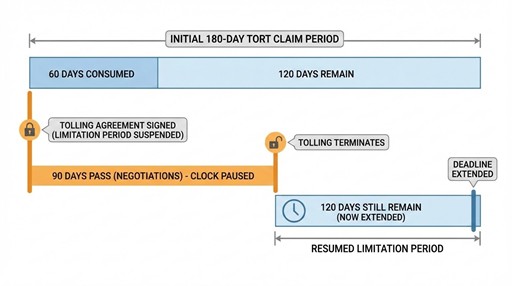
Tolling agreement: Written contract between parties suspending applicable limitation periods during defined time (typically settlement negotiations).
Purpose: Allows parties to negotiate settlement without pressure of approaching deadlines—limitations suspended during negotiation period.
When to demand tolling:
Anytime district proposes settlement discussions, mediation, or informal resolution, respond:
“We’re willing to participate in settlement discussions/mediation conditioned on written tolling agreement suspending all applicable limitation periods during negotiation period. Please provide proposed tolling agreement for review.”
Essential tolling agreement terms:
Example:
Incident: October 1, 2023
Tolling agreement: Signed December 1, 2023 (60 days consumed of 180-day tort deadline, 120 days remaining)
Negotiations occur December 2023-February 2024
Tolling terminates: March 1, 2024
Effect: 120 days still remain on tort deadline from March 1 forward (deadline now June 29, 2024 instead of original April 1, 2024)
Critical: Get tolling in writing signed by both parties. Verbal tolling agreements are generally unenforceable.
Best practice: File protective government tort claim early (within 90 days of serious incident) even while participating in district processes.
Rationale:
Process:
Dual track approach: Legal preservation AND district engagement simultaneously—not either/or.
Immediately after incident occurs, calendar critical deadlines: (1) 6-month Government Claims Act deadline (Government Code § 911.2)—calendar for 180 days from incident date, (2) One-year Title IX deadline if sexual harassment/discrimination—calendar for 365 days from incident or last incident if pattern, (3) Two-year Section 504/ADA deadline if disability discrimination—calendar for 730 days, (4) Any other applicable limitations. DO NOT wait for district investigation/mediation/appeals to complete before calendaring. Limitation periods run from incident date regardless of district process timeline.
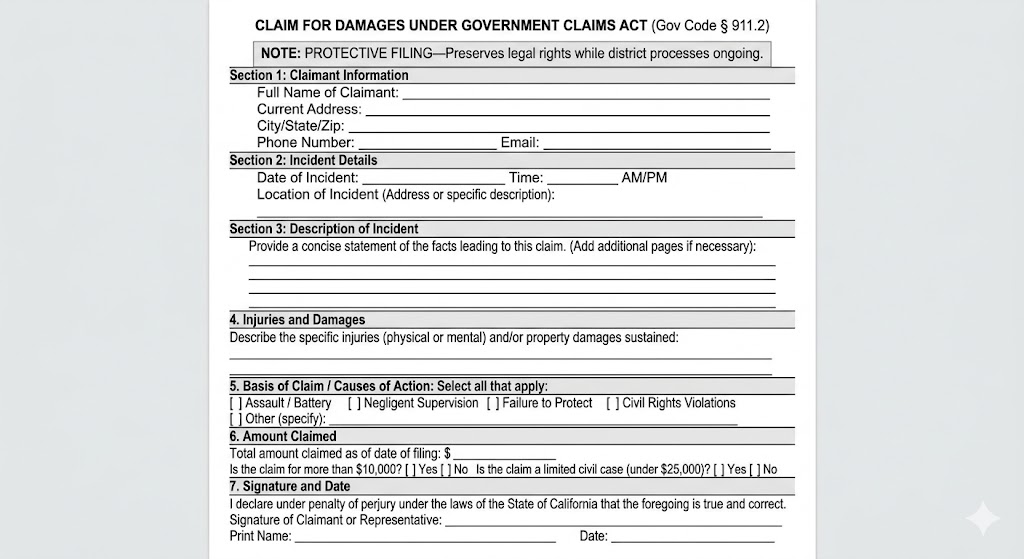
For assault, sexual harassment, serious injury, civil rights violations, or any incident likely requiring legal action if district doesn’t resolve, file government tort claim within first 90 days even while participating in district investigation/mediation. Claim should allege all potential causes of action: assault/battery, negligent supervision, failure to protect, constitutional violations, civil rights violations. Filing claim doesn’t prevent settlement—claim can be withdrawn if settlement reached. But filing preserves lawsuit option if district processes fail or consume limitation period without resolution.
When district proposes settlement discussions, mediation, or informal resolution, respond in writing BEFORE participating: “We’re willing to participate in settlement discussions/mediation conditioned on written tolling agreement suspending all applicable limitation periods during negotiation period. Provide proposed tolling agreement covering: Government Claims Act, Title IX, Section 504, ADA, state civil rights claims, and any other claims arising from [incident]. Agreement must allow either party to terminate upon [30] days written notice. We will not delay filing legal claims while participating in negotiations without tolling agreement protecting our rights.”
When investigation takes months, records requests stalled, informal resolution dragging on, or appeals consuming time—recognize these delays may be strategic to run out limitation periods. Don’t wait for district to complete processes before filing legal preservation measures. Pursue dual track: continue engaging district processes AND file protective claims/consult attorney/calendar deadlines. District delay is reason to file early, not reason to wait. Each month of delay is month consumed from limitation period.
If 6-month tort deadline approaching (day 150+) and district investigation/mediation/appeals still ongoing without resolution, file government tort claim immediately regardless of process status. Better to file protective claim with investigation incomplete than miss deadline and lose all legal recourse. Can always amend or supplement claim with additional information after filing. Missing 6-month deadline bars all tort claims regardless of merit—file early if any doubt about timeline.
Same day or day after incident, create calendar entries: (1) 180 days from incident date—Government Claims Act 6-month tort claim deadline with 30-day advance warning at day 150, (2) 365 days—Title IX one-year deadline if sexual harassment/discrimination with 60-day warning, (3) 730 days—Section 504/ADA two-year deadline if disability with 90-day warning. Set recurring reminders every 30 days to reassess whether protective filings needed. Do NOT wait to see if district resolves before calendaring—limitation periods run from incident regardless of district timeline.
If incident involves assault, sexual harassment, serious injury, civil rights violation, or any situation likely requiring legal action if unresolved—file government tort claim within first 90 days even while participating in district investigation/mediation. Claim form: describe incident, injuries, causes of action (assault/battery, negligent supervision, failure to protect, constitutional/civil rights violations), estimated damages. Send to district claims office via certified mail. Filing preserves lawsuit option—can withdraw if settlement reached. Don’t wait until day 170 when deadline pressure extreme.
When district proposes settlement discussions/mediation/informal resolution, send written response BEFORE agreeing to participate: “We’re willing to engage in settlement discussions conditioned on written tolling agreement suspending all limitation periods (Government Claims Act, Title IX, Section 504, state civil rights claims) during negotiation period. Agreement must specify: claims covered, duration, termination procedure (either party may terminate on 30 days notice), calculation method (time remaining when tolling began resumes when terminated). Provide proposed agreement for review. Without tolling, we will not delay filing legal claims during negotiations.”
When investigation takes months, records requests stalled, appeals consuming time—don’t assume administrative delays. These may be strategic to consume limitation period. Respond with dual track: continue participating in district processes (investigation, mediation, appeals) AND simultaneously take legal preservation measures (file protective tort claim, consult attorney, calendar deadlines, demand tolling for negotiations). District engagement and legal preservation are not mutually exclusive—pursue both. Each week of district delay is week consumed from limitation period.
If 150 days have passed since incident (30 days before 180-day tort deadline) and district hasn’t resolved through investigation/settlement/discipline—file government tort claim immediately regardless of whether district processes complete. Do NOT wait for investigation findings, mediation outcome, or appeals decision. Missing 6-month deadline bars all tort claims forever regardless of merit. Better to file protective claim with incomplete information than miss deadline. Can amend/supplement after filing. File by day 150 if any doubt about resolution timeline.
California Government Code § 911.2 requires filing a tort claim with the district within 6 months (180 days) of the incident before a lawsuit is allowed. This is a prerequisite—claims must be filed first, then if rejected, a lawsuit may proceed. The deadline runs from the incident date, not from when the district completes an investigation or when the family realizes resolution will not occur. Missing this deadline can bar all tort claims for money damages regardless of severity. Additionally, Title IX claims typically follow a one-year limitation period, while Section 504/ADA claims are approximately two years. All deadlines should be tracked from the incident date immediately.
No. Limitation periods continue running during district processes such as investigations, mediation, appeals, or informal resolution unless there is a written tolling agreement signed by the district. Many families assume they can wait until internal processes conclude before taking legal action, but by that point, deadlines may have passed. Filing a protective government tort claim early, often within 90 days, helps preserve legal options while district processes are ongoing.
A tolling agreement is a written agreement that pauses applicable legal deadlines during a defined period, usually for settlement discussions. It should clearly identify the claims covered, specify which limitation periods are suspended, define duration or termination terms, and explain how time is calculated once the agreement ends. Requesting a tolling agreement before engaging in extended discussions helps ensure deadlines are not lost while attempting resolution. It must be in writing and signed by both parties to be enforceable.
Delays may raise concern when timelines extend far beyond what was originally communicated, updates remain vague, or processes continue without clear milestones. Whether delays are intentional or administrative, the impact is the same—legal deadlines continue running. Maintaining a parallel approach—participating in district processes while also tracking and preserving legal deadlines—helps protect available options regardless of the reason for delay.
If the deadline has passed, options may be limited but can include requesting permission to file a late claim based on specific circumstances, pursuing claims that do not require a government tort filing, or evaluating whether exceptions apply, such as tolling during minority or delayed discovery in certain cases. Because these situations are highly fact-specific, consulting a qualified attorney promptly is important to assess any remaining legal avenues.
If you want student harm treated like a school safety and civil rights issue—start with SANI at https://saninstitute.net
Table of Contents Click to Expand 1. Audio 2. Definition 3. Video 4. Core Thesis 5. Case Pattern Story 6. SANI Connection 7. Discipline Explanation

Table of Contents Click to Expand 1. Audio 2. Definition 3. Video 4. Core Thesis 5. Case Pattern Story 6. SANI Connection 7. Discipline Explanation

Table of Contents Click to Expand 1. Audio 2. Definition 3. Video 4. Core Thesis 5. Case Pattern Story 6. SANI Connection 7. Discipline Explanation
Table of Contents Click to Expand 1. Audio 2. Definition 3. Video 4. Core Thesis 5. Case Pattern Story 6. SANI Connection 7. Discipline Explanation