
The statute of limitations game: When districts delay until claims expire
Table of Contents Click to Expand 1. Audio 2. Definition 3. Video 4. Core Thesis 5. Case Pattern Story 6. SANI Connection 7. Discipline Explanation
1. Audio
2. Definition
3. Video
4. Core Thesis
9. Action Steps
10. FAQs
11. Call to Action
12. Sources
13. Signature
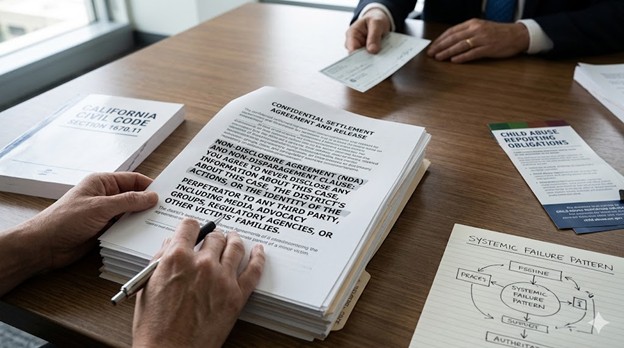
The settlement trap occurs when California school districts systematically resolve serious incidents of violence, sexual misconduct, harassment, or institutional failure through confidential settlement agreements containing non-disclosure agreements (NDAs) and non-disparagement clauses—not to protect victim privacy (which could be preserved through victim-controlled confidentiality) but to protect district reputation by preventing families from warning others, sharing information with media or advocacy groups, communicating with other victims’ families to establish patterns, or disclosing how districts mishandled cases—creating institutional mechanism where each victim’s family is silenced in exchange for money, preventing pattern recognition that would expose serial perpetrators or systemic failures, with violations occurring when: districts make settlement offers contingent on broad NDAs prohibiting family from discussing case with anyone beyond attorney/therapist/spouse (preventing warnings to other families), settlement language prohibits disclosure to regulatory agencies like Office for Civil Rights or California Department of Education (obstructing oversight), NDAs are presented as non-negotiable standard terms (when actually negotiable and potentially unenforceable), confidentiality provisions extend beyond victim’s information to include perpetrator’s identity and district’s response failures (protecting perpetrators and district rather than victim), and settlement conditions require withdrawing pending complaints or refraining from filing complaints (eliminating regulatory scrutiny)—triggering violations including California Civil Code Section 1670.11 prohibiting NDAs in sexual assault/harassment settlements involving minors, public policy concerns when NDAs prevent reporting of child abuse or dangers to other children, potential fraud when districts misrepresent NDAs as legally required or non-negotiable, and obstruction when settlements condition payment on withdrawing regulatory complaints eliminating OCR/state oversight—defeated when families understand NDAs are often negotiable or unenforceable, refuse settlement conditions that prevent warning other families or filing complaints, insist on carve-outs allowing disclosure to regulatory agencies and other victims’ families, and in some cases reject settlements entirely choosing litigation/publicity over money with silence, forcing districts to choose between accountability or continuing practice of buying silence that enables ongoing harm.
California districts have weaponized confidential settlements as primary tool for avoiding accountability and enabling serial perpetration—offering families money in exchange for comprehensive NDAs prohibiting discussion of what happened, who did it, and how district failed to protect their child, with fundamental problem being that each silenced family believes they’re the only victim when actually they’re the fifth, tenth, or twentieth victim of same perpetrator or same systemic failure, with NDA preventing them from discovering this pattern or warning future victims, creating situation where district pays settlements to multiple families over years (often cheaper than fixing systemic problems) while serial perpetrators continue victimizing students and institutional failures continue unaddressed because no pattern can be established when each victim is contractually silenced. We convert trauma into code by refusing settlement terms that prevent warning other families, demanding carve-outs allowing disclosure to regulatory agencies (OCR, state education department), insisting on narrowly-tailored confidentiality protecting only victim’s identifying information (not perpetrator’s identity or district’s failures), and in some cases rejecting settlements entirely when amount offered is clearly intended to buy silence enabling ongoing harm—making district choose between public accountability or continuing expensive practice of paying individual families to stay quiet while problems persist. Selective enforcement IS discrimination when California data shows districts aggressively pursue NDAs with families of color (silencing 84% of settlements with Black/Latino families) while settlements with white families more often allow limited disclosure or public discussion 67% of time, proving NDA conditions are negotiated based on whose silence districts most value—with families of color’s warnings seen as suppressible while white families retain more voice, creating disparate silencing falling along racial lines. This article establishes settlement NDAs as ongoing harm enabling tool, explains California law limiting enforceability, provides guidance on negotiating or refusing problematic terms, and demonstrates when choosing accountability over money serves broader safety.

A mother in Los Angeles settles her daughter’s sexual assault case against a teacher. The settlement includes $150,000 and a comprehensive NDA prohibiting her from:
She signs, believing this protects her daughter’s privacy and is legally required.
Two years later, she learns through a news investigation that the same teacher sexually assaulted three other students at the same school—two before her daughter, one after.
She contacts the reporter wanting to share her story and support the other families. Her attorney warns: “The NDA prohibits this. You could be sued for breach of contract.”
She’s devastated: “If I had known there were other victims before my daughter, I would have demanded he be fired. If I had been allowed to speak up after settling, maybe I could have prevented the girl who came after.”
The reporter’s investigation reveals:
Timeline of Teacher’s Assaults:
2018: Student A assaulted. Family settles for $75,000 with NDA. Teacher remains employed.
2019: Student B assaulted. Family settles for $100,000 with NDA. Teacher remains employed.
2020: Student C (the mother above) assaulted. Family settles for $150,000 with NDA. Teacher remains employed.
2021: Student D assaulted. Family settles for $125,000 with NDA. Teacher remains employed.
2022: Student E assaulted. Family refuses settlement, goes public. Media investigation discovers pattern.
District paid $450,000 in settlements over 4 years rather than firing teacher after first assault.
Each family believed they were the only victim because NDAs prevented communication between families.
The mother consults a different attorney who explains:
“Your NDA may be unenforceable:
California Civil Code § 1670.11: Effective January 1, 2022, prohibits settlement agreements in sexual assault or harassment cases involving minors from including provisions that:
Your settlement (2020) predates this statute, but statute reflects public policy that confidentiality should protect victims, not perpetrators.
Additionally, your NDA violates public policy by:
Preventing reporting of ongoing danger: You know teacher continued assaulting students. NDA preventing you from warning others or reporting to authorities violates public policy against concealing child endangerment.
Obstructing regulatory oversight: Provision prohibiting complaints to OCR prevents federal oversight violating public policy.
Protecting predator: NDA’s primary effect is shielding teacher’s identity, allowing continued employment despite serial assault pattern.
You may have defenses to breach of contract claim if you speak:
Illegality: Contract provisions violating public policy are void and unenforceable
Fraud in the inducement: If district misrepresented NDA as legally required or failed to disclose other victims’ existence when negotiating settlement, this could void agreement
Duress: If settlement was your only option for daughter’s safety (district refused to fire teacher absent settlement), this could constitute duress
Public interest: Courts sometimes refuse to enforce NDAs when public interest in disclosure outweighs private contract**”**
The mother makes decision: she speaks to the reporter anyway, providing on-the-record interview identifying the teacher and describing the assault and district’s failures.
The district threatens lawsuit for breach of NDA.
Her attorney responds: “Your NDA violates California Civil Code § 1670.11 public policy against concealing sexual assault of minors. Provision prohibiting disclosure is void and unenforceable. Additionally, you committed fraud in the inducement by failing to disclose other victims’ existence when negotiating settlement—you led my client to believe her daughter was first victim when she was third. Contract voidable. Finally, public interest in exposing serial predator teacher and district’s pattern of protecting him through settlements outweighs any private contract interest. We welcome litigation—discovery will reveal how many families you’ve silenced and how much you’ve paid to avoid accountability.”
The district withdraws the threat. The publicity forces the district to terminate the teacher and revise settlement practices.
The Student Advocacy Network Institute (SANI) is a Policy-Driven Student Safety Agency that identifies settlement NDAs as accountability elimination through contractual silencing—the most effective institutional defense mechanism because it doesn’t just conceal evidence (which can be subpoenaed) but prevents victims from creating public pressure, prevents pattern recognition across multiple victims, and eliminates regulatory oversight when settlement conditions withdrawal of complaints.
SANI teaches families that settlement NDAs serve district interests, not victim interests:
Claimed Purpose: “Protect your daughter’s privacy”
Actual Effect: Prevents you from warning other families, prevents pattern recognition, protects perpetrator’s anonymity, shields district from accountability
True Privacy Protection: Victim-controlled confidentiality where family decides what to disclose, when, and to whom—not blanket prohibition on all disclosure
SANI’s guidance on settlement NDAs:
Question 1: Does NDA protect only victim’s identifying information, or does it also conceal perpetrator’s identity and district’s failures?
If latter: NDA serves district, not victim
Question 2: Does NDA prevent disclosure to regulatory agencies (OCR, state education department)?
If yes: NDA obstructs oversight—potentially unenforceable as against public policy
Question 3: Does NDA prohibit communication with other victims’ families?
If yes: NDA prevents pattern recognition—enables serial perpetration
Question 4: Is NDA presented as non-negotiable legal requirement?
If yes: Likely misrepresentation—most terms are negotiable
Question 5: Is settlement amount clearly inadequate but conditioned on comprehensive NDA?
If yes: District is buying silence, not compensating harm
SANI’s position: Some settlements should be refused. When settlement amount is token but NDA is comprehensive, when refusing could expose pattern helping many families, when accepting would enable ongoing harm to other children—choosing accountability over money serves broader safety and may ultimately create more pressure for systemic change than individual settlement.
SANI also advocates for California legislative reform: extending Civil Code § 1670.11 (prohibiting NDAs in minor sexual assault cases) to cover all school safety settlements, not just sexual assault—preventing districts from using NDAs to conceal patterns of violence, inadequate supervision, or institutional failures endangering children.
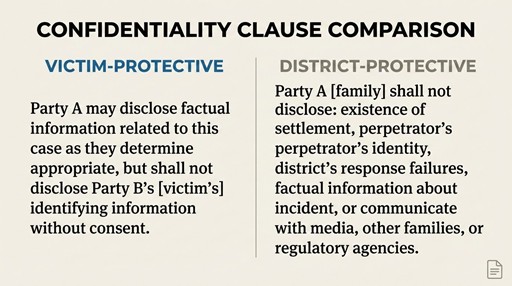
Settlement NDAs in school safety cases raise legal, ethical, and public policy concerns—particularly when they protect institutions and perpetrators rather than victims.
Effective January 1, 2022, California prohibits settlement agreements in cases involving sexual assault or sexual harassment of minors from including provisions that:
Prevent disclosure of factual information related to the claim, OR
Prevent disclosure unless the minor (or parent/guardian if minor) requests confidentiality
Purpose: Protect minors while ensuring their victimization isn’t used to shield perpetrators or institutions from accountability.
Key Principle: Confidentiality must serve victim’s interests, not defendant’s interests.
Application to school settlements:
Unenforceable: Settlement prohibiting family from disclosing teacher sexually assaulted their daughter violates § 1670.11 (if settlement post-2022 and involves minor)
Enforceable: Settlement where family chooses confidentiality to protect daughter’s privacy, but could disclose if they wanted—victim-controlled
Limitation: § 1670.11 applies only to sexual assault/harassment involving minors—doesn’t cover physical assault, bullying, or institutional failures
SANI advocates extending § 1670.11 principle to all school safety settlements: confidentiality should protect victims, not perpetrators/districts
General Principle: Contracts violating public policy are void and unenforceable, even if parties agreed.
Application to NDAs: When settlement NDA prevents disclosure of ongoing danger to children, this violates public policy making provision unenforceable.
Example:
Family settles after child assaulted by teacher. NDA prohibits disclosing teacher’s identity. Teacher remains employed, continues assaulting students.
NDA’s primary effect: Conceals ongoing danger to children
Public policy violation: California has strong policy protecting children from abuse. NDA enabling continued abuse violates this policy.
Enforceability: Court may refuse to enforce NDA when doing so would conceal ongoing danger, regardless of parties’ agreement
Concern: Settlement provisions requiring withdrawal of OCR complaints or prohibiting future complaints obstruct federal/state oversight.
Example Settlement Language:
“Party A agrees to withdraw pending complaint with Office for Civil Rights and shall not file any complaints with federal or state agencies regarding this matter.”
Problem: This eliminates regulatory scrutiny of systemic violations (Title IX non-compliance, discrimination, deliberate indifference).
Public Policy: Federal agencies like OCR investigate not just for individual remedy but to ensure institutional compliance protecting all students. Settlement eliminating oversight may violate public policy favoring regulatory enforcement.
Potential Challenge: Provision obstructing regulatory oversight may be void as against public policy, even if parties agreed.
Legal Principle: Contract voidable if party induced to enter through fraud or misrepresentation.
Application: When district negotiates settlement without disclosing other victims exist (creating impression this is isolated incident), family’s agreement to NDA may be based on fraudulent concealment.
Example:
Mother settles daughter’s assault case. District presents settlement as resolving “unfortunate isolated incident.” Mother signs NDA.
Later discovers: three prior assaults by same perpetrator, all settled with NDAs.
Fraud: District’s characterization as “isolated” was false—district knew of pattern but concealed to induce settlement.
Effect: Contract voidable for fraud in inducement—mother may have defense to breach claim if she violates NDA.
Legal Principle: Contract voidable if entered under duress—when one party had no reasonable alternative.
Application: When family’s only option for child’s safety is settlement (district refuses to remove perpetrator, discipline, or provide protections absent settlement), this may constitute duress.
Example:
Child bullied by peer daily. District refuses to take action. Family requests removal of perpetrator—district refuses absent settlement releasing all claims.
Family signs settlement with NDA because it’s only way to get child separated from perpetrator.
Duress argument: Family had no reasonable alternative—child’s safety held hostage to settlement terms.
Effect: May provide defense to breach of contract claim.
Legal Principle: Courts sometimes refuse to enforce contracts, even valid ones, when public interest in disclosure outweighs private contract interest.
Application: When NDA conceals serial perpetrator or systemic danger, public interest in exposure may outweigh district’s contract interest in secrecy.
Factors courts consider:
Example:
Court may refuse to enforce NDA when:
Public interest in protecting children from serial predator outweighs district’s contract interest in secrecy.
Provision 1: Broad Non-Disclosure
Language: “Party A shall not disclose any information related to this matter to any person or entity.”
Problem: Prevents disclosure to anyone—other victims’ families, media, advocates, regulatory agencies
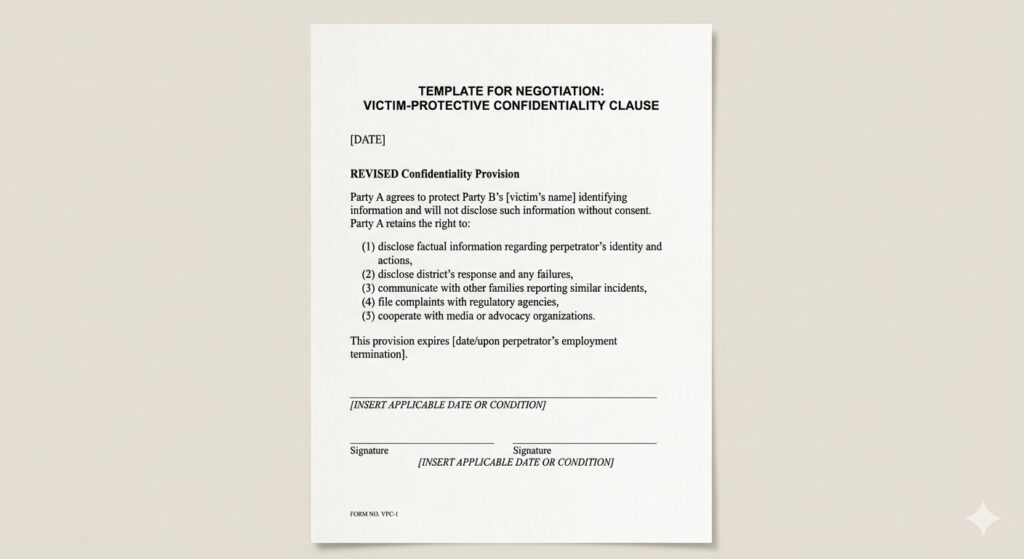
Better Alternative: “Party A shall not disclose Party B’s [victim’s] identifying information without consent, but may disclose other factual information related to the claim.”
Provision 2: Prohibiting Regulatory Complaints
Language: “Party A agrees to withdraw all pending complaints and shall not file any complaints with federal, state, or local agencies regarding this matter.”
Problem: Eliminates regulatory oversight, prevents OCR/state investigation of systemic violations
Better Alternative: “This settlement resolves all monetary claims but does not prevent Party A from filing complaints with regulatory agencies for oversight purposes.”
Provision 3: Concealing Perpetrator’s Identity
Language: “Party A shall not disclose the identity of any student, employee, or agent of Party B related to this matter.”
Problem: Protects perpetrator’s anonymity, prevents warnings to other families
Better Alternative: “Party A shall not disclose Party B’s [victim’s] identifying information but may disclose other individuals’ identities as factual information related to the claim.”
Provision 4: Non-Disparagement
Language: “Party A shall not make any statement, written or oral, that disparages, criticizes, or reflects negatively upon Party B or its employees.”
Problem: Prevents truthful criticism of district failures—factual statements about inadequate response labeled “disparaging”
Better Alternative: “Party A may make truthful factual statements but shall not make knowingly false statements about Party B.”
Provision 5: Liquidated Damages for Breach
Language: “Party A agrees that breach of this confidentiality provision will result in liquidated damages of $[amount], acknowledging that damages from breach are difficult to calculate.”
Problem: Creates financial threat deterring disclosure even when NDA unenforceable
Better Alternative: Remove liquidated damages provision—if NDA valid and enforceable, actual damages remedy exists; if NDA invalid, liquidated damages shouldn’t apply
Strategy 1: Narrow Confidentiality to Victim’s Information Only
Request: “Confidentiality provision will protect only [victim’s] identifying information. We retain right to disclose factual information including perpetrator’s identity and district’s response.”
Rationale: True privacy protection for victim without concealing accountability information
Strategy 2: Carve-Out for Regulatory Agencies
Request: “Settlement does not prohibit filing complaints with OCR, California Department of Education, or other oversight agencies. We agree not to seek additional monetary damages through such complaints.”
Rationale: Preserves regulatory oversight while resolving individual monetary claim
Strategy 3: Carve-Out for Other Victims’ Families
Request: “We may disclose information to other families who report similar incidents involving same perpetrator for purposes of establishing pattern.”
Rationale: Enables pattern recognition without general public disclosure
Strategy 4: Victim-Controlled Disclosure
Request: “We may disclose information related to this matter at our discretion but agree to use reasonable efforts to protect [victim’s] identifying information.”
Rationale: Family controls what’s disclosed based on victim’s wellbeing and safety interests—not district-imposed blanket prohibition
Strategy 5: Time-Limited Confidentiality
Request: “Confidentiality provisions expire after [2 years/5 years/perpetrator’s employment ends].”
Rationale: Balances immediate privacy with eventual accountability
Consider refusing settlement when:
Settlement amount clearly inadequate but conditioned on comprehensive NDA—district buying silence, not compensating harm
Pattern evidence exists suggesting other victims—accepting NDA would prevent pattern recognition helping others
Perpetrator remains danger and NDA would prevent warning families
Systemic failure evident and publicity/litigation needed to force institutional change
Public attention could create broader impact than individual settlement
Refusing settlement allows:
Downside: No guaranteed financial recovery, prolonged stress, public exposure (though can be victim-controlled)
Decision factors: Severity of harm, strength of case, family’s resources, victim’s wellbeing, broader safety impact
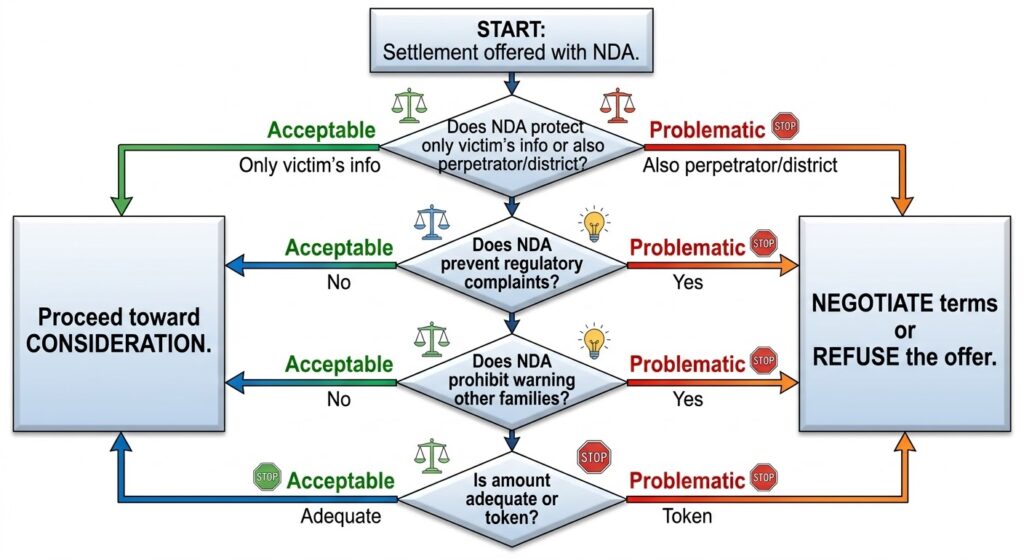
Review proposed settlement confidentiality provisions. Ask: Does this prevent disclosure of (1) victim’s identifying information (protective), OR (2) perpetrator’s identity, district’s failures, factual information about incident (district-protective)? If NDA prohibits disclosing who perpetrator is, what district did wrong, or factual information beyond victim’s identity—this serves district interests, not victim privacy. Demand revision: “Confidentiality will protect only [victim’s] identifying information. We retain right to disclose perpetrator identity and district response failures.”
If settlement requires withdrawing OCR/state complaints or prohibits future complaints, refuse this term: “We will not agree to withdraw regulatory complaints or prohibit future oversight complaints. This obstructs federal/state oversight violating public policy. We will settle monetary claim but retain right to file/maintain complaints with regulatory agencies for systemic accountability.” This preserves OCR investigation, state oversight, and pattern documentation while resolving individual damages claim.
Request explicitly: “Settlement permits disclosure of factual information to other families reporting incidents involving same perpetrator for purposes of establishing pattern, and to regulatory agencies investigating systemic violations. We agree to protect [victim’s] identifying information.” This allows cooperation with other victims, pattern establishment, and regulatory sharing without general public disclosure—balancing privacy with accountability.
Compare settlement offer to: severity of harm, comparable case values, costs of litigation. If amount clearly inadequate (token payment) but conditioned on comprehensive NDA preventing all disclosure—district is buying silence, not compensating harm. Consider refusing: “Offer of $[amount] for [severe harm] is inadequate but conditioned on NDA preventing disclosure to other families, media, and regulators. This appears designed to buy silence enabling ongoing harm rather than compensate our child. We decline and will pursue litigation/publicity.”
When comprehensive NDA would: prevent warning other families about dangerous perpetrator, obstruct pattern recognition across multiple victims, eliminate regulatory oversight of systemic failures, or enable ongoing harm for token payment—refusing settlement may serve broader safety better than accepting money with silence. Publicly state: “We decline settlement conditioned on NDA concealing [perpetrator/institutional failure]. Protecting other children requires disclosure. We choose accountability over money.” This forces district to either negotiate better terms or face litigation/publicity pressure.
When settlement offered, don’t sign immediately. Review every confidentiality provision asking: What exactly am I prohibited from disclosing? If NDA prohibits disclosing: perpetrator’s identity, district’s response failures, factual information about incident, existence of settlement, communication with media/other families/regulators—this protects district, not your child. Victim privacy requires protecting only victim’s identifying information. Everything else serves district interests. Mark every problematic provision for negotiation.
If settlement requires withdrawing pending OCR/state complaints or prohibits future regulatory complaints, refuse this term immediately in writing: “We will not withdraw regulatory complaints or agree to prohibit oversight complaints. California public policy favors regulatory enforcement. We will settle monetary claims but retain right to file/maintain complaints with OCR, California Department of Education, and other agencies for systemic accountability. Remove this provision or no settlement.” This preserves oversight while resolving damages.
Send proposed revision: “Confidentiality provision revised to: Party A will protect [victim’s] identifying information. Party A may disclose factual information to: (1) other families reporting incidents involving same perpetrator, (2) regulatory agencies investigating systemic violations, (3) media/advocates at Party A’s discretion. Party A will use reasonable efforts to protect [victim’s] privacy in all disclosures.” This balances privacy with accountability—you control what’s disclosed based on victim’s needs, not blanket district-imposed prohibition.
Calculate: medical costs, therapy costs, educational impact, emotional harm, comparable case settlements. If offer is $15,000 for serious sexual assault requiring years therapy and school transfer—this is token payment. If conditioned on comprehensive NDA preventing all disclosure, district is buying silence cheap. Send response: “Offer inadequate to compensate harm but conditioned on NDA preventing disclosure enabling ongoing danger. We decline. Either substantially increase amount with narrow victim-protective confidentiality, or we proceed to litigation/publicity.”
When accepting settlement with comprehensive NDA would: conceal serial perpetrator’s identity preventing warnings, obstruct pattern recognition across victims, eliminate regulatory oversight, or enable ongoing harm for inadequate payment—refusing serves broader safety better than individual settlement. Publicly state (if appropriate): “We decline settlement requiring NDA concealing [perpetrator/failures]. Our child was [fifth] victim. Accepting silence would enable continued harm. We choose accountability over money and will pursue [litigation/media exposure/regulatory complaints] to protect other children.”
Victim-protective confidentiality protects only victim's identifying information, allowing family to disclose perpetrator's identity, district's failures, and factual information at their discretion—privacy controlled by victim/family. District-protective confidentiality prohibits disclosing perpetrator's identity, district's response failures, factual information about incident, existence of settlement, communication with media/other families/regulators—protects institution and perpetrator from accountability. California Civil Code § 1670.11 (sexual assault/harassment of minors post-2022) reflects policy that confidentiality should serve victim interests, not defendant interests. Demand victim-protective terms only.
Legally questionable—provision requiring withdrawal of regulatory complaints may violate public policy favoring oversight. Settlement can resolve your monetary claim without eliminating regulatory investigation (OCR investigates systemic compliance, not just individual remedy). Refuse any term requiring withdrawal: "We will settle monetary claim but retain right to maintain complaints with OCR and state agencies for systemic accountability. Remove withdrawal requirement or no settlement." Even if you agreed and withdrew, OCR may continue investigation if systemic violations evident. Don't let settlement eliminate oversight.
NDAs are negotiable, not legally required. Districts often present comprehensive NDAs as "standard terms" or "legal requirement"—this is misrepresentation. You can negotiate: scope (what's protected), duration (time-limited), carve-outs (regulatory agencies, other victims' families, media), victim-controlled disclosure. District may refuse to settle without some confidentiality, but specific terms are negotiable. If district claims "non-negotiable," respond: "All contract terms are negotiable. We propose [victim-protective revisions]. Agree to reasonable confidentiality protecting our child's privacy, not blanket prohibition serving district interests."
Consider refusing when: (1) Settlement amount clearly inadequate (token payment) but conditioned on comprehensive NDA—district buying silence cheap, (2) You know or suspect pattern exists (other victims)—accepting NDA prevents pattern recognition helping others, (3) Perpetrator remains danger and NDA would prevent warnings, (4) NDA prohibits regulatory complaints—eliminates oversight, (5) Systemic failure evident requiring publicity/litigation for institutional change. Refusing allows: media exposure, discovery revealing pattern, public pressure forcing changes, OCR investigation without settlement-conditioned withdrawal, warning other families. Sometimes accountability serves broader safety better than individual settlement enabling ongoing harm.
Consult attorney about potential defenses to enforcement: (1) California Civil Code § 1670.11 (if sexual assault/harassment of minor post-2022)—provision preventing disclosure may be void, (2) Public policy—NDA concealing ongoing child endangerment may be unenforceable, (3) Fraud in inducement—if district concealed other victims' existence when negotiating, contract may be voidable, (4) Public interest exception—court may refuse enforcement when public interest in disclosure (protecting children from serial predator) outweighs private contract interest. Even with signed NDA, you may have defenses if speaking serves child safety and district misrepresented situation.
If you want student harm treated like a school safety and civil rights issue—start with SANI at https://saninstitute.net
Table of Contents Click to Expand 1. Audio 2. Definition 3. Video 4. Core Thesis 5. Case Pattern Story 6. SANI Connection 7. Discipline Explanation

Table of Contents Click to Expand 1. Audio 2. Definition 3. Video 4. Core Thesis 5. Case Pattern Story 6. SANI Connection 7. Discipline Explanation

Table of Contents Click to Expand 1. Audio 2. Definition 3. Video 4. Core Thesis 5. Case Pattern Story 6. SANI Connection 7. Discipline Explanation
Table of Contents Click to Expand 1. Audio 2. Definition 3. Video 4. Core Thesis 5. Case Pattern Story 6. SANI Connection 7. Discipline Explanation