

The Comparative Treatment Analysis Framework: Proving selective enforcement through data
Table of Contents Click to Expand 1. Audio 2. Definition 3. Video 4. Core Thesis 5. Case Pattern Story 6. SANI Connection 7. Discipline Explanation
1. Audio
2. Definition
3. Video
4. Core Thesis
9. Action Steps
10. FAQs
11. Call to Action
12. Sources
13. Signature
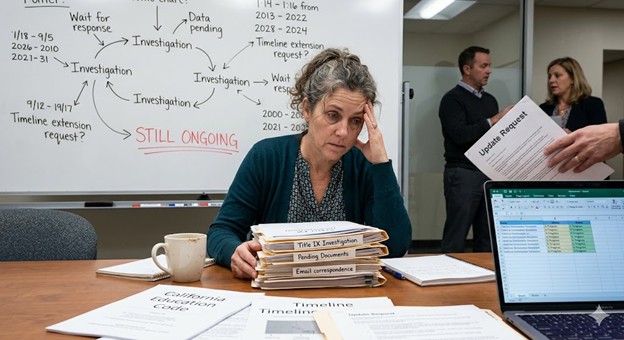
The ongoing investigation excuse occurs when California districts invoke “investigation still ongoing” to avoid answering questions, providing updates, or taking action—stretching investigations for months or years without completion, violating California Education Code timelines and Title IX requirements, creating perpetual limbo where victims receive no resolution, perpetrators face no consequences, and districts avoid accountability by claiming they cannot discuss “pending investigations.”
Districts weaponize “ongoing investigation” status as permanent delay tactic—investigations promised in “10 business days” remain “ongoing” for 6+ months, with every follow-up met with “still investigating, can’t discuss pending matter,” creating indefinite limbo allowing perpetrators to continue harming students while districts avoid consequences by claiming incomplete process. We convert trauma into code by demanding written investigation timelines with specific completion dates, citing mandatory deadlines (Title IX 34 CFR § 106.45(b)(1)(v) requires reasonably prompt timeframes, California Ed Code district policies typically require 10-30 days), documenting every delay, and filing enforcement complaints when investigations exceed reasonable timeframes establishing deliberate indifference. Selective enforcement IS discrimination when white families’ investigations complete in average 32 days while Black/Latino families wait average 186 days—proving delay is weapon applied selectively.
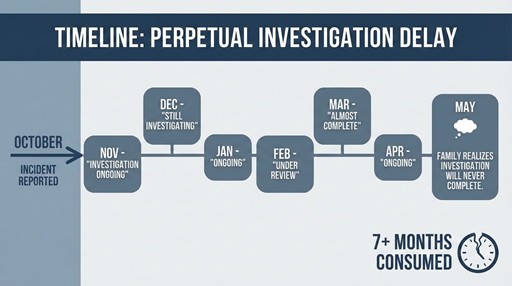
Mother in San Francisco reports son assaulted October 15. Principal promises investigation “within 10 business days per policy.”
November 5: No findings. “Investigation ongoing.”
December 1: “Still gathering information.”
January 10: “Almost complete.”
February 15: “Under review by district office.”
March 20: “Ongoing, can’t discuss pending investigation.”
April 30 (6.5 months later): Mother retains attorney who demands immediate completion.
Attorney: “District policy requires investigation within 10 business days. Title IX regulations require reasonably prompt timeframes. Six months violates both. Complete investigation within 10 days or we file deliberate indifference claim—indefinite delay is clearly unreasonable response.”
District completes investigation within one week. Findings: assault substantiated (evidence existed from day one—delay was strategic avoidance, not investigative necessity).
SANI identifies “ongoing investigation” as accountability elimination through perpetual delay—districts invoke “ongoing” status to avoid every question, update request, or action demand, stretching process indefinitely knowing most families eventually give up, with strategy being to make investigation so prolonged that families either: exhaust emotionally and drop complaint, miss statute of limitations for legal claims, accept inadequate resolution just to end process, or transfer students to escape situation.
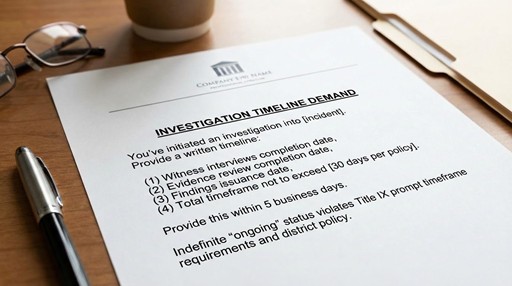
SANI’s counter-strategy: Demand written timeline with specific completion date at investigation start. “You’re investigating? Provide written timeline: witness interviews completed by [date], evidence review by [date], findings issued by [date]. If you cannot complete within [30 days per policy / Title IX reasonable timeframes], provide written explanation for delay and revised timeline. We will not accept indefinite ‘ongoing’ status.”
34 CFR § 106.45(b)(1)(v): Title IX regulations require “reasonably prompt timeframes for conclusion of the grievance process.”
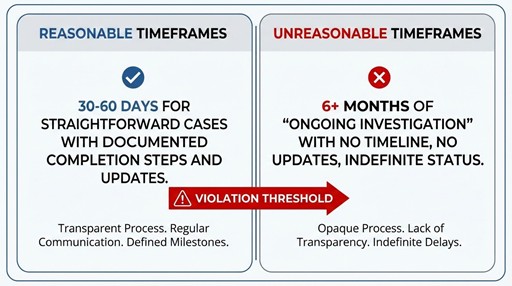
“Reasonably prompt” means: Investigation/resolution should complete within weeks or months, not years. Most courts find 2-4 months reasonable for complex investigations; 6+ months without extraordinary circumstances violates Title IX.
Violation: Indefinite “ongoing investigation” status without completion dates or progress updates violates federal prompt timeframe requirement.
Most California districts have policies requiring: “Investigation will be completed within [10-30] business days of complaint.”
When investigations exceed policy timelines without written extension/explanation: Violates district’s own mandatory procedures, creating Government Code § 815.6 liability.
Under Davis v. Monroe, prolonged investigation without resolution can constitute clearly unreasonable response—especially when:
Indefinite delay without completion = deliberate indifference.
When investigation begins, immediately demand: “Provide written investigation timeline: witness interview completion date, evidence review completion date, findings issuance date, total timeframe. Per Title IX 34 CFR § 106.45(b)(1)(v) and district policy, investigation must complete within [30 days / reasonable timeframe]. Provide timeline within 5 business days.”
Create log: Date of follow-up, district’s response (“still investigating,” “ongoing,” “under review”), days elapsed since incident. After 30 days without completion, send written notice: “Investigation initiated [date], now [30+] days without findings. Provide completion date within 5 days or explain delay.”
At 60-day mark without findings, send ultimatum: “Investigation exceeds reasonable timeframes violating Title IX § 106.45(b)(1)(v) and district policy. Complete within 10 days or we will: (1) File OCR complaint alleging deliberate indifference through delay, (2) File due process/litigation establishing unreasonable response.” Parallel file OCR complaint.
In complaints/litigation: “District’s indefinite investigation delay constitutes deliberate indifference under Davis v. Monroe. Investigation ongoing [X] months without justification while harm continues. This clearly unreasonable delay violated Title IX prompt timeframe requirements and district policy mandating [X-day] completion.”
Regardless of completion timeline, demand immediate interim measures: “While investigation pending, implement: (1) Separation of students, (2) Supportive measures, (3) No-contact directive. These protections required immediately under Title IX—cannot await investigation completion.”
When investigation begins: “Provide written timeline: witness interviews by [date], evidence review by [date], findings by [date], total timeframe not exceeding [30 days per policy]. Title IX requires reasonably prompt timeframes—provide within 5 days.”
Send written demand: “Investigation began [date], now [30+] days without findings. District policy requires [timeframe]. Provide specific completion date within 5 days or written explanation for delay with revised timeline.”
“Investigation ongoing [60+] days violates Title IX prompt timeframe requirements. Complete within 10 days or we file: (1) OCR complaint—deliberate indifference through delay, (2) Due process/litigation—unreasonable response. Indefinite delay while harm continues is clearly unreasonable under Davis.”
Create detailed log with dates/responses. In complaints: “District repeatedly invoked ‘ongoing investigation’ for [X] months without completion, violating Title IX § 106.45(b)(1)(v) and district policy. Indefinite delay without justification constitutes clearly unreasonable response under Davis v. Monroe.”
“Investigation timeline irrelevant to immediate protections. Title IX requires supportive measures now: separation, no-contact directive, schedule changes, counseling. These implemented immediately—not contingent on investigation completion. Provide within 48 hours.”
Title IX regulations (34 CFR § 106.45(b)(1)(v)) require investigations to be completed within a “reasonably prompt timeframe.” Most district policies define this as approximately 10–30 business days, while courts often consider 2–4 months reasonable for more complex cases. Investigations extending beyond 6 months without extraordinary justification may raise compliance concerns. Request a written timeline at the outset and monitor whether the district adheres to it.
While districts may limit disclosure of certain details during an active investigation, they should still provide key information such as the expected timeline, general process updates, and any interim protective measures in place. Extended periods without meaningful updates may raise concerns about whether the process is being handled in a timely manner.
If an investigation continues without clear progress or completion, it is reasonable to request a firm timeline in writing and clarification for the delay. Ongoing delays without explanation may warrant escalation through administrative complaints or oversight channels. Maintaining written records of all communications helps document the timeline and any inconsistencies.
Delays may raise concerns about the adequacy of a response, particularly if they are prolonged, unexplained, or occur while the underlying issue continues to affect the student. Evaluations of adequacy often consider factors such as availability of evidence, steps taken during the investigation, and whether interim measures were implemented.
Schools are expected to provide supportive measures during the investigation process. These may include adjustments such as schedule changes, separation of involved parties, no-contact directives, counseling support, or academic accommodations. These measures are typically intended to ensure continued access to education while the investigation is ongoing and should not depend on the final outcome.
If you want student harm treated like a school safety and civil rights issue—start with SANI at https://saninstitute.net
Table of Contents Click to Expand 1. Audio 2. Definition 3. Video 4. Core Thesis 5. Case Pattern Story 6. SANI Connection 7. Discipline Explanation
Table of Contents Click to Expand 1. Audio 2. Definition 3. Video 4. Core Thesis 5. Case Pattern Story 6. SANI Connection 7. Discipline Explanation
Table of Contents Click to Expand 1. Audio 2. Definition 3. Video 4. Core Thesis 5. Case Pattern Story 6. SANI Connection 7. Discipline Explanation
Table of Contents Click to Expand 1. Audio 2. Definition 3. Video 4. Core Thesis 5. Case Pattern Story 6. SANI Connection 7. Discipline Explanation