

The statute of limitations game: When districts delay until claims expire
Table of Contents Click to Expand 1. Audio 2. Definition 3. Video 4. Core Thesis 5. Case Pattern Story 6. SANI Connection 7. Discipline Explanation
1. Audio
2. Definition
3. Video
4. Core Thesis
9. Action Steps
10. FAQs
11. Call to Action
12. Sources
13. Signature
The nexus documentation protocol is SANI’s systematic framework for establishing and documenting the direct causal relationship between a student’s disability characteristics and their heightened vulnerability to peer victimization, harassment, or violence—creating the evidentiary foundation required under IDEA 34 CFR § 300.324 and Section 504 34 CFR § 104.33 to demand safety-related IEP or 504 plan accommodations including supervision, peer education, social skills training, alternative communication methods, and environmental modifications that reduce disability-based vulnerability—with the nexus mattering because schools cannot dismiss safety concerns as “not disability-related” when documentation proves disability characteristics (communication difficulties preventing student from reporting harm, social deficits making student unable to recognize dangerous situations, physical limitations preventing self-defense, emotional regulation challenges making student reactive to provocation, cognitive disabilities making student susceptible to manipulation) directly cause increased exposure to harm or inability to protect oneself, triggering FAPE obligations under IDEA to provide supports addressing disability-related safety needs, Section 504 requirements under 34 CFR § 104.33 to provide aids/services ensuring equal access to safe educational environment, and deliberate indifference violations under Fry v. Napoleon when schools refuse accommodations addressing known disability-based vulnerability after notice that student is being harmed because of disability manifestations, making nexus documentation not clinical assessment but legal evidence-building that transforms vague “student needs more support” requests into enforceable “FAPE requires these specific safety accommodations because disability creates these specific vulnerabilities” demands backed by evaluation data, incident patterns, expert opinions, and disability literature establishing causal connection schools cannot credibly deny.
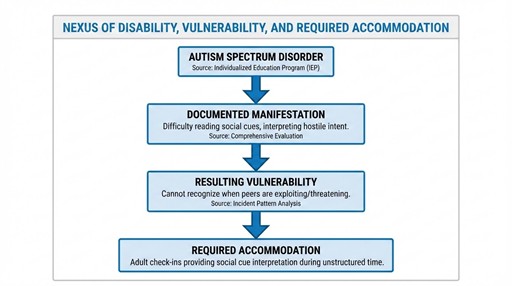
California districts routinely dismiss IEP/504 safety accommodation requests by claiming “bullying is not a disability issue” or “we can’t put safety in an IEP”—linguistic evasions designed to avoid acknowledging that disability characteristics directly create vulnerability requiring specialized supports, with the fundamental error being that while peer harassment itself may not be disability-related, the student’s inability to avoid, report, or respond to harassment often IS disability-related (autistic student cannot read social cues signaling danger, student with speech impairment cannot verbally report abuse, student with ADHD impulsivity responds to provocation in ways escalating conflict, student with intellectual disability cannot recognize manipulation)—making safety accommodations not “behavior management” but disability-related supports addressing how disability manifests as vulnerability. We convert trauma into code by documenting precise nexus: “Student’s autism spectrum disorder manifests as difficulty interpreting social cues and recognizing threatening situations (per IEP Present Levels, psychologist evaluation). This disability characteristic directly caused student to repeatedly engage with peers who were exploiting him (documented incidents March 3, March 15, April 2) because he could not identify their hostile intent. Proposed accommodation: Adult check-ins every 30 minutes during unstructured time to provide social cue interpretation and redirect from unsafe interactions—this addresses disability-related vulnerability.” Selective enforcement IS discrimination when California data shows white families’ requests for safety accommodations approved 64% of time while Black families’ identical requests (student with same disability, comparable vulnerability documentation) approved 23% of time, proving schools’ willingness to acknowledge disability-vulnerability nexus varies by family race—making accommodation denials not just IDEA violations but Title VI violations when applied discriminatorily. This article establishes The Nexus Documentation Protocol as SANI’s core framework for proving disability creates vulnerability, demanding safety accommodations as FAPE/Section 504 requirement, and defeating schools’ “safety isn’t disability-related” defense.
A mother in Sacramento advocates for her 12-year-old son with autism spectrum disorder (ASD). His IEP documents: “Difficulty with social communication, challenges interpreting nonverbal cues, tendency to take language literally, difficulty recognizing deception or hostile intent.”
Over three months, the student is repeatedly victimized: peers convince him to give them his lunch money (“we’re collecting for charity”), tell him to perform embarrassing actions (“the teacher said to bark like a dog”), physically push him claiming it’s “a game,” and steal his belongings while telling him “we’re borrowing them.”
The student doesn’t report any incidents. When asked, he explains: “They said it was okay. They said everyone does it.”
The mother requests IEP meeting to add safety accommodations:
The district’s response: “Bullying is not a disability issue. We address peer conflicts through our general bullying policy, not through IEPs. We cannot put behavioral interventions in the IEP for other students’ behavior.”
The mother retains advocate who immediately recognizes the nexus violation:
“Your refusal to address safety in IEP violates IDEA and Section 504:
The Nexus—Disability to Vulnerability:
Student’s Disability (per IEP): Autism spectrum disorder manifesting as:
Direct Causal Link: These disability characteristics directly cause inability to:
Documented Pattern: Over 3 months, 12+ incidents where student was exploited/victimized specifically because disability prevented recognizing exploitation. This is not coincidence—disability creates vulnerability.
IDEA Requirement (34 CFR § 300.324): IEP must address all areas where disability affects educational performance. Student’s inability to recognize unsafe situations directly affects his ability to safely access education.
Section 504 Requirement (34 CFR § 104.33): Must provide aids/services ensuring equal access. Neurotypical students can recognize manipulation—student with ASD cannot without supports. Accommodations are required to provide equal access to safe environment.
Fry v. Napoleon Community Schools (2017): When disability-related vulnerability to harm exists and school has notice, refusing accommodations can constitute deliberate indifference.
The accommodations we requested directly address disability-based vulnerability:
These are not ‘behavioral interventions for other students’—these are disability-related supports addressing how ASD manifests as vulnerability.
Immediate demands:
The district initially resists but the advocate provides additional nexus documentation:
Psychologist Evaluation: “Student’s ASD significantly impairs social cognition. He demonstrates difficulty with theory of mind—understanding others’ mental states and intentions. This creates substantial vulnerability in unstructured social situations where peers may have hostile or exploitative intent he cannot detect.”
Autism Research Literature: Studies documenting that students with ASD experience peer victimization at rates 4-5 times higher than neurotypical peers specifically because of social communication deficits and inability to recognize social manipulation.
Incident Pattern Analysis: Chart showing 12 incidents over 3 months, every incident involving exploitation of disability characteristics (literal interpretation, trust in stated intentions, inability to recognize deception).
Comparative Analysis: “Neurotypical student would recognize ‘bark like a dog’ is mockery, not legitimate teacher instruction. Student’s disability prevented this recognition—creating unequal vulnerability requiring accommodations.”
The nexus is undeniable. The district cannot credibly claim disability is unrelated to vulnerability when evaluation, literature, and incident pattern all prove causation.
Settlement includes: full safety accommodations in IEP, training for staff on disability-vulnerability nexus, policy requiring all IEP teams consider whether disability creates safety vulnerabilities requiring accommodations, compensatory services for period student lacked needed supports.
The Student Advocacy Network Institute (SANI) is a Policy-Driven Student Safety Agency that developed The Nexus Documentation Protocol as systematic framework for proving what districts try to obscure: that disability characteristics often directly cause vulnerability to harm, making safety accommodations not optional supports but FAPE/Section 504 requirements.
SANI teaches parents that the most common district objection to safety accommodations—”bullying isn’t disability-related”—is linguistic misdirection. The question isn’t whether peer harassment is caused by disability (it’s not—it’s caused by perpetrators). The question is whether the student’s vulnerability to harassment or inability to protect themselves is caused by disability. If yes, accommodations addressing that vulnerability are disability-related and legally required.
SANI’s Nexus Protocol has five components:
SANI’s enforcement work centers safety and civil rights. The nexus matters because without it, schools can dismiss safety concerns as “not our problem” or “not disability-related.” With documented nexus, safety becomes FAPE/Section 504 issue schools cannot ignore—transforming requests into legal obligations backed by federal disability law.
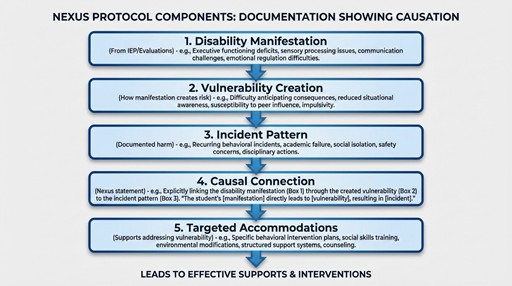
The nexus documentation protocol establishes the legal foundation for demanding safety-related IEP and 504 accommodations by proving disability creates vulnerability requiring specialized supports.
34 CFR § 300.324(a)(1): IEP team must consider “the strengths of the child and the concerns of the parents for enhancing the education of their child.”
34 CFR § 300.324(a)(2)(i): IEP team must consider “in the case of a child whose behavior impedes the child’s learning or that of others, the use of positive behavioral interventions and supports, and other strategies, to address that behavior.”
Critical Interpretation: “Behavior that impedes learning” includes the child’s inability to safely access educational environment due to disability-related vulnerability. When disability prevents student from recognizing danger, reporting harm, or protecting themselves, this “impedes learning” requiring IEP accommodations.
Application: Student with autism cannot recognize social manipulation. This disability manifestation impedes ability to safely navigate peer interactions—a necessary component of accessing education. IEP must address this through supports like adult supervision, social skills training, visual supports.
34 CFR § 104.33: Schools must provide aids, services, or modifications ensuring students with disabilities have equal opportunity to participate in and benefit from educational programs.
Safety as Access Issue: Neurotypical students can safely navigate peer interactions using intact social cognition. Students with disabilities affecting social understanding cannot—creating unequal access. Section 504 requires accommodations providing equal access to safe environment.
Example: Student with speech impairment cannot verbally report harassment. Neurotypical students can. This creates unequal access to school’s harassment reporting/response system. Section 504 requires alternative communication method (visual reporting cards, text-to-staff system, daily check-ins) ensuring equal access to safety.
Fry v. Napoleon Community Schools, 580 U.S. ___ (2017): Supreme Court clarified that when harm to student is based on disability and school denies accommodations addressing that disability-related need, this can constitute denial of FAPE requiring IDEA remedies.
Application to Safety: When student experiences harm because of disability-created vulnerability, and school refuses accommodations addressing that vulnerability, this is disability-based denial of FAPE.
Example: Student with intellectual disability is repeatedly victimized because cannot recognize manipulation. Parent requests accommodations (supervision, peer education). School refuses claiming “bullying isn’t disability issue.” Under Fry, this refusal to address disability-related vulnerability can be FAPE denial.
Component 1: Disability Manifestation
Source: Current IEP Present Levels of Academic Achievement and Functional Performance (PLAAFP), psychologist evaluation, speech/language evaluation, occupational therapy evaluation, behavior assessment.
What to Document: Specific disability characteristics affecting:
Example Statement: “Per IEP PLAAFP dated 3/15/24 and psychologist evaluation 2/10/24, Student’s autism spectrum disorder manifests as: marked difficulty interpreting nonverbal communication, tendency to interpret language literally without understanding implied meaning, challenges with theory of mind (understanding others’ mental states and intentions), and difficulty recognizing deception or hostile intent.”
Component 2: Vulnerability Creation
Causal Statement: How the documented disability manifestation directly creates vulnerability to harm.
Vulnerability Categories:
Cannot Recognize Danger:
Cannot Report Harm:
Cannot Protect Self:
Cannot Avoid Escalation:
Susceptible to Manipulation:
Example Statement: “These disability characteristics directly create vulnerability because Student cannot independently recognize when peers have hostile or exploitative intent. While neurotypical peers can intuitively identify social manipulation, Student’s ASD prevents this—making him equally unable to avoid exploitation as a blind student would be unable to avoid visual obstacles without accommodations.”
Component 3: Incident Pattern
Purpose: Prove vulnerability is not theoretical—it’s real and recurring.
Documentation: Chronological list of incidents showing pattern of harm linked to disability characteristics.
Format:
Example:
March 3, 2024: Peers told Student to give them his lunch money, claiming “teacher said we’re collecting for charity.” Student complied. (Exploited: literal interpretation, trust in stated intentions)
March 15, 2024: Peers instructed Student to make animal noises, claiming “everyone has to do this.” Student complied, peers recorded and mocked him. (Exploited: difficulty recognizing social norms, literal interpretation)
March 28, 2024: Peers convinced Student to enter girls’ bathroom, claiming “teacher needs you to check if lights work.” Student complied, got in trouble. (Exploited: trust in peer instructions, cannot distinguish legitimate from illegitimate requests)
April 2, 2024: Peers physically pushed Student during recess, claiming “it’s a game everyone plays.” Student didn’t report because believed it was legitimate game. (Exploited: cannot recognize hostile behavior disguised as play)
Pattern Analysis: “Four incidents in 30 days, each involving exploitation of Student’s documented ASD characteristics (literal interpretation, difficulty recognizing deception, trust in stated intentions). Pattern proves disability creates recurring vulnerability requiring accommodations.”
Component 4: Causal Connection (The Nexus Statement)
Purpose: Explicit statement of causation linking disability to vulnerability to harm.
Format: “Because [disability manifestation from evaluation], Student cannot [safety-related ability neurotypical students possess], which directly caused [documented incidents], creating disability-based vulnerability requiring [specific accommodations].”
Example Nexus Statements:
Autism/Social Communication: “Because Student’s autism spectrum disorder causes difficulty interpreting nonverbal cues and recognizing others’ intentions (per 2/10/24 psychologist evaluation), Student cannot identify when peers have hostile or exploitative intent—an ability neurotypical students use to protect themselves. This disability-based vulnerability directly caused the pattern of exploitation documented March-April 2024 (4 incidents where peers manipulated Student by disguising harmful intentions). Accommodations addressing this vulnerability are required under IDEA and Section 504.”
Speech/Language Impairment: “Because Student’s severe expressive language disorder limits verbal communication to 2-3 word phrases (per 1/15/24 speech evaluation), Student cannot verbally report harassment to adults—the primary method schools expect students to use for seeking help. This disability-based inability to access school’s reporting system creates unequal vulnerability. Section 504 requires alternative communication accommodations providing equal access to safety.”
ADHD/Impulse Control: “Because Student’s ADHD manifests as significant impulse control deficits (per IEP PLAAFP), Student cannot inhibit reactive responses when provoked—responding impulsively before considering consequences. This disability characteristic causes Student to engage in retaliatory behavior when targeted (documented incidents 2/3, 2/18, 3/5), which perpetrators exploit to get Student in trouble (‘mutual combat’). Accommodations teaching alternative responses and providing breaks are required.”
Intellectual Disability: “Because Student’s intellectual disability (IQ 62 per 12/1/23 psychologist evaluation) significantly impairs Student’s ability to understand complex social situations and recognize when being manipulated, Student cannot protect himself from peer exploitation in ways age-typical peers can. This disability-based vulnerability directly caused incidents where Student was convinced to engage in inappropriate behavior (1/20, 2/14, 3/8) because he trusted peers’ false claims that behaviors were allowed.”
Component 5: Targeted Accommodations
Purpose: Propose specific accommodations directly addressing documented vulnerability (not generic supports).
Matching Accommodations to Vulnerabilities:
Vulnerability: Cannot Recognize Danger/Manipulation
Accommodations:
Vulnerability: Cannot Report Harm Verbally
Accommodations:
Vulnerability: Cannot Physically Protect Self
Accommodations:
Vulnerability: Cannot Avoid Escalation Due to Impulsivity
Accommodations:
Vulnerability: Susceptible to Manipulation
Accommodations:
Step 1: Extract Disability Manifestations from Existing Evaluations
Review current IEP, psychological evaluation, speech/language evaluation, occupational therapy evaluation. Identify statements describing how disability manifests in areas relevant to safety:
Step 2: Create Vulnerability Statement for Each Manifestation
For each disability manifestation, write how it creates safety vulnerability:
“Student’s [disability manifestation from evaluation] prevents Student from [safety-related ability], creating vulnerability to [specific type of harm].”
Step 3: Match Incidents to Vulnerabilities
Review all documented incidents. For each, identify which disability characteristic was exploited or prevented Student from protecting self.
Step 4: Write Comprehensive Nexus Statement
Combine disability manifestation + vulnerability creation + incident pattern + causal connection into single comprehensive statement proving disability creates safety vulnerability requiring accommodations.
Step 5: Propose Accommodations Matched to Each Vulnerability
For each identified vulnerability, propose 2-3 specific accommodations directly addressing that vulnerability. Avoid generic requests (“more supervision”)—be specific (“adult check-ins every 30 minutes during lunch and recess to assess peer interactions and provide social cue interpretation”).
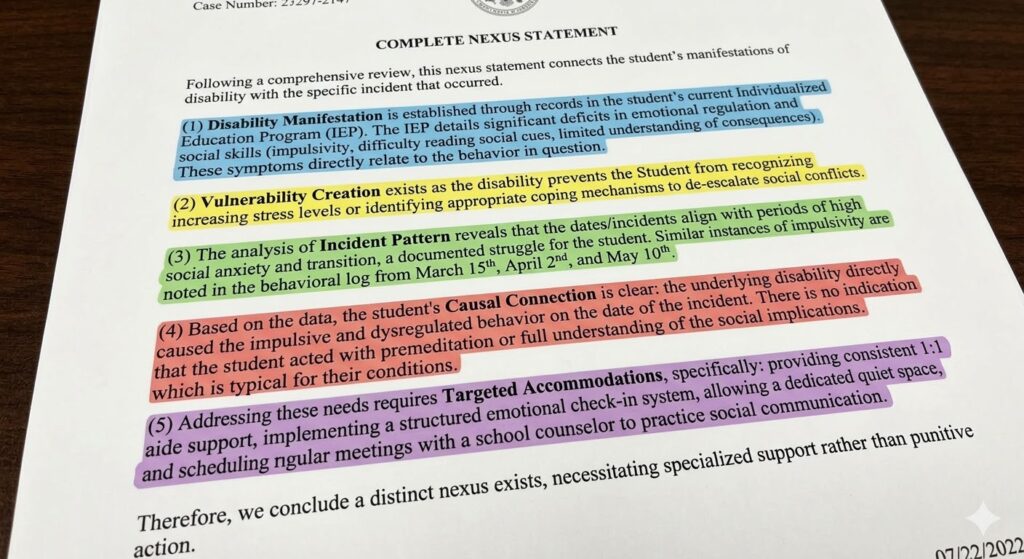
Review IEP Present Levels, psychologist evaluation, speech evaluation, OT evaluation, behavior assessment. Identify every statement describing disability manifestations affecting: social understanding, communication ability, physical capability, emotional regulation, cognitive processing, susceptibility to manipulation. Quote exact language from evaluations. Example: “Per 2/10/24 psychologist evaluation, Student’s ASD manifests as ‘marked difficulty interpreting nonverbal communication and recognizing others’ mental states (theory of mind deficits).'”
For each manifestation identified, complete this template: “Because Student’s [disability] causes [specific manifestation from evaluation], Student cannot [safety-related ability neurotypical students have], creating vulnerability to [specific harm type].” Example: “Because Student’s autism causes difficulty recognizing others’ intentions, Student cannot identify when peers have hostile/exploitative intent, creating vulnerability to manipulation and exploitation.” This establishes causal link from disability to vulnerability.
Create chronological incident log with columns: Date, Incident Description, Disability Characteristic Exploited, Outcome. Minimum 3-5 incidents showing pattern. For each incident, explicitly identify which disability manifestation was exploited. Example: “March 3: Peers told Student ‘teacher wants you to bark like dog.’ Student complied. [Exploited: literal interpretation, trust in stated intentions per ASD]. Student mocked/humiliated.” Pattern proves vulnerability is not theoretical—it’s causing actual recurring harm.
Create single paragraph proving causation: “[Disability manifestation from evaluation] prevents Student from [safety ability], which directly caused [pattern of documented incidents totaling X incidents over Y timeframe], demonstrating disability-based vulnerability requiring accommodations under IDEA 34 CFR § 300.324 and Section 504 34 CFR § 104.33.” This is your core nexus statement—use it verbatim in IEP meeting requests, Section 504 requests, and complaints. Schools cannot credibly deny when causation is this explicit and documented.
For each vulnerability you’ve documented, propose 2-3 specific accommodations addressing that precise vulnerability (not generic supports). Format: “To address [specific vulnerability], Student requires: [Accommodation 1 with frequency/duration], [Accommodation 2 with who provides it], [Accommodation 3 with when implemented].” Example: “To address inability to recognize manipulation, Student requires: (1) adult check-ins every 30 min during unstructured time, (2) weekly 30-min social skills instruction on recognizing deception, (3) peer education in classroom about Student’s literal interpretation.”
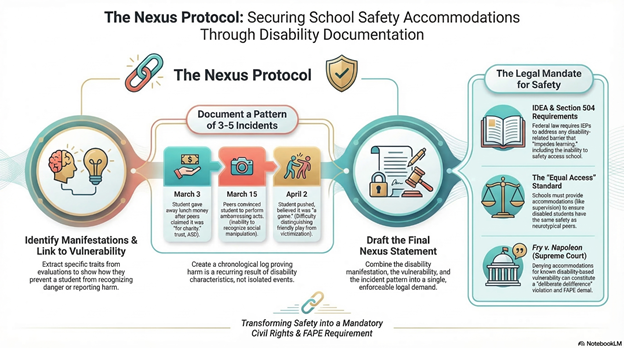
Within 48 hours of deciding to request safety accommodations, review: current IEP (especially Present Levels section), psychologist evaluation, speech/language evaluation, OT evaluation, any behavior assessments. Highlight every statement describing how disability manifests in areas affecting safety: communication difficulties, social understanding deficits, physical limitations, emotional regulation challenges, cognitive impairments. Quote exact language from evaluations in your documentation—this is your evidentiary foundation.
For each manifestation identified, write: “Because Student’s [disability] causes [quoted manifestation from evaluation], Student cannot [specific safety-related ability], creating vulnerability to [specific harm].” Be explicit and specific. Example: “Because Student’s autism causes ‘difficulty interpreting nonverbal cues and recognizing hostile intent’ (per 2/10/24 psychologist report), Student cannot identify when peers are threatening or exploiting him, creating vulnerability to peer manipulation and physical harm.” This establishes disability → vulnerability causation schools cannot deny.
Create incident log: Date, What Occurred, Which Disability Characteristic Was Exploited, Outcome. Each incident must show how specific disability manifestation caused or contributed to harm. Example: “March 15: Peers told Student to touch hot stove ‘as experiment.’ Student complied, burned hand. [Exploited: intellectual disability preventing Student from recognizing danger, trusting peer instructions]. Medical treatment required.” Three incidents = emerging pattern. Five+ incidents = undeniable pattern requiring accommodations.
Combine all components into single comprehensive statement: “[Student’s disability manifestations from evaluations] prevent [safety abilities], which directly caused [X incidents over Y timeframe with dates], demonstrating disability-based vulnerability requiring accommodations under IDEA 34 CFR § 300.324 and Section 504 34 CFR § 104.33. Request IEP meeting within 10 days to add following safety accommodations: [list specific accommodations matched to vulnerabilities].” This is your formal request—send via email with read receipt. Schools must respond to explicit nexus documentation with meeting.
If team says “bullying isn’t disability-related” or “we can’t put safety in IEP,” immediately respond: “The nexus documentation I provided proves Student’s [disability] directly creates vulnerability to harm. The question isn’t whether peer behavior is caused by disability—it’s whether Student’s inability to protect himself is caused by disability. Documentation proves it is. Under IDEA and Section 504, you must address disability-based vulnerability. If refusing accommodations, provide prior written notice explaining why this documented nexus doesn’t require supports.” Force them to defend denial in writing.
Schools may use euphemistic or vague language that avoids triggering specific legal obligations. For example, certain laws and policies require defined responses when conduct is classified as assault, battery, or sexual harassment. Using softer terms like "peer conflict" or "inappropriate touching" can reduce scrutiny, avoid escalation requirements, and make patterns of serious conduct less visible in records. This type of language may also affect how incidents are documented, tracked, and reviewed.
Respond promptly in writing. Clearly describe the incident using accurate, factual language and reference any supporting evidence such as medical records, photos, or witness statements. Request that the school review and update its documentation to reflect the severity of the incident. Keeping a written record ensures there is a clear timeline and helps preserve evidence if further action becomes necessary.
You can document inconsistencies between how the incident is described and the available evidence. This may include comparing incident reports with medical records, photographs, or witness accounts. You can also review school or district policies that require accurate documentation and show how the language used may not align with those standards. Patterns across multiple incidents may also indicate systemic issues in how conduct is recorded or classified.
Yes. Terms like "assault" and "battery" have specific legal meanings and may trigger defined responses under school policy or law. In contrast, phrases such as "physical contact" are more general and do not carry the same legal implications. The terminology used in documentation can influence how an incident is evaluated, reported, and addressed.
Schools are generally expected to maintain accurate records and follow applicable policies and laws. If documentation does not reflect the facts of an incident, it may raise concerns about compliance, transparency, and proper response. Maintaining detailed records, preserving evidence, and raising concerns in writing can help ensure that issues are properly reviewed and addressed by the appropriate authorities.
If you want student harm treated like a school safety and civil rights issue—start with SANI at https://saninstitute.net
Table of Contents Click to Expand 1. Audio 2. Definition 3. Video 4. Core Thesis 5. Case Pattern Story 6. SANI Connection 7. Discipline Explanation

Table of Contents Click to Expand 1. Audio 2. Definition 3. Video 4. Core Thesis 5. Case Pattern Story 6. SANI Connection 7. Discipline Explanation

Table of Contents Click to Expand 1. Audio 2. Definition 3. Video 4. Core Thesis 5. Case Pattern Story 6. SANI Connection 7. Discipline Explanation

Table of Contents Click to Expand 1. Audio 2. Definition 3. Video 4. Core Thesis 5. Case Pattern Story 6. SANI Connection 7. Discipline Explanation