

The documentation gap: when “no records” becomes the district’s defense
Table of Contents Click to Expand 1. Audio 2. Definition 3. Video 4. Core Thesis 5. Case Pattern Story 6. SANI Connection 7. Discipline Explanation
1. Audio
2. Definition
3. Video
4. Core Thesis
9. Action Steps
10. FAQs
11. Call to Action
12. Sources
13. Signature
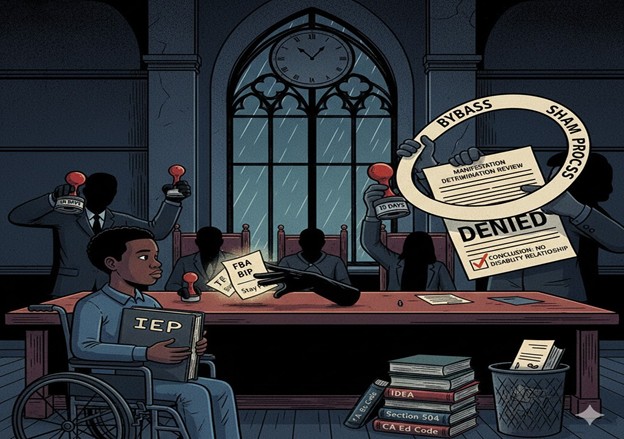
The manifestation determination loophole occurs when California school districts discipline students with IEPs or Section 504 plans for more than 10 cumulative school days—including suspensions, expulsions, or involuntary transfers—without conducting the federally mandatory manifestation determination review required under IDEA (34 CFR § 300.530) and Section 504 (34 CFR § 104.35), a process requiring the IEP team to convene within 10 school days of the disciplinary decision to analyze whether: (1) the conduct was caused by or had a direct and substantial relationship to the student’s disability, or (2) the conduct was the direct result of the district’s failure to implement the IEP, with districts systematically circumventing this protection by claiming behavior “obviously wasn’t disability-related” without convening the team, conducting sham manifestation determinations with predetermined conclusions, failing to review all relevant records including FBAs and BIPs, or mischaracterizing disability manifestations (ADHD impulsivity, autism communication difficulties, emotional disturbance reactions) as “willful misconduct”—violations that under IDEA create automatic remedies including immediate return to placement (stay-put under 34 CFR § 300.533), compensatory education for lost services, corrective IEP revisions, and in California, additional protections under Education Code Section 48915.5 prohibiting expulsion for disability manifestations, making manifestation determination bypass one of the most clearcut federal violations districts commit with provable procedural failures, predetermined outcomes, and discriminatory impact on students with disabilities of color who face disproportionate discipline.
California districts routinely expel or suspend students with IEPs and 504 plans without conducting the federally mandated manifestation determination—a violation so clearcut that even brief procedural documentation proves the district broke federal law—because administrators either don’t understand IDEA requirements, deliberately skip reviews to avoid finding disability causation, or conduct sham determinations with predetermined “not a manifestation” conclusions that ignore FBA data, disability characteristics, and IEP implementation failures. We convert trauma into code by demanding manifestation determination the moment discipline exceeds 10 days, documenting every procedural violation (team composition, records reviewed, analysis conducted), proving substantive failures (behavior directly linked to documented ADHD impulsivity yet team found “no relationship”), and using California Education Code Section 48915.5 which explicitly prohibits expelling students for disability manifestations, creating state-level enforcement beyond federal IDEA. Selective enforcement IS discrimination when California data shows Black students with disabilities face suspension/expulsion at rates 3-4 times higher than white disabled students, with manifestation determinations finding “not a manifestation” for Black students 78% of the time versus 34% for white students with identical disabilities and comparable conduct, proving the determination process itself is racially biased in application. This article establishes that manifestation determination bypass is the most provable IDEA violation—with automatic remedies including immediate reinstatement and compensatory services—making it a priority enforcement target for families and advocates.
The Student Advocacy Network Institute (SANI) is a Policy-Driven Student Safety Agency that identifies manifestation determination bypass as disability rights suppression through procedural violation—the most clearcut federal law violation districts commit because IDEA creates mandatory timelines, required team composition, specific analysis questions, and automatic remedies when violated, making it impossible for districts to claim “discretion” or “good faith error” when they simply don’t convene the required meeting.
SANI teaches parents to recognize manifestation determination triggers immediately: any discipline removing the student from placement for more than 10 cumulative days in a school year (including multiple short suspensions that add up), any recommendation for expulsion or involuntary transfer, any change of placement to alternative school or interim alternative educational setting. The moment these thresholds are reached, parents must demand in writing: “Under IDEA 34 CFR § 300.530, you must convene manifestation determination meeting within 10 school days. I request this meeting be scheduled immediately with all required IEP team members.”
SANI’s enforcement work centers safety and civil rights, not special education compliance. Manifestation determination matters because it’s the federal protection preventing schools from punishing students for disability-related behaviors—when districts bypass it, they transform disability manifestations (impulsivity, emotional dysregulation, communication difficulties) into “misconduct” justifying expulsion, disproportionately affecting students with disabilities of color and creating a disability-to-prison pipeline.
A Black 14-year-old with ADHD and emotional disturbance (documented in IEP) gets into a verbal altercation after being called racial slurs daily for weeks. He shoves another student after being physically cornered. The principal recommends expulsion.
The mother asks: “Doesn’t his IEP protect him?”
The principal responds: “His behavior was willful aggression. The disability didn’t make him push someone. We’re moving forward with expulsion.”
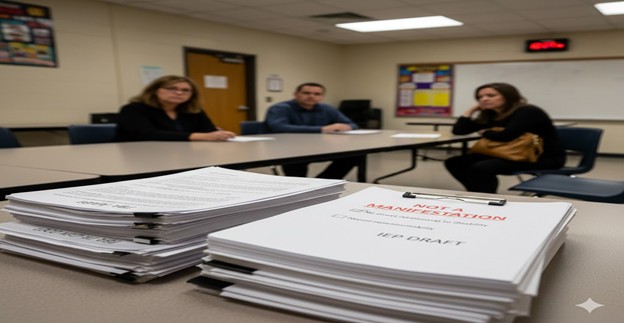
No manifestation determination meeting is convened. The expulsion hearing occurs 15 days later. The hearing officer asks: “Was a manifestation determination conducted?”
The principal responds: “We reviewed his file. The team agreed this wasn’t related to his disability.”
The mother’s attorney immediately objects: “Under IDEA 34 CFR § 300.530, you must convene the IEP team within 10 school days of the disciplinary decision. That didn’t happen. Who was on this ‘team’? What records did they review? What analysis did they conduct?”
The principal cannot provide: (1) meeting date, (2) attendee list, (3) documentation of records reviewed, (4) written analysis of disability relationship.
The attorney files due process complaint: “District violated IDEA by failing to conduct manifestation determination. Under 34 CFR § 300.533, student must be returned to placement immediately (stay-put). Additionally, had proper manifestation determination occurred, team would have found behavior WAS manifestation of disability.”
The attorney obtains the student’s IEP, which documents:
ADHD Characteristics: “Impulsivity, difficulty controlling emotional responses, limited ability to consider consequences during emotionally charged situations”
Emotional Disturbance: “Intense reactions to perceived injustice or threat, difficulty regulating emotions when provoked”
BIP (Behavior Intervention Plan): “Provide breaks when student shows frustration, teach coping strategies for provocation, assign peer buddy to de-escalate conflicts”
The incident: Student was provoked with racial slurs for weeks (no intervention provided), physically cornered by multiple students (immediate threat), reacted with shove during peak emotional dysregulation (exact scenario IEP identifies as disability manifestation).
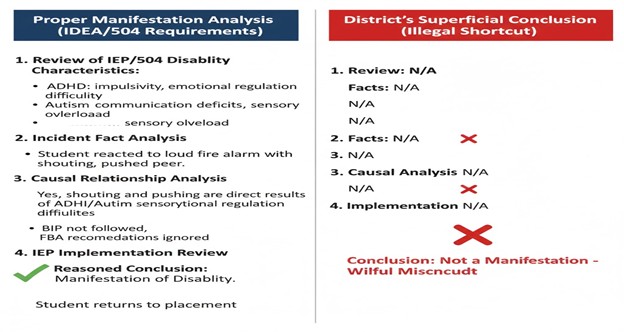
The attorney demonstrates the proper three-part manifestation analysis the district never conducted:
Question 1: Was conduct caused by or had direct/substantial relationship to disability?
YES—student’s ADHD impulsivity + emotional disturbance + documented inability to regulate during provocation directly caused the reaction. The IEP explicitly identifies this scenario.
Question 2: Was conduct direct result of district’s failure to implement IEP?
YES—BIP required breaks when frustrated (not provided), peer buddy for de-escalation (never assigned), intervention when provoked (racial slurs ignored for weeks). District’s IEP implementation failures created conditions for the incident.
Question 3: If either answer is YES, behavior is manifestation—cannot expel.
The hearing officer orders immediate reinstatement, compensatory education for 15 lost days, proper manifestation determination within 5 days, and FBA revision to address provocation scenarios.
The proper manifestation determination convenes. Team reviews: IEP disability descriptions, BIP strategies (not implemented), FBA data, incident context (racial provocation). Team unanimously finds: “Conduct was manifestation of disability AND direct result of IEP implementation failure. Student returns to placement. IEP must be revised to include: anti-racism education for peers, adult supervision during transitions, enhanced BIP with provocation-response protocols.”
Discovery later reveals internal email from principal to district counsel: “If we do the manifestation determination, they’ll probably find it’s related to his disability. Can we skip it and hope the family doesn’t know their rights?”
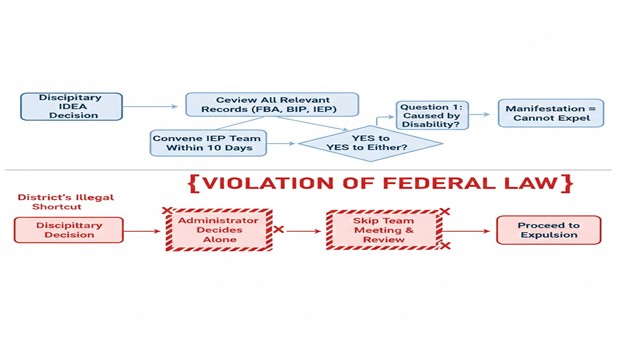
Manifestation determination is a federal procedural safeguard under IDEA and Section 504 preventing schools from punishing students for disability-related conduct. Understanding the precise legal requirements exposes how districts systematically violate them.
34 CFR § 300.530(e): Triggering Events
Districts must conduct manifestation determination when disciplinary action would:
Critical: The 10-day count includes ALL removals in the school year, not just current incident.
California Enhancement: Education Code § 48915.5 prohibits recommending expulsion of student with disability until manifestation determination is conducted and finds behavior was NOT manifestation.
34 CFR § 300.530(e)(1): Within 10 School Days
Manifestation determination must occur within 10 school days of the decision to take disciplinary action. Districts cannot delay pending expulsion hearing or other processes—the 10-day clock starts when administration decides to recommend discipline exceeding 10 days.
34 CFR § 300.530(e)(1): LEA, Parent, and Relevant IEP Team Members
The manifestation determination team must include:
Typical violations: Principal conducts alone, counselor makes determination without parent present, “team” excludes special education staff who understand disability.
34 CFR § 300.530(e)(1): Review All Relevant Information
Team must review:
Districts cannot make determination without reviewing these documents. “We looked at his file” doesn’t satisfy statutory requirement for comprehensive review.
34 CFR § 300.530(e)(1): Required Analysis
Team must determine whether:
Question 1: “Was the conduct in question caused by, or did it have a direct and substantial relationship to, the child’s disability?”
Analysis requires examining:
Example: Student with ADHD documented as “impulsive, acts without considering consequences” makes impulsive decision to leave campus → direct relationship exists.
Question 2: “Was the conduct in question the direct result of the LEA’s failure to implement the IEP?”
Analysis requires examining:
Example: BIP requires “provide breaks when frustrated” but no breaks provided, student acts out when frustrated → direct result of implementation failure.
Critical Standard: If answer to EITHER question is YES, conduct is manifestation.
34 CFR § 300.530(f): Determination That Behavior Was Manifestation
If team determines conduct was manifestation, district must:
California Protection: Education Code § 48915.5 explicitly prohibits expulsion when behavior is manifestation of disability.
34 CFR § 300.530(c): Authority of School Personnel
Even if team determines conduct was NOT manifestation, student with disability:
34 CFR § 300.533: Placement During Appeals
If parent challenges manifestation determination or placement decision, student remains in interim alternative educational setting pending decision (not sent home). Parent can request expedited due process hearing challenging the determination.
34 CFR § 300.530(g): Special Circumstances
Districts can remove student to interim alternative educational setting for up to 45 school days WITHOUT manifestation determination finding if conduct involved:
But: Even in special circumstances, manifestation determination must still occur to determine long-term placement after 45 days.
Violation 1: No Meeting Convened
District simply decides “not disability-related” without convening IEP team. Principal or counselor makes unilateral determination.
Violation 2: Improper Team Composition
Meeting occurs without parent, without special education staff, or with only administrator present—not the required “relevant IEP team members.”
Violation 3: Inadequate Records Review
Team doesn’t review FBA, BIP, teacher observations, or parent input. Administrator claims “I looked at his IEP”—insufficient.
Violation 4: Conclusory Analysis
Team simply states “not a manifestation” without actually analyzing the two required questions with supporting rationale.
Violation 5: Ignoring Disability Characteristics
Team acknowledges student has ADHD documented as causing impulsivity, then claims impulsive conduct had “no relationship” to disability—logically inconsistent.
Violation 6: Ignoring IEP Implementation Failures
Team doesn’t examine whether IEP/BIP was actually implemented. Student’s BIP required daily check-ins (never provided), yet team finds no implementation failure.
Violation 7: Timeline Violations
Manifestation determination occurs 20+ days after disciplinary decision, or after expulsion hearing—violating 10-day requirement.
Violation 8: Predetermined Outcome
Internal emails reveal administrator instructed team to find “not a manifestation” before meeting occurred—sham process with predetermined conclusion.
IDEA Due Process Remedies:
California State Complaint Remedies:
File with California Department of Education Special Education Division alleging IDEA procedural violations. CDE can order corrective action including reinstatement and compensatory services.
The moment district recommends discipline exceeding 10 cumulative days (including multiple short suspensions), send written demand same day: “Under IDEA 34 CFR § 300.530(e), you must convene manifestation determination meeting within 10 school days. I request this meeting be scheduled immediately with required IEP team members including LEA representative, special education staff, and parent. Provide proposed meeting date within 48 hours.” This starts the procedural clock and creates documentation of your demand.
Three days before scheduled meeting, confirm in writing: “Please confirm manifestation determination meeting will include: (1) LEA representative with decision-making authority, (2) parent, (3) relevant IEP team members including [student’s] special education case manager and general education teacher. Please confirm team will review: current IEP, most recent FBA and BIP, teacher observations, all parent-provided information. If any required member or document will be absent, meeting must be rescheduled per IDEA requirements.”
Prepare written analysis for the meeting showing how conduct relates to documented disability: “Per [student’s] IEP, their ADHD manifests as: [quote IEP language about impulsivity, emotional regulation]. The conduct at issue [describe] directly exhibits these disability characteristics because [explain causal relationship]. Additionally, district failed to implement BIP which required [list strategies] that were not provided, creating conditions for incident.” This forces substantive discussion rather than conclusory dismissal.
If manifestation determination is procedurally deficient (wrong team composition, records not reviewed) or substantively wrong (ignores obvious disability relationship), send immediate written objection: “I am objecting to manifestation determination conducted [date] which violated IDEA by: [list specific violations]. Under 34 CFR § 300.533, [student] must remain in current placement (stay-put) pending resolution. I am requesting expedited due process hearing to challenge this determination. Provide prior written notice of district’s position within 48 hours.”
Within 10 days of deficient manifestation determination, file: (1) Due process complaint requesting expedited hearing, stay-put, and compensatory education (timeline-sensitive—file immediately), (2) State complaint with California Department of Education Special Education Division alleging procedural violations (investigation creates independent pressure), (3) OCR complaint if racial disparities exist (if data shows Black disabled students disproportionately found “not manifestation”). Multiple proceedings force settlement.
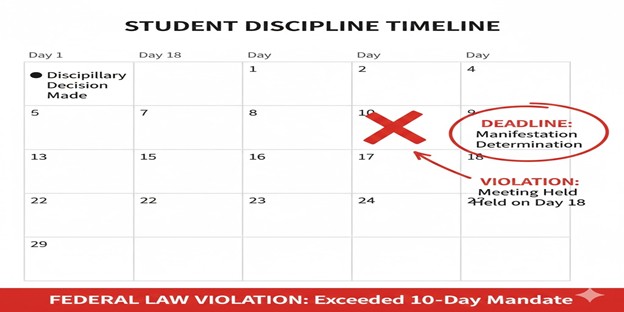
Track all disciplinary removals (suspensions, in-school suspensions, days sent home). When cumulative total reaches 10 days OR district recommends expulsion/transfer, immediately send written demand: “Under 34 CFR § 300.530(e), manifestation determination required within 10 school days. Schedule meeting immediately with all required IEP team members. Provide proposed date within 48 hours.” Do not wait for district to initiate—they may not.
Review student’s current IEP, FBA, and BIP. Create written document: “Disability Characteristics per IEP: [quote specific language about impulsivity, emotional regulation, communication difficulties]. Conduct at Issue: [describe]. Relationship: The conduct directly exhibits documented disability characteristics because [explain]. IEP Implementation Failures: BIP required [strategies] which were not provided [document instances].” Provide to team at meeting. This forces substantive analysis.
Do not allow conclusory statements. When team says “not a manifestation,” ask: “Which of the two required questions did you answer NO to? Please explain your analysis showing how [specific conduct] had NO relationship to [student’s documented ADHD impulsivity]. Please explain how you determined the IEP WAS fully implemented despite [list non-implementation evidence].” Insist on reasoned analysis documented in writing.
If meeting violated procedures (wrong attendees, records not reviewed, no parent present) or reached unsupported conclusion (ignores disability relationship), send immediate objection: “Manifestation determination violated IDEA by: [specific violations]. Under 34 CFR § 300.533, [student] must remain in placement pending resolution of this dispute (stay-put). I am requesting expedited due process hearing. No further disciplinary action may proceed until this is resolved.”
IDEA provides expedited timeline for manifestation determination disputes (20 school days vs. normal 45 days). File due process complaint alleging: procedural violations (team composition, timeline, records review failures), substantive errors (ignored disability relationship, ignored implementation failures), and requesting: return to placement (stay-put), proper manifestation determination, compensatory education. Also file California state complaint simultaneously for dual pressure.
Under California Education Code § 48911, emergency removal is authorized only when a student's presence creates immediate danger to persons/property or threatens to disrupt instruction— requiring actual present danger, not predicted future risk. True emergencies are obvious: active physical violence, weapons possession, genuine psychiatric crisis. Districts misuse authority by claiming vague "threatening statements" or "safety concerns" create emergencies, then extending removals for weeks. If a student is sent home (not hospitalized) and days pass without a hearing, the "emergency" was pretextual.
Under Goss v. Lopez 419 U.S. 565, students must receive: (1) written notice within 24 hours specifying what conduct created what danger, (2) opportunity to respond and present their explanation, (3) hearing within reasonable time (California courts interpret as 2–5 school days). Emergency circumstances don't eliminate due process—they accelerate it. If 3+ days pass without hearing, the emergency justification expires and continued exclusion becomes unconstitutional deprivation.
Emergency removals count toward the 10-day IDEA discipline threshold under 34 CFR § 300.530. If removal—alone or combined with prior removals—exceeds 10 cumulative days, the district must conduct manifestation determination within 10 school days. Districts cannot bypass manifestation determination by calling removal "emergency." If a student has a disability (ADHD impulsivity, emotional disturbance, autism communication difficulties), the conduct may be a disability manifestation requiring return to placement rather than continued exclusion.
After 24 hours without written notice or after 5 days without hearing, send written notice asserting due process violations and demanding immediate return pending proper hearing. If the district refuses, file: (1) application for temporary restraining order (court orders immediate return), (2) due process complaint if IEP/504 student, (3) state complaint with California Department of Education, (4) OCR complaint if discrimination suspected. Courts grant emergency relief when districts cannot articulate specific ongoing danger.
File a California Public Records Act request for: "All emergency removals past 24 months showing student race, disability status, specific conduct, removal duration, outcome." If data shows Black students removed for vague frustrated statements while white students making explicit threats face no removal, this supports Title VI disparate impact. Include data analysis in an OCR complaint demonstrating disparate rates, disparate treatment for comparable conduct, and lack of legitimate nondiscriminatory justification for disparities.
If you want student harm treated like a school safety and civil rights issue—start with SANI at https://saninstitute.net
Table of Contents Click to Expand 1. Audio 2. Definition 3. Video 4. Core Thesis 5. Case Pattern Story 6. SANI Connection 7. Discipline Explanation
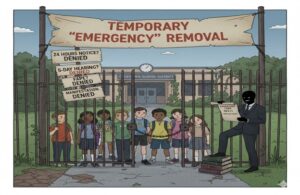
Table of Contents Click to Expand 1. Audio 2. Definition 3. Video 4. Core Thesis 5. Case Pattern Story 6. SANI Connection 7. Discipline Explanation

Table of Contents Click to Expand 1. Audio 2. Definition 3. Video 4. Core Thesis 5. Case Pattern Story 6. SANI Connection 7. Discipline Explanation

Table of Contents Click to Expand 1. Audio 2. Definition 3. Video 4. Core Thesis 5. Case Pattern Story 6. SANI Connection 7. Discipline Explanation