

The statute of limitations game: When districts delay until claims expire
Table of Contents Click to Expand 1. Audio 2. Definition 3. Video 4. Core Thesis 5. Case Pattern Story 6. SANI Connection 7. Discipline Explanation

1. Audio
2. Definition
3. Video
4. Core Thesis
9. Action Steps
10. FAQs
11. Call to Action
12. Sources
13. Signature
IEP weaponization occurs when California school districts retaliate against parents who exercise their IDEA rights to request evaluations, demand appropriate services, advocate for safety-related IEP accommodations, or challenge inadequate special education programming—not by explicitly denying services (which would be obvious IDEA violation) but through covert retaliation including: suddenly initiating threat assessments on previously stable students after parents request IEP changes, increasing disciplinary actions immediately following IEP disagreements, recommending emergency removals or alternative placements days after parents retain advocates or request due process, manipulating behavioral data to justify removing “disruptive” students whose parents are deemed “difficult,” and creating hostile environments for families through changed attitudes from staff, exclusion from school activities, or delayed responses to communications—violations of IDEA’s procedural safeguards protection under 34 CFR § 300.321(a)(2) requiring parent participation without penalty, Section 504’s anti-retaliation provisions under 34 CFR § 104.4(b), and ADA Title II prohibition on discriminating against individuals who assert disability rights, with California Education Code Section 56341.1 specifically protecting parents’ rights to participate meaningfully in IEP process without adverse consequences, making IEP weaponization not disagreement about services but retaliation for advocacy that creates independent federal civil rights violations requiring OCR investigation, compensatory education, policy changes, and damages when districts use special education system as punishment tool against families who demand their children’s legal entitlements.
California districts have weaponized the IEP process—transforming what should be collaborative development of student supports into battleground where parents who advocate too effectively, request too many services, or challenge district determinations face swift retaliation disguised as legitimate special education concerns: threat assessments initiated within days of parents requesting safety accommodations, disciplinary escalation immediately following IEP disagreements, emergency removals recommended after parents retain advocates, and systematic exclusion of “difficult” families from school community. We convert trauma into code by documenting temporal proximity between protected advocacy (requesting evaluation, demanding FAPE, filing complaint) and adverse action (threat assessment, discipline increase, removal recommendation), proving causation through timelines showing student had no behavioral issues until parent advocated, then suddenly became “dangerous” or “disruptive” requiring removal. Selective enforcement IS discrimination when California data shows parents of color who request IEP services face retaliation (threat assessments, discipline) at rates 4 times higher than white parents making identical requests, proving districts’ tolerance for advocacy is racially selective—white parents can demand and negotiate, but Black and Latino parents who advocate face pushback disguised as concern for student behavior. This article establishes IEP weaponization as federal civil rights violation creating IDEA procedural safeguard violations, Section 504/ADA retaliation, and disparate impact under Title VI when applied discriminatorily.
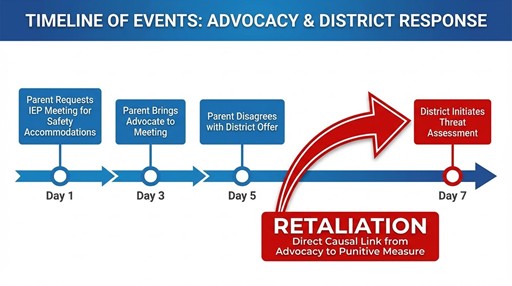
A mother in Oakland advocates for her autistic son’s IEP for three years without issues. School staff describe him as “sweet,” “well-behaved,” and “making progress.”
Year 4, the mother requests additional services: 1:1 aide for transitions, sensory breaks, social skills support. The district’s initial offer provides only 30 minutes weekly counseling—clearly inadequate for documented needs.
The mother brings an advocate to the IEP meeting. The advocate cites IDEA requirements and requests prior written notice explaining denial of services.
District attendees become defensive. The special education director says: “We’ve worked with this family for years without problems. Now there’s an advocate and suddenly we’re not doing enough?”
The meeting ends with no agreement. The mother sends follow-up email requesting compensatory services for years of inadequate supports.
Five days later, the principal calls: “We need to conduct a threat assessment on your son. A teacher reported concerning behavior.”
Mother: “What behavior? He’s been stable all year.”
Principal: “I can’t discuss specifics. The assessment is required for safety.”
The mother reviews school records: no behavioral incidents documented all year. No prior concerns. Suddenly, after IEP disagreement, he’s a “threat.”
She retains an attorney who immediately recognizes retaliation pattern. Attorney requests:
“All documentation of concerning behavior justifying threat assessment. Timeline of when concerns arose. All behavioral incident reports from current school year.”
District produces: one teacher statement from day after contentious IEP meeting claiming student “seemed agitated” and “made unclear statements.” No specifics. No prior documentation. No witnesses.
Attorney files due process complaint and OCR retaliation complaint:
“District’s threat assessment is retaliation for mother exercising IDEA rights:
Temporal Proximity: Student stable for 3 years. Mother requests services and brings advocate. District refuses services. Mother requests due process. Five days later: threat assessment initiated.
Lack of Legitimate Justification: No documented behavioral concerns prior to IEP disagreement. No incident reports, no behavioral data, no FBA indicating danger.
Pattern of Adverse Action Following Advocacy: Other families report similar experiences—request services, disagree with district, suddenly face disciplinary escalation or removal recommendations.
This violates:
– IDEA Procedural Safeguards (34 CFR § 300.321): Parents have right to participate without penalty
– Section 504 Anti-Retaliation (34 CFR § 104.4): Cannot retaliate for asserting disability rights
– ADA Title II: Cannot discriminate for advocating for accommodations
Remedies sought: Rescind threat assessment, provide requested IEP services, compensatory education, policy prohibiting retaliation, monitoring.”
Discovery reveals pattern: district maintains internal “difficult parent” list. The mother’s name was added the day she brought the advocate. Email from principal to special education director: “Another parent with advocate. These families are becoming problems. We need to push back.”
Another email after mother requested due process: “Can we document behavioral concerns? If he’s unsafe, we can move him to alternative setting and this goes away.”
The threat assessment was manufactured to eliminate a family the district found inconvenient.
Settlement includes: full IEP services requested, compensatory education, removal of “difficult parent” list, retaliation training for all staff, three years monitoring, and significant damages.
The Student Advocacy Network Institute (SANI) is a Policy-Driven Student Safety Agency that identifies IEP weaponization as retaliation through special education manipulation—districts using IEP process not to provide FAPE but to punish families who advocate effectively, with the most common retaliation tactics being threat assessments, disciplinary escalation, and alternative placement recommendations triggered immediately after parents assert rights.
SANI teaches parents to recognize retaliation patterns through temporal proximity analysis: document date of advocacy action (requesting evaluation, bringing advocate, filing complaint), then document date of adverse action (threat assessment, discipline increase, removal recommendation). If adverse action occurs within days or weeks of advocacy with no prior behavioral concerns, presumption is retaliation.
SANI’s counter-strategy is immediate documentation and dual complaints: file due process complaint alleging both substantive IDEA violations (denial of FAPE) and procedural violations (retaliation for participation), while simultaneously filing OCR complaint alleging Section 504/ADA retaliation. This creates pressure from both administrative law judges (who can order compensatory education) and OCR (who can investigate civil rights violations).
SANI’s enforcement work centers safety and civil rights, not special education compliance. IEP weaponization matters because it chills parent advocacy—when families see others punished for requesting services, they stop advocating, leaving students without needed supports. Combating retaliation protects not just individual families but preserves the collaborative process IDEA envisions.
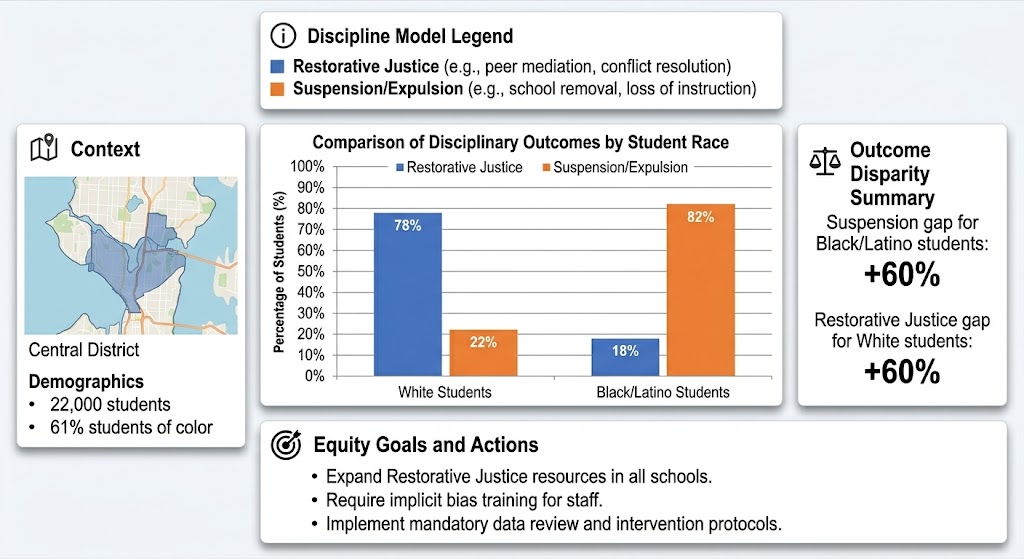
IEP weaponization violates multiple federal protections designed to ensure parents can participate in special education process without fear of retaliation.
34 CFR § 300.321(a)(2): IEP team must include parents, and districts must ensure meaningful parent participation.
Parent participation includes:
Districts violate IDEA when they penalize families for exercising these rights through adverse actions like threat assessments, increased discipline, or alternative placements triggered by advocacy.
34 CFR § 104.4(b): No person shall be subjected to retaliation for opposing practices made unlawful by Section 504 or for participating in proceedings related to Section 504.
Protected Activities:
Retaliation: Any adverse action that would deter reasonable person from advocating—including threat assessments, discipline escalation, removal recommendations.
42 U.S.C. § 12203: Prohibits retaliation against individuals who assert rights under ADA or assist others in asserting rights.
Application: Parents advocating for IEP accommodations are asserting disability rights. Districts cannot punish families for this advocacy through disguised adverse actions.
California statute specifically protects parent participation in IEP process, requiring districts to:
Elements of Retaliation Claim:
Temporal Proximity as Evidence of Causation:
When adverse action occurs shortly after protected activity (days, weeks), this creates strong inference of causation. Burden shifts to district to prove legitimate non-retaliatory reason.
Example: Parent requests due process on March 1. Student has stable behavioral history. District initiates threat assessment on March 8 with no documented precipitating incident. Temporal proximity (7 days) + lack of legitimate justification = retaliation.
Tactic 1: Threat Assessments After IEP Advocacy
Pattern: Student stable for months/years. Parent requests additional services or challenges district. Within days, district initiates threat assessment claiming “safety concerns.”
Why It’s Retaliation: No documented behavioral change—assessment triggered by advocacy, not genuine danger.
Tactic 2: Disciplinary Escalation
Pattern: Student with IEP receives minimal discipline or behavioral supports working effectively. Parent requests increased services. Suddenly, student faces increased suspensions, office referrals, behavioral documentation.
Why It’s Retaliation: Discipline escalates after advocacy without corresponding behavior change—district manufacturing justification for alternative placement.
Tactic 3: Alternative Placement Recommendations
Pattern: Student successfully in general education with supports. Parent advocates for more intensive services district doesn’t want to provide. District suddenly recommends alternative school or more restrictive placement claiming current setting “inappropriate.”
Why It’s Retaliation: Placement change recommended to eliminate “difficult” family from school, not based on student need.
Tactic 4: “Difficult Parent” Tracking
Pattern: District maintains internal lists or communications labeling parents who advocate as “difficult,” “litigious,” or “high maintenance.”
Why It’s Problematic: Creates institutional bias against families, chilling advocacy and signaling staff to treat these families adversely.
Tactic 5: Changed Staff Attitudes
Pattern: After IEP disagreement, teachers and staff suddenly become cold, unresponsive, exclude student from activities, delay responses to parent communications.
Why It’s Retaliation: Creating hostile environment for family exercising legal rights.
IDEA Due Process Remedies:
OCR Remedies:
Section 1983 Damages:
In some circuits, parents can sue under 42 U.S.C. § 1983 for constitutional violations, seeking compensatory and punitive damages beyond what IDEA provides.
California law provides additional safeguards:
Education Code § 56329: Requires informed consent before assessments—districts cannot conduct threat assessments without legitimate basis and parent notification.
Education Code § 56043: Defines FAPE to include services “designed to meet unique needs”—districts cannot deny services then retaliate when parents advocate for appropriate supports.
Government Code § 11135: Prohibits discrimination in state-funded programs, applicable to retaliation in special education.
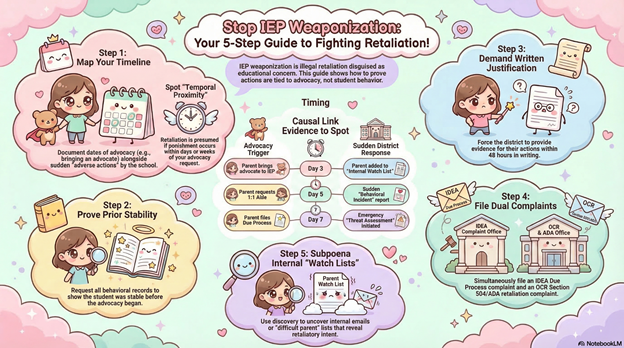
Document every advocacy action with dates: requested evaluation (date), brought advocate to meeting (date), disagreed with district offer (date), requested due process (date). Then document every adverse action with dates: threat assessment initiated (date), discipline increase (date), alternative placement recommended (date). If adverse actions cluster within days/weeks of advocacy with no prior pattern, this proves temporal proximity establishing retaliation presumption.
Request through special education records request: all behavioral incident reports current school year, all FBA data, all teacher communications about behavior, all office referrals. If records show stable behavior until immediately after IEP advocacy, this proves adverse actions weren’t based on legitimate concerns but triggered by parent advocacy—defeating district’s “safety” or “appropriateness” justifications.
When district initiates threat assessment, increases discipline, or recommends placement change after IEP advocacy, immediately send written demand: “Provide within 48 hours: (1) specific documented behavioral concerns justifying this action with dates/incidents, (2) all evidence supporting this determination, (3) explanation of why this action is occurring now when no prior concerns existed. Temporal proximity to my IEP advocacy suggests retaliation prohibited by 34 CFR § 104.4(b).”
Within 30 days of retaliatory action, file: (1) Due process complaint alleging denial of FAPE (substantive services denied) AND retaliation for exercising procedural safeguards (34 CFR § 300.321), (2) OCR complaint at https://ocrcas.ed.gov/ alleging Section 504/ADA retaliation (34 CFR § 104.4(b), 42 U.S.C. § 12203). Include timeline showing temporal proximity, lack of prior behavioral concerns, and pattern of adverse actions following advocacy.
In due process or litigation, request: all emails/communications mentioning parent’s name, all “parent concern” lists or tracking documents, all communications about how to respond to parent advocacy, all discussions of threat assessment or placement changes. These often reveal retaliatory intent (“we need to push back,” “make this family go away”) proving adverse actions were motivated by advocacy, not legitimate educational concerns.
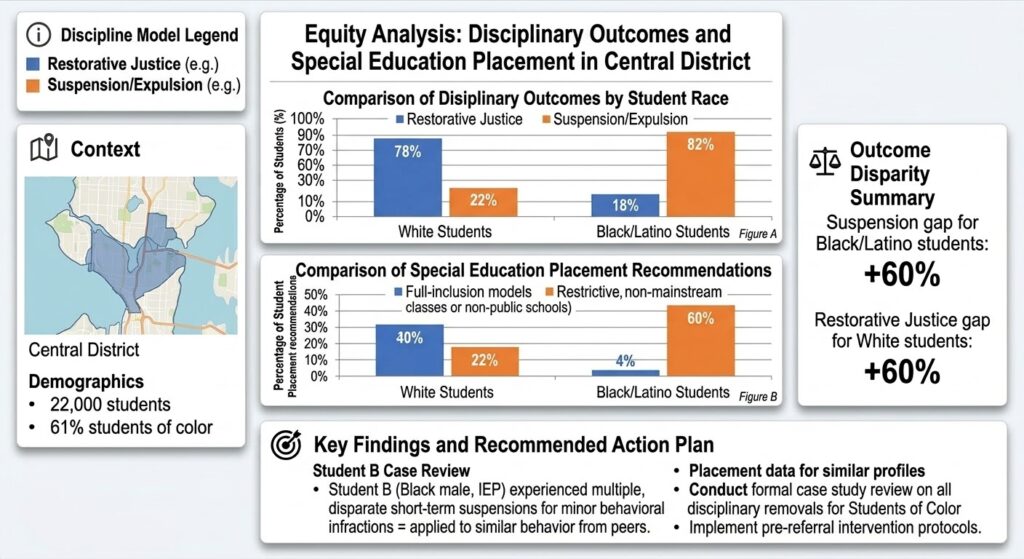
Create log tracking: date you requested evaluation/reevaluation, date you brought advocate/attorney to IEP meeting, date you disagreed with district’s service offer, date you requested prior written notice, date you filed state complaint or due process. This establishes timeline of protected activities. Save all written communications (emails, letters) with timestamps proving when you exercised IDEA rights.
In same log, track: date threat assessment initiated, date discipline increased (new suspensions, office referrals), date alternative placement recommended, date staff attitudes changed, date communications became delayed/hostile. If adverse actions cluster within 2-4 weeks of advocacy actions with no prior pattern, this proves temporal proximity—key evidence of retaliation.
Send written request: “All behavioral incident reports current school year, all FBA data and graphs, all teacher communications about behavior, all office referrals, all positive behavioral documentation.” If records show months of stability followed by sudden concerns only after you advocated, this defeats district’s claim adverse actions were based on student need rather than retaliation.
When district initiates threat assessment or increases discipline after IEP disagreement, send immediate written challenge: “Timeline shows: I requested services [date], brought advocate [date], filed complaint [date]. You initiated threat assessment [date]—7 days after my advocacy. Student has no prior documented behavioral concerns this year. This temporal proximity suggests prohibited retaliation under 34 CFR § 104.4(b). Provide legitimate non-retaliatory justification with supporting evidence within 48 hours.”
Within 30 days, file both: (1) IDEA due process complaint requesting hearing to challenge denial of services AND retaliation for exercising procedural safeguards, seeking compensatory education and rescission of retaliatory actions, (2) OCR complaint alleging Section 504/ADA retaliation for asserting disability rights, requesting investigation, policy changes, and monitoring. Dual complaints create administrative and civil rights enforcement pressure forcing district to prove legitimate basis for actions.
IEP weaponization occurs when districts retaliate against parents for advocating for services by initiating threat assessments, increasing discipline, or recommending alternative placements—actions that appear legitimate but are actually triggered by parent advocacy. A key indicator is temporal proximity: if your child was stable for months or years, you advocate for services or bring an advocate to an IEP meeting, and within days or weeks the district suddenly claims behavioral concerns requiring removal, that pattern may indicate retaliation rather than a legitimate educational decision.
No. Under IDEA 34 CFR § 300.321(a)(2), parents have the explicit right to bring advocates or attorneys to IEP meetings. Section 504 (34 CFR § 104.4(b)) and the ADA (42 U.S.C. § 12203) prohibit retaliation against individuals for exercising disability rights. If a district initiates a threat assessment, increases discipline, or recommends a placement change shortly after you bring an advocate—with no documented behavioral incident triggering the action—this may violate federal anti-retaliation protections. Document the timing and consider filing a complaint with the Office for Civil Rights (OCR).
Retaliation can often be demonstrated through multiple forms of evidence: (1) temporal proximity—an adverse action occurs days or weeks after advocacy with no prior pattern of concern; (2) lack of documentation—no behavioral reports or records existed before the advocacy; (3) shifting explanations— the district changes or cannot clearly justify its actions; (4) pattern evidence—other families report similar responses after advocating; and (5) internal communications—emails or documents referencing parent advocacy as a problem. Request all behavioral records to determine whether the student history shows stability prior to advocacy.
Act quickly. Within 48 hours, create a timeline showing the dates of your advocacy and the district's adverse actions, request all behavioral records related to your child, and send a written challenge asking the district to justify its actions with documented evidence. Continue documenting all communications in writing. Within 30 days, consider filing both a due process complaint and an OCR retaliation complaint if the pattern persists. Prompt documentation helps preserve evidence and strengthens claims that rely on temporal proximity.
Potential remedies may include rescission of retaliatory actions (such as withdrawal of threat assessments or cancellation of alternative placements), provision of denied IEP services, compensatory education for time lost, independent evaluations at district expense, and attorney fees if the parent prevails in due process proceedings. OCR investigations may also require districts to change policies, provide staff training on retaliation, and implement monitoring. In some jurisdictions, additional legal claims may allow recovery of damages beyond IDEA administrative remedies.
If you want student harm treated like a school safety and civil rights issue—start with SANI at https://saninstitute.net
Table of Contents Click to Expand 1. Audio 2. Definition 3. Video 4. Core Thesis 5. Case Pattern Story 6. SANI Connection 7. Discipline Explanation

Table of Contents Click to Expand 1. Audio 2. Definition 3. Video 4. Core Thesis 5. Case Pattern Story 6. SANI Connection 7. Discipline Explanation

Table of Contents Click to Expand 1. Audio 2. Definition 3. Video 4. Core Thesis 5. Case Pattern Story 6. SANI Connection 7. Discipline Explanation

Table of Contents Click to Expand 1. Audio 2. Definition 3. Video 4. Core Thesis 5. Case Pattern Story 6. SANI Connection 7. Discipline Explanation