
The documentation gap: when “no records” becomes the district’s defense
Table of Contents Click to Expand 1. Audio 2. Definition 3. Video 4. Core Thesis 5. Case Pattern Story 6. SANI Connection 7. Discipline Explanation
1. Audio
2. Definition
3. Video
4. Core Thesis
9. Action Steps
10. FAQs
11. Call to Action
12. Sources
13. Signature
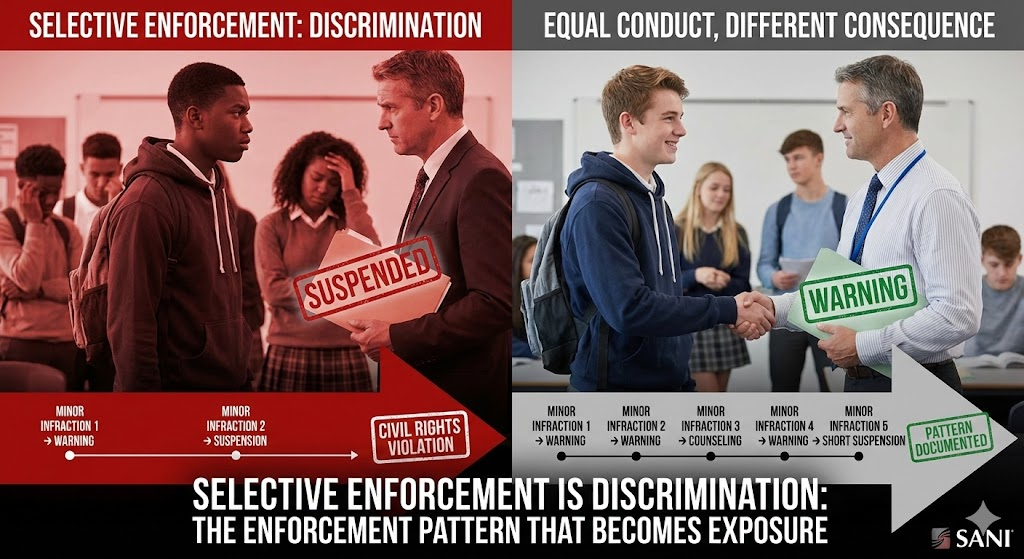
Selective Enforcement is the disparate application of school discipline policies based on protected characteristics (race, disability, gender, sexual orientation) or social capital, resulting in some students receiving multiple warnings or informal interventions while others receive immediate formal consequences for identical or lesser conduct. Under federal civil rights law (Title VI, Section 504, Title IX), selective enforcement constitutes discrimination when it creates a pattern of disparate impact or reflects intentional bias. Documentation of enforcement patterns—who gets disciplined, how quickly, how severely, and for what conduct—transforms individual incidents into systemic civil rights violations.
Selective enforcement is not just unfair—it is discrimination. When schools punish some students harshly and quickly while allowing others repeated chances for identical behavior, they violate federal civil rights law. The Student Advocacy Network Institute, a Policy-Driven Student Safety Agency, exists because selective enforcement is the hidden architecture of institutional discrimination in K-12 education. We convert trauma into code by documenting who gets disciplined, for what, how fast, and how severely—then proving the pattern is based on race, disability, or other protected characteristics. Selective enforcement IS discrimination, and enforcement patterns become legal exposure when properly documented. This article teaches parents to recognize, document, and prove selective enforcement as a civil rights violation.
The Student Advocacy Network Institute was built to expose and dismantle selective enforcement. As the nation’s first Policy-Driven Student Safety Agency, SANI operates at the intersection of discipline data analysis, civil rights enforcement, and pattern documentation.
When a parent contacts SANI and says, “My child was suspended but another student who did the same thing wasn’t,” we ask:
We convert trauma into code by transforming individual grievances into provable patterns. Selective enforcement IS discrimination when the pattern reveals disparate impact based on protected class membership.
SANI treats student harm as both a school safety issue and a civil rights issue because selective enforcement is one of the most damaging and pervasive forms of institutional discrimination. It teaches students that justice depends on who you are, not what you did. It creates hostile educational environments for marginalized students. It violates Title VI, Section 504, and Title IX.
We document the pattern. We prove the discrimination. We force accountability.
Selective enforcement is not always conscious racism or bias. It often results from:
Implicit Bias: Unconscious associations that lead adults to perceive identical behavior differently based on a student’s race, gender, disability, or appearance. Research shows teachers are more likely to perceive Black boys as threatening and girls as defiant compared to white boys exhibiting identical behavior.
Cultural Mismatch: Discipline systems designed around white, middle-class behavioral norms punish students whose communication styles, emotional expression, or conflict resolution patterns differ from the dominant culture.
Disability Misunderstanding: Students with disabilities (ADHD, autism, trauma-related disorders) are punished for behaviors that are manifestations of their disability rather than willful misconduct.
Social Capital Protection: Students whose parents have relationships with staff, donate to the school, or hold community influence receive informal interventions, while students without such capital receive formal consequences.
Staff Discretion Without Oversight: When individual administrators apply subjective standards without data review or accountability, patterns of discrimination emerge even without intent.
Regardless of intent, the legal standard is impact. If enforcement patterns create disparate outcomes based on protected characteristics, discrimination has occurred.
Title VI of the Civil Rights Act of 1964 (race, color, national origin):
Schools that receive federal funding cannot discriminate on the basis of race. This includes facially neutral policies that are applied in discriminatory ways. Selective enforcement violates Title VI when:
Section 504 of the Rehabilitation Act / ADA (disability):
Schools cannot discriminate against students with disabilities. Selective enforcement violates Section 504 when:
Title IX (sex/gender):
Schools cannot discriminate on the basis of sex. Selective enforcement violates Title IX when:
Disparate Impact: A policy or practice that appears neutral but results in disproportionate harm to a protected group. Intent is not required. The pattern itself is the violation.
Intentional Discrimination: Deliberate, conscious bias. Harder to prove but often revealed through statements, emails, or staff testimony.
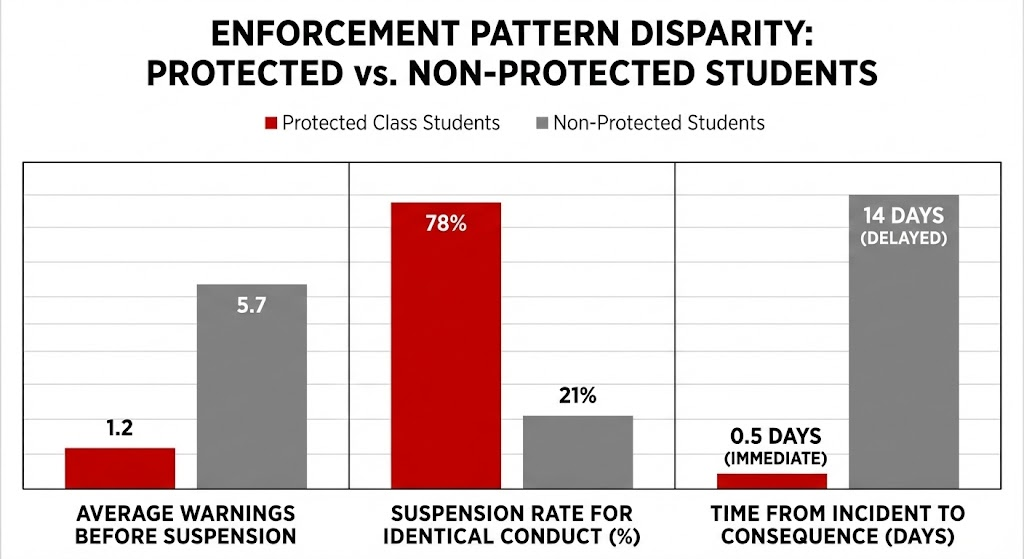
Most selective enforcement cases are proven through disparate impact analysis because the data speaks louder than intent. When Black students are suspended at 4x the rate of white students for the same conduct, no administrator needs to admit racism—the numbers prove the discrimination.
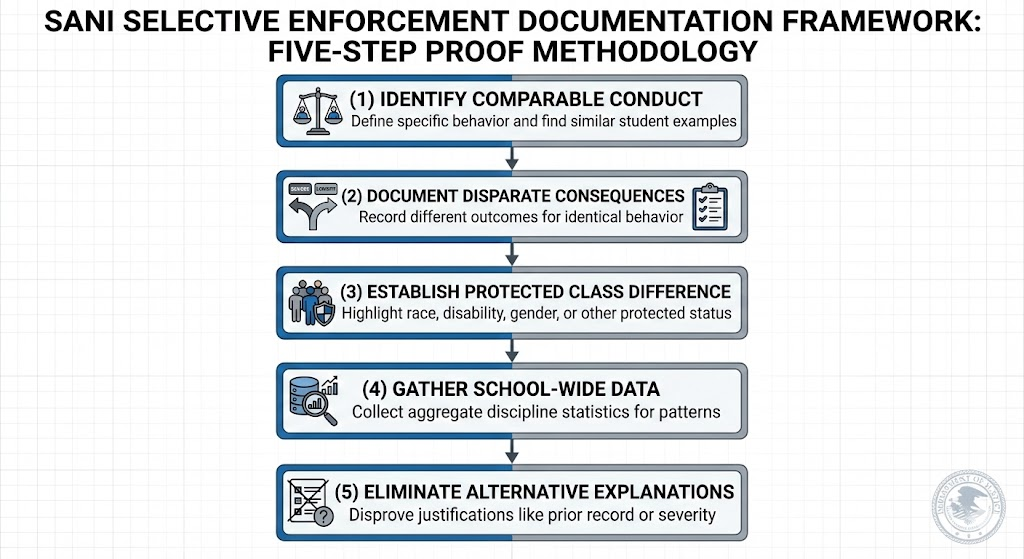
Proving selective enforcement requires comparative evidence:
What behavior led to your child’s discipline? Find other students who engaged in identical or similar conduct. Example:
The conduct must be comparable. Minor differences in wording or context can matter, but the core violation should be the same.
Create a chart:
Student | Conduct | Consequence | Timeline | Prior Record |
Your Child (Black) | Profanity + threat | 3-day suspension | Same day | 0 priors |
Student B (White) | Profanity + threat | Verbal warning | Same day | 3 priors |
This visual comparison is powerful evidence.
Identify how your child differs from the comparison student:
If the primary difference is a protected characteristic, you have the foundation for a discrimination claim.
Request discipline data through a public records request:
This data reveals patterns the school cannot explain away as “individual case judgment.”
The school will argue that differences in discipline are justified by:
You must show these justifications don’t hold:
When you eliminate alternative explanations, the only remaining variable is the protected characteristic—and that’s discrimination.
When your child is disciplined, create this chart:
Element | Your Child | Comparison Student(s) |
Conduct | [Describe exactly] | [Same conduct] |
Consequence | [Suspension, expulsion, etc.] | [Warning, counseling, etc.] |
Prior Record | [Number of priors] | [Number of priors] |
Timeline | [Incident to consequence] | [Incident to consequence] |
Protected Class | [Race, disability, etc.] | [Race, disability, etc.] |
If you don’t know the details of other students’ discipline, request them through public records laws (with names redacted).
If your child was harmed by another student and that student received lenient treatment, document:
Pattern matters. If your child reports harm and nothing happens, but when your child is accused, consequences are immediate—that’s selective enforcement.
Submit this public records request:
Subject: Public Records Request – Discipline Data
Dear [District Records Officer]:
Under [state public records law], I am requesting the following discipline data for [School Name] for the past three years:
Please provide this data in a format that allows comparison across demographic groups (e.g., Excel spreadsheet, anonymized).
Sincerely,
[Your Name]
[Date]
This data reveals patterns that individual case comparisons cannot.
If you have evidence of selective enforcement, file a complaint with the U.S. Department of Education Office for Civil Rights (OCR):
Online: https://www2.ed.gov/about/offices/list/ocr/complaintintro.html
Required Information:
OCR investigates and can force policy changes, training, data monitoring, and compensatory remedies.
When meeting with the school or district, state clearly:
“The discipline pattern here raises civil rights concerns. My child, who is [protected class], received [harsh consequence] with [X prior warnings]. Another student, who is [comparison class], received [lenient consequence] with [Y prior warnings] for the same conduct. This is selective enforcement, and it violates [Title VI / Section 504 / Title IX]. I am requesting that my child’s record be expunged and that the district conduct a review of its enforcement practices.”
This language shifts the conversation from “my child was unfairly treated” to “the district has legal exposure.”
Selective enforcement often operates in both directions:
Document both. If your child reported bullying by a white or non-disabled student and the school gave that student multiple chances, but when your Black or disabled child defended themselves, they were immediately suspended—that’s a double selective enforcement pattern.
This is especially powerful because it shows the school both fails to protect and fails to discipline fairly.
Selective enforcement is the unequal application of school discipline or safety policies, where some students receive repeated warnings, informal interventions, or protection, while others receive immediate or harsher consequences for identical or lesser conduct. When these disparities align with protected characteristics such as race, disability, or gender, selective enforcement constitutes discrimination under federal civil rights law.
Selective enforcement is proven through comparative evidence, including: (1) similar conduct between students, (2) different disciplinary or safety outcomes, (3) the key distinguishing factor being a protected characteristic, (4) supporting school-wide or historical data showing a pattern, and (5) the school’s inability to provide a legitimate, non-discriminatory justification. Comparative charts and aggregate discipline data are the strongest forms of proof.
Yes. Selective enforcement violates Title VI (race), Section 504 and the ADA (disability), and Title IX (gender) when it creates a pattern of disparate impact on students in protected classes. Civil rights law does not require proof of intent—if the outcomes disproportionately harm protected students, the practice is unlawful.
This is a common deflection. Individualized decision-making does not excuse discriminatory patterns. Courts and the Office for Civil Rights evaluate outcomes, not stated intentions. If “individual judgment” consistently results in harsher discipline or less protection for Black students or students with disabilities, the pattern itself establishes discrimination.
Yes—and this is critical. Selective enforcement operates in two directions: over-enforcement (disproportionate punishment of protected students) and under-enforcement (failure to protect protected students when they report harm). When a school punishes your child swiftly but gave the aggressor repeated chances, it demonstrates a dual selective enforcement pattern.
Submit a public records request for aggregate, anonymized discipline data disaggregated by race, gender, and disability status. While individual student records are protected, statistical data revealing patterns must be disclosed. A school’s refusal or delay can be challenged and may itself support an inference of discriminatory concealment.
No. Selective enforcement is evaluated comparatively, not absolutely. The relevant question is whether similarly situated students outside your child’s protected class received more warnings, more leniency, or more protection for comparable conduct histories. If white or non-disabled students routinely receive greater tolerance for the same behavior, selective enforcement still exists.
If you want student harm treated like a school safety and civil rights issue—start with SANI at https://saninstitute.net
The Student Advocacy Network Institute (SANI) is a national research, accountability, and discipline institute founded by Bullying Is A Drug to define, document, and address institutional failure in K–12 education—treating student harm as a school safety and civil rights issue.
Explore the Institute:
https://saninstitute.net
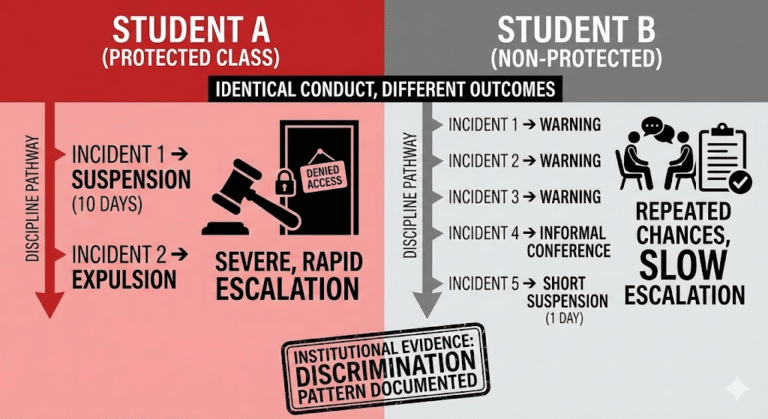
Two eighth-grade students get into a verbal argument in the hallway. Both students use profanity and threaten to fight after school. A teacher breaks it up and sends both to the office.
Student A is Black. He has no prior disciplinary record. The assistant principal suspends him for three days for “threats of violence” under Ed Code 48900.2. His parents are notified by phone and letter. The suspension goes on his permanent record.
Student B is white. He has three prior incidents this semester—two for disruption, one for defiance. The assistant principal gives him a verbal warning and calls his parents to “let them know what happened.” No suspension. No formal documentation. No record entry.
When Student A’s parents ask why their son was suspended while the other student received a warning, the assistant principal says: “Every case is different. We look at the totality of circumstances.”
The parents discover through a public records request that over the past two years:
This is not subjective judgment. This is selective enforcement—and it is racial discrimination under Title VI of the Civil Rights Act of 1964.
The school will claim: “We treat every student as an individual. We don’t consider race.”
The data proves otherwise. When enforcement patterns consistently disadvantage students based on race, disability, or other protected characteristics, the pattern itself is the violation—even if no single administrator consciously intended to discriminate.
Table of Contents Click to Expand 1. Audio 2. Definition 3. Video 4. Core Thesis 5. Case Pattern Story 6. SANI Connection 7. Discipline Explanation
Table of Contents Click to Expand 1. Audio 2. Definition 3. Video 4. Core Thesis 5. Case Pattern Story 6. SANI Connection 7. Discipline Explanation
Table of Contents Click to Expand 1. Audio 2. Definition 3. Video 4. Core Thesis 5. Case Pattern Story 6. SANI Connection 7. Discipline Explanation

Table of Contents Click to Expand 1. Audio 2. Definition 3. Video 4. Core Thesis 5. Case Pattern Story 6. SANI Connection 7. Discipline Explanation