
The documentation gap: when “no records” becomes the district’s defense
Table of Contents Click to Expand 1. Audio 2. Definition 3. Video 4. Core Thesis 5. Case Pattern Story 6. SANI Connection 7. Discipline Explanation
1. Audio
2. Definition
3. Video
4. Core Thesis
9. Action Steps
10. FAQs
11. Call to Action
12. Sources
13. Signature
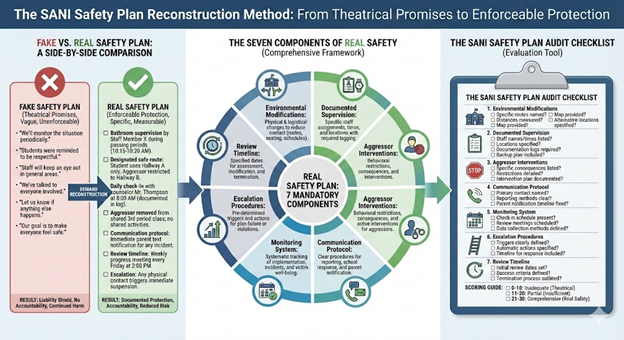
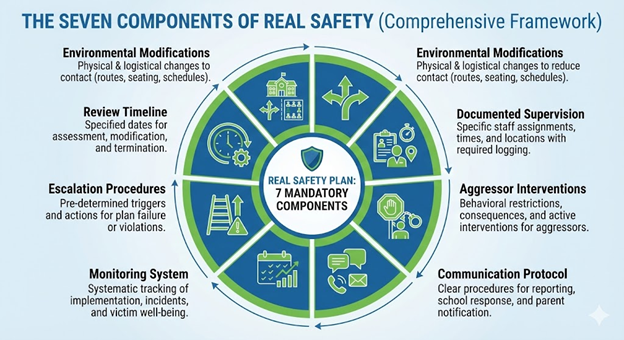
The Safety Plan Reconstruction Method is a systematic framework for building enforceable, comprehensive student protection protocols when school-provided safety plans are inadequate, vague, unenforceable, or nonexistent. Real safety plans contain seven mandatory components: specific environmental modifications, documented supervision enhancements, concrete behavioral interventions for aggressors, explicit communication protocols, measurable monitoring systems, escalation procedures with accountability triggers, and review timelines with consequences for non-compliance. When schools provide “plans” that consist of vague promises (“we’ll monitor the situation”) without specifics, enforcement mechanisms, or accountability, parents must reconstruct actual safety using evidence-based protocols that courts and regulators recognize as meeting duty of care standards.
Most school “safety plans” are procedural theater designed to create the appearance of action without providing actual protection. The Student Advocacy Network Institute, a Policy-Driven Student Safety Agency, operates on this principle: a safety plan without specifics, enforcement mechanisms, and accountability is not a plan—it’s a liability shield. We convert trauma into code by teaching parents to recognize the seven components of real safety and demand reconstruction when schools provide vague promises. Real safety is measurable, specific, enforceable, and documented. Fake safety sounds protective but delivers nothing. When schools say “we’ll keep an eye on things” or “we’ve talked to everyone about being respectful,” they are providing fake safety. Selective enforcement IS discrimination, and inadequate safety planning often reveals disparate treatment—some students receive comprehensive, detailed protection while others receive vague promises. This article provides the complete reconstruction methodology that transforms theatrical safety into enforceable protection.
The Student Advocacy Network Institute was founded on the recognition that most safety plans are designed to protect the school from liability claims, not protect students from harm. As the nation’s first Policy-Driven Student Safety Agency, SANI operates at the intersection of safety science, threat assessment protocols, and accountability enforcement.
When a parent contacts SANI and says, “The school created a safety plan but the harassment continues,” we ask: “What does the plan actually say?”
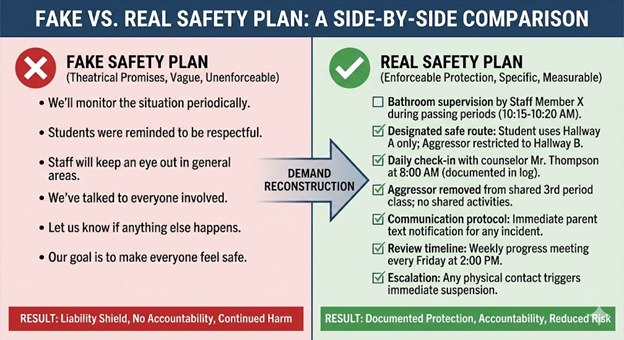
Typical responses reveal fake plans:
Real plans contain specifics:
We convert trauma into code by teaching parents the Seven Components of Real Safety and providing the reconstruction methodology when schools deliver vague promises.
SANI treats student harm as both a school safety issue and a civil rights issue because inadequate safety planning often reveals discriminatory treatment. When we analyze safety plans across cases, we discover:
Selective enforcement IS discrimination—and safety plan quality is one of the clearest indicators. The reconstruction method ensures every student gets real protection, regardless of their parents’ legal literacy or social capital.
Schools have competing pressures when creating safety plans:
Pressure 1: Minimize Disruption
Comprehensive safety plans require:
Schools prefer plans that require minimal operational changes.
Pressure 2: Avoid Accountability
Specific, written plans create accountability:
Vague plans (“we’ll monitor”) avoid creating measurable failure points.
Pressure 3: Maintain Access for Aggressors
Schools resist removing aggressors from activities, classes, or school entirely due to:
Vague plans allow aggressors to remain with minimal restrictions.
Result: Schools gravitate toward safety theater—plans that sound protective but change nothing.
Real safety plans are specific, measurable, enforceable, and documented. Each component answers: Who, What, When, Where, How, and What If?
Definition: Physical and logistical changes to the school environment that reduce or eliminate victim-aggressor contact.
Fake Version: “Students will avoid each other” “Keep your distance” “Stay away from that area”
Real Version:
Designated Routes:
Bathroom Assignments:
Classroom Changes:
Lunch/Cafeteria:
Schedule Modifications:
Location Restrictions:
Why This Matters: Environmental modifications create physical separation, reducing opportunity for contact.
Definition: Specific staff assignments for monitoring designated locations, with documentation requirements.
Fake Version: “Staff will keep an eye out” “We’re monitoring the situation” “Everyone’s been reminded to watch”
Real Version:
Staff Assignments:
Supervision Protocols:
Documentation Requirements:
Communication Among Supervisors:
Why This Matters: Named accountability prevents “everyone’s responsibility = no one’s responsibility” failures.
Definition: Specific behavioral interventions, restrictions, and consequences for students who posed the threat.
Fake Version: “We’ve talked to them” “They agreed to be respectful” “They know this is serious”
Real Version:
Behavioral Expectations:
Consequences for Violations:
Active Interventions:
Restrictions:
Monitoring of Aggressors:
Why This Matters: If aggressors face no consequences and receive no intervention, they continue the behavior.
Definition: Clear procedures for how victim reports concerns, how school responds, and how parents are notified.
Fake Version: “Let us know if anything happens” “Come to the office if you need help” “We’ll stay in touch”
Real Version:
Victim Reporting:
Reporting Method:
School Response Timeline:
Parent Notification:
Documentation:
Why This Matters: Clear communication prevents “I didn’t know” or “Why didn’t you tell anyone?” failures.
Definition: Systematic, documented tracking of plan implementation and victim safety.
Fake Version: “We’ll check in periodically” “Staff are monitoring” “Let us know how things are going”
Real Version:
Daily Check-Ins:
Supervision Verification:
Incident Tracking:
Data Collection:
Weekly Review Meeting:
Why This Matters: Monitoring reveals whether the plan is working or failing in real time.
Definition: Pre-determined triggers and actions that occur if the plan fails or violations occur.
Fake Version: “We’ll address any issues as they come up” “Let us know if it continues” “We’ll take further action if necessary”
Real Version:
Escalation Triggers:
Administrative Review:
Plan Modification:
External Escalation:
Why This Matters: Pre-determined escalation removes discretion and forces accountability.
Definition: Specified dates for plan review, assessment, and modification or termination.
Fake Version: “We’ll reassess as needed” “We’ll see how things go” “Let’s give it some time”
Real Version:
Initial Intensive Period:
Regular Review Schedule:
Assessment Criteria:
Plan Modification:
Plan Termination:
Why This Matters: Plans without timelines continue indefinitely without assessment or improvement.
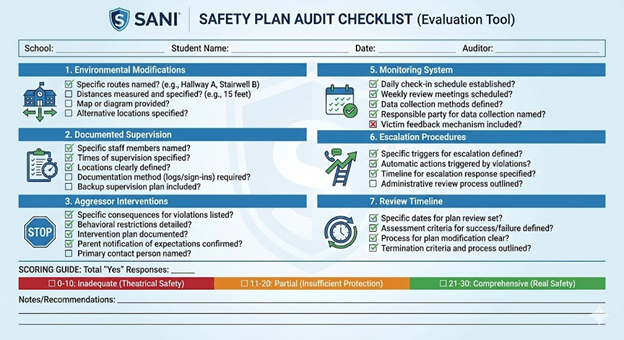
If the school provides a safety plan, audit it using the Seven Components:
Create a Safety Plan Audit Document:
Component | Present? | Specific? | Measurable? | Enforceable? | Score (0-5) | Notes |
1. Environmental Modifications | ☐ Yes ☐ No | ☐ Yes ☐ No | ☐ Yes ☐ No | ☐ Yes ☐ No | __/5 | Example: “Says ‘avoid each other’ – no specific routes” |
2. Documented Supervision | ☐ Yes ☐ No | ☐ Yes ☐ No | ☐ Yes ☐ No | ☐ Yes ☐ No | __/5 |
|
3. Aggressor Interventions | ☐ Yes ☐ No | ☐ Yes ☐ No | ☐ Yes ☐ No | ☐ Yes ☐ No | __/5 |
|
4. Communication Protocol | ☐ Yes ☐ No | ☐ Yes ☐ No | ☐ Yes ☐ No | ☐ Yes ☐ No | __/5 |
|
5. Monitoring System | ☐ Yes ☐ No | ☐ Yes ☐ No | ☐ Yes ☐ No | ☐ Yes ☐ No | __/5 |
|
6. Escalation Procedures | ☐ Yes ☐ No | ☐ Yes ☐ No | ☐ Yes ☐ No | ☐ Yes ☐ No | __/5 |
|
7. Review Timeline | ☐ Yes ☐ No | ☐ Yes ☐ No | ☐ Yes ☐ No | ☐ Yes ☐ No | __/5 |
|
TOTAL SCORE |
|
|
|
| __/35 |
|
Scoring:
If score is below 21, send this reconstruction demand:
Subject: Safety Plan Reconstruction Required – Inadequate Protections
Dear [Administrator]:
I have reviewed the safety plan provided on [DATE]. While I appreciate the effort, the plan lacks essential components required for genuine safety. I am requesting reconstruction of the plan to include all seven components of comprehensive safety planning.
Current Plan Deficiencies:
[List specific gaps, e.g.:]
Requested Reconstruction:
I am requesting a revised written safety plan within 5 business days that includes:
Legal Framework:
Under [STATE EDUCATION CODE], schools have a duty to provide a safe learning environment. Under Davis v. Monroe, schools exhibit deliberate indifference when their response to known harassment is clearly unreasonable. A vague, unenforceable safety plan that provides no actual protection is clearly unreasonable.
Escalation Notice:
If a comprehensive, written safety plan meeting these standards is not provided within 5 business days, I will:
I am requesting a meeting within 3 business days to discuss the reconstructed plan.
Sincerely,
[Your Name]
[Date]
Some schools genuinely don’t know how to create real safety plans. Provide this template:
COMPREHENSIVE SAFETY PLAN TEMPLATE
Student Name: _______________
Date: _______________
Plan Duration: _______________ (Initial: 30 days, reviewed weekly)
Designated Routes:
Bathroom Assignment:
Classroom Arrangements:
Lunch/Cafeteria:
Schedule Modifications:
Location | Staff Member | Time | Documentation Method |
[Hallway B] | [Ms. Rodriguez] | [10:15-10:25] | [Daily log, initials] |
[Cafeteria] | [Mr. Chen] | [11:30-12:00] | [Supervisor checklist] |
[Main entrance] | [Mrs. Johnson] | [7:45-8:15] | [Sign-in sheet] |
Backup supervision plan if assigned staff absent: _______________
Behavioral Expectations for Aggressor(s):
Consequences for Violations:
Active Interventions:
Restrictions:
Primary Contact:
Reporting Methods:
Response Timeline:
Documentation:
Daily Check-Ins:
Weekly Review Meetings:
Data Collection:
Supervision Verification:
Trigger | Action | Responsible Party | Timeline |
Any physical contact | Immediate suspension of aggressor | [Principal] | [Same day] |
Verbal harassment | Parent meeting + consequences | [Assistant Principal] | [Within 24 hours] |
2 violations in 1 week | Plan modification meeting | [Counselor] | [Within 48 hours] |
3 violations in 30 days | Removal/transfer recommendation | [Principal] | [Within 1 week] |
Plan Modification Process:
Initial Period:
Regular Reviews:
Assessment Criteria:
Plan Termination:
SIGNATURES
School Representative: _______________ Date: _______________
Parent: _______________ Date: _______________
Student (if appropriate): _______________ Date: _______________
NEXT REVIEW DATE: _______________
Once a real plan exists, monitor compliance:
Create a Safety Plan Compliance Tracker:
Date | Plan Element | Implemented? | Evidence | Violations Noted |
10/5 | Daily 8:15 AM check-in | YES | Check-in log reviewed | None |
10/6 | Ms. Rodriguez hallway supervision 10:15-10:25 | NO | My child reports Ms. Rodriguez not present | Violation documented, reported to principal |
10/7 | Aggressor stayed away from Table 7 | YES | My child confirms | None |
Report compliance failures immediately and document them as safety plan violations.
If the plan is not being implemented or is ineffective:
Subject: Safety Plan Violation – Immediate Modification Required
Dear [Administrator]:
The safety plan dated [DATE] is not being implemented as written. I am documenting the following violations:
Violation 1:
Plan requires: [Specific element]
Actual implementation: [What actually happened]
Date/time: [When]
Violation 2:
[Continue for each violation]
Additionally, despite plan implementation, my child experienced [X] incidents of harassment on [DATES], demonstrating the plan is inadequate.
I am requesting an emergency safety plan modification meeting within 2 business days to:
If meeting is not scheduled and plan not modified within 3 business days, I will escalate with documentation of plan failures as evidence of deliberate indifference.
Sincerely,
[Your Name]
Real safety plans are specific, measurable, enforceable, and documented. They answer:
• Who: specific staff names responsible for actions
• What: exact actions to keep the child safe
• When: specific times for monitoring or intervention
• Where: precise locations of supervision or restricted areas
• How: method of documentation for incidents
• What If: escalation triggers if plan fails
Fake plans use vague language such as “staff will watch” or “we’ll monitor,” without specifics, enforceability, or accountability.
Yes. Many schools lack expertise in creating comprehensive safety plans. Providing a template gives them a starting point.
• The school must agree to implement it and formally sign off.
• Your template serves as a negotiation starting point, not an imposed solution.
If the school genuinely cannot ensure your child’s safety, they must offer alternatives:
• Transfer the aggressor(s) to a different school
• Transfer the victim to a different school (last resort, with parental consent)
• Provide virtual or homebound instruction until safety is ensured
• Acknowledge in writing they cannot provide a safe environment (creates legal liability)
Document their admission—this strengthens any future claims.
Typical timeline:
• Initial period: 30 days with weekly reviews
• If successful: continue with monthly reviews
• Until: no incidents for 60 consecutive days + victim feels safe
• Post-termination monitoring: 30 days to ensure safety is maintained
Plans should not be ended prematurely just because “things seem okay.”
Safety plan violations are evidence of:
• Breach of duty (committed actions but failed to implement)
• Deliberate indifference (knew plan was necessary but ignored it)
• Bad faith (appearance of safety without substance)
Document every violation and escalate immediately. Multiple violations may justify:
• Demand for alternative placement
• OCR complaint
• Legal action using the plan as evidence of negligence
Yes—and this should be prioritized. The victim should not bear the burden of safety planning. Demand aggressor removal first:
• Transfer to a different school
• Alternative placement
• Suspension during investigation
• Homebound instruction for the aggressor
If the school refuses, ask: “Why is the victim being restricted while the aggressor faces no consequences?”
Yes. Safety planning must be incorporated into IEPs or 504 Plans:
• Address safety concerns during IEP/504 meetings
• Safety plan becomes part of legally enforceable education plan
• Failure to implement violates FAPE (Free Appropriate Public Education)
• Additional protections and enforcement mechanisms apply
Linking the safety plan to an IEP/504 dramatically strengthens enforcement.
If you want student harm treated like a school safety and civil rights issue—start with SANI at https://saninstitute.net
The Student Advocacy Network Institute (SANI) is a national research, accountability, and discipline institute founded by Bullying Is A Drug to define, document, and address institutional failure in K–12 education—treating student harm as a school safety and civil rights issue.
Explore the Institute:
https://saninstitute.net
Parent A: Accepts Fake Safety Plan (Fails)
A seventh-grader reports being harassed and threatened by a group of students. After investigation (which itself was inadequate), the assistant principal presents the “safety plan”:
“We’ve talked to all the students involved. They’ve agreed to keep their distance and be respectful. Our staff will monitor the situation and make sure everyone feels safe. We’ll check in with your son periodically. If anything else happens, please let us know.”
Parent, relieved that “something” is being done: “Thank you. I appreciate you taking this seriously.”
Two weeks later: The harassment continues in bathrooms, at lunch, during class transitions—all the places where “monitoring” doesn’t actually happen.
Parent calls school: “The safety plan isn’t working.”
Assistant principal: “We’re continuing to monitor. These situations take time.”
One month later: The harassment escalates to physical assault.
Parent discovers the “safety plan” consisted of:
The plan was empty words with zero enforcement. The harassment continued because nothing actually changed in the school environment.
Parent B: Demands Real Safety Plan (Succeeds)
Same initial scenario. Assistant principal presents vague plan: “We’ll monitor and check in periodically…”
Parent’s response:
“Thank you for addressing this, but I need a more specific safety plan. The terms ‘monitor,’ ‘periodically,’ and ‘keep their distance’ are not measurable or enforceable. I’m requesting a written safety plan that includes:
I’m requesting this written plan within 3 business days. If the school cannot provide these specifics, I need to know what is preventing comprehensive safety planning so I can escalate appropriately.”
School’s response (48 hours later):
A three-page written safety plan with:
Result: Specific, measurable, enforceable protection. When aggressors violated the plan (attempted contact in hallway), they were immediately suspended. Plan was modified after 30 days to gradually reintroduce normal schedule as harassment stopped.
The difference: Parent B demanded real safety and rejected theatrical promises.
Table of Contents Click to Expand 1. Audio 2. Definition 3. Video 4. Core Thesis 5. Case Pattern Story 6. SANI Connection 7. Discipline Explanation
Table of Contents Click to Expand 1. Audio 2. Definition 3. Video 4. Core Thesis 5. Case Pattern Story 6. SANI Connection 7. Discipline Explanation
Table of Contents Click to Expand 1. Audio 2. Definition 3. Video 4. Core Thesis 5. Case Pattern Story 6. SANI Connection 7. Discipline Explanation
Table of Contents Click to Expand 1. Audio 2. Definition 3. Video 4. Core Thesis 5. Case Pattern Story 6. SANI Connection 7. Discipline Explanation