

The documentation gap: when “no records” becomes the district’s defense
Table of Contents Click to Expand 1. Audio 2. Definition 3. Video 4. Core Thesis 5. Case Pattern Story 6. SANI Connection 7. Discipline Explanation
1. Audio
2. Definition
3. Video
4. Core Thesis
9. Action Steps
10. FAQs
11. Call to Action
12. Sources
13. Signature
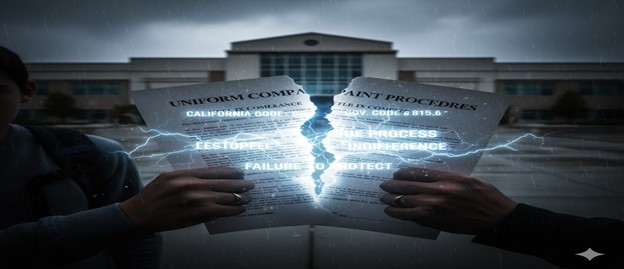
Procedural failure as liability occurs when California school districts violate their own written policies, procedures, or protocols governing harassment investigations, safety responses, incident documentation, complaint resolution, or student protections—creating independent legal claims beyond the underlying harm because California courts recognize that when districts adopt formal procedures (in board policies, student handbooks, safety plans, or administrative regulations), those procedures create enforceable rights and legitimate expectations that students and families can rely upon, with violations constituting: breach of mandatory duty under California Government Code Section 815.6, denial of due process under the Fourteenth Amendment when procedural violations deprive students of protected interests, evidence of deliberate indifference under Title VI/Title IX/Section 504 when policy violations demonstrate unreasonable response despite actual knowledge, estoppel preventing districts from defending failures by claiming they “weren’t required” to follow policies they voluntarily adopted, and consciousness of wrongdoing when systematic policy violations prove districts understood proper procedures but chose to circumvent them to avoid accountability.
Under California law, procedural failures transform what might be discretionary decisions into mandatory duty violations with direct causation to harm—meaning when districts fail to follow their own 24-hour investigation timeline, fail to notify parents as their policy requires, fail to implement safety plans their handbook promises, or fail to document incidents their regulations mandate, they create independent liability for those procedural violations even if the underlying substantive claim (negligence, harassment) is disputed, making procedural compliance documentation one of the most powerful litigation and enforcement tools available because it proves the district knew what proper response looked like, wrote it down as binding policy, then deliberately chose not to follow it—demonstrating bad faith, conscious indifference, and institutional prioritization of self-protection over student safety.
California school districts publish detailed policies, procedures, and timelines governing how they will respond to harassment, bullying, safety threats, and discrimination—creating binding commitments that courts enforce—yet systematically violate these self-imposed rules when actually responding to incidents, betting that families won’t obtain the policies, won’t compare district conduct to written requirements, and won’t understand that procedural violations create independent liability even when underlying harm is difficult to prove. We convert trauma into code by obtaining every applicable policy (board policies, administrative regulations, student handbooks, safety plans, complaint procedures), creating side-by-side comparisons of what the policy required versus what the district actually did, and documenting each procedural violation with timestamps proving the district failed to meet its own mandatory deadlines, notification requirements, investigation standards, or safety protocols. Selective enforcement IS discrimination when California districts scrupulously follow procedures for certain students (wealthy, white, connected families receive investigations within 24 hours, written updates, safety plans exactly as policies require) while systematically violating the same procedures for Black, Latino, disabled, or immigrant students (no investigation, no timeline, no notifications), proving procedural failures are not resource constraints but deliberate choices about whose safety matters and whose complaints warrant policy compliance. This article proves that procedural failure is not “technical violation” or “harmless error”—it is substantive evidence of bad faith, creates independent causes of action under California law, establishes deliberate indifference for federal civil rights claims, and provides the clearest, most provable path to liability because unlike contested factual disputes about what happened, procedural violations are documented: the policy says X, the district did Y, the violation is undeniable and creates direct liability.
The Student Advocacy Network Institute (SANI) is a Policy-Driven Student Safety Agency that identifies procedural failures as self-inflicted institutional liability—the most provable form of district wrongdoing because unlike contested factual disputes, procedural violations are documented: the policy says one thing, the district did another, and no factual dispute can obscure that violation.
SANI teaches parents to obtain every applicable policy before or immediately after reporting incidents: board policies on harassment/discrimination/bullying, administrative regulations implementing those policies, student/parent handbooks with complaint procedures, safety plans with specific timelines, and Title IX/504 procedures. SANI then creates policy compliance matrices—side-by-side comparisons showing what each policy required, what date the district was required to act by, and what the district actually did—making violations undeniable and creating evidence that judges, OCR investigators, and juries can understand immediately without complex legal or factual analysis.
SANI’s enforcement work centers safety and civil rights, not procedural compliance for its own sake. Procedural violations matter because they prove districts knew what proper response looked like (they wrote it down), understood the timelines required (they published them), and chose to violate their own rules—demonstrating that inadequate response was not mistake or resource constraint but conscious choice to prioritize institutional convenience over student safety, particularly when procedural compliance varies by student demographics.

Procedural failure as liability operates through multiple intersecting legal frameworks in California, creating both independent causes of action and evidence strengthening underlying substantive claims.
Statute: “Where a public entity is under a mandatory duty imposed by an enactment that is designed to protect against the risk of a particular kind of injury, the public entity is liable for an injury of that kind proximately caused by its failure to discharge the duty…”
Application to Schools:
When California school districts adopt policies governing harassment investigations, safety responses, or complaint procedures, those policies can create “mandatory duties” if they:
Example:
Board Policy states: “Upon receiving harassment complaint, principal shall immediately investigate and complete investigation within 10 school days.”
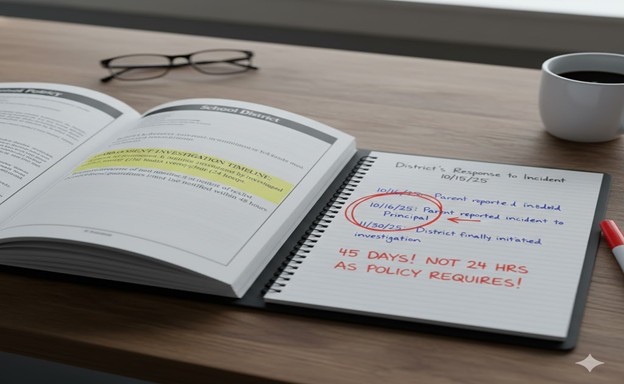
This creates mandatory duty. If principal waits 45 days to investigate, allowing harassment to continue, the delay violates mandatory duty and creates liability under Section 815.6.
Critical Distinction:
“Shall” = mandatory (creates duty) “May” = discretionary (no mandatory duty) “Should” = aspirational (generally no mandatory duty unless context shows it’s binding)
Under federal civil rights laws, schools violate Title VI, Title IX, and Section 504 when they respond to known harassment with “deliberate indifference”—defined as response that is “clearly unreasonable in light of the known circumstances.”
How Procedural Violations Prove Deliberate Indifference:
The district’s own policies define what “prompt and effective response” looks like. When districts violate their own procedures, they prove their response was unreasonable by their own standards.
Example:
Title IX policy requires investigation within 60 days. District takes 120 days. District cannot argue its response was “reasonable” when it violated its own 60-day timeline that it established as the reasonable response period.
California Authority:
California Education Code Section 234.1 (Safe Place to Learn Act) requires districts to adopt policies prohibiting harassment and bullying. Courts interpret systematic violation of these self-imposed policies as evidence supporting deliberate indifference claims.
When districts create formal procedures, students and families develop legitimate expectations that those procedures will be followed. Arbitrary denial of those procedures without justification violates procedural due process.
Requirements:
Example:
Student handbook promises: “Students accused of harassment will receive written notice of allegations and opportunity to respond before discipline imposed.”
If school suspends student without notice or hearing, that violates procedural due process even if student ultimately did commit the alleged conduct.
Doctrine: When districts make specific commitments in writing (policies, handbooks, safety plans), they cannot later disclaim those commitments to avoid liability.
Application:
District cannot argue “we weren’t legally required to investigate within 60 days” when its own policy says “shall complete investigation within 60 days.” The district is estopped (prevented) from claiming the timeline was voluntary when it published it as a binding commitment.
Student handbooks and enrollment agreements can create contractual obligations. When schools promise specific protections or procedures and fail to provide them, students may have breach of contract claims—though California courts are divided on whether public school handbooks create enforceable contracts.
More Reliable in:
California law imposes extensive procedural obligations on schools, creating numerous opportunities for procedural violation claims:
California Education Code Section 234.1 – Safe Place to Learn Act
Requires districts to adopt policies prohibiting discrimination, harassment, intimidation, and bullying. Policies must include:
Violation: When districts adopt these policies (as required) but fail to follow them, they violate both the Education Code and create Section 815.6 mandatory duty liability.
California Code of Regulations, Title 5, Section 4621 – Uniform Complaint Procedures
Requires districts to investigate complaints alleging:
Mandatory Timelines:
Violation: Failure to meet these timelines creates independent violation of Title 5 regulations, appealable to California Department of Education.
California Education Code Section 48900 et seq. – Discipline Procedures
When districts suspend or expel students, they must provide:
Violation: Suspending without proper notice violates Education Code and creates due process violation.
Title IX Procedures (34 CFR § 106.45)
Federal regulations require specific procedures for investigating sexual harassment under Title IX, including:
Violation: California schools violating these procedures face OCR enforcement and potential loss of federal funding, plus civil liability.
Category 1: Investigation Timeline Violations
Policy Requirement: “Shall complete investigation within [X] days”
Common Violations:
Liability: Delays allow harm to continue; prove response was not “prompt” under Title IX; create mandatory duty violation under Section 815.6.
Category 2: Notification Failures
Policy Requirement: “Shall notify complainant of investigation outcome within [X] days”
Common Violations:
Liability: Prevents complainant from exercising appeal rights; violates due process; proves deliberate indifference when delays are systematic.
Category 3: Documentation Failures
Policy Requirement: “Shall document all harassment complaints in incident report”
Common Violations:
Liability: Spoliation when destruction occurs after notice of claim; prevents pattern recognition required for Title IX/VI compliance; violates mandatory duty to document.
Category 4: Safety Plan Implementation Failures
Policy Requirement: “Shall implement safety plan including [specific measures] within [X] days”
Common Violations:
Liability: Direct causation when policy violation allows harm to continue; proves inadequate response under Title IX.
Category 5: Appeal Rights Violations
Policy Requirement: “Complainant may appeal within [X] days; district shall respond within [X] days”
Common Violations:
Liability: Due process violation; Title 5 regulation violation; proves bad faith when districts ignore their own appeal procedures.
Step 1: Obtain All Applicable Policies
Before or immediately after incident, obtain:
Board Policies:
Administrative Regulations:
Handbooks:
Other:
How to Obtain:
Step 2: Create Policy Compliance Matrix
Build a table with columns:
Policy Requirement | Citation | Required Timeline | Actual District Action | Violation? | Evidence |
Example Entry:
Policy Requirement | Citation | Required Timeline | Actual District Action | Violation? | Evidence |
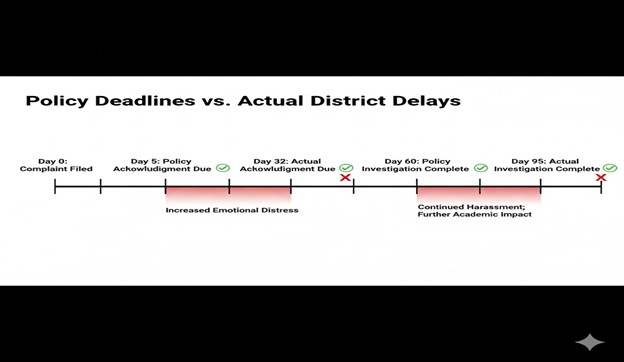
Acknowledge complaint within 5 business days | AR 5145.7, ¶3 | Within 5 business days of receipt | No acknowledgment received for 32 days | YES | Parent’s complaint dated 10/1; first response dated 11/2 (32 days) |
Step 3: Document Each Violation with Evidence
For each procedural violation, gather:
Step 4: Present Violations in Complaints/Litigation
Procedural violations should be:
Basis for requesting adverse inference or sanctions
This framework ensures parents can identify, document, and weaponize districts’ violations of their own policies to create independent liability and prove bad faith.
Immediately after filing complaint or reporting serious incident, request in writing: “Please provide all board policies, administrative regulations, handbooks, and procedures governing: harassment investigations, bullying response, Title IX complaints, safety planning, incident documentation, and complaint resolution. I am requesting these under California Public Records Act.” Also download policies from district website. This ensures you know what procedures the district committed to follow before they can claim policies “don’t apply” or were “updated.”
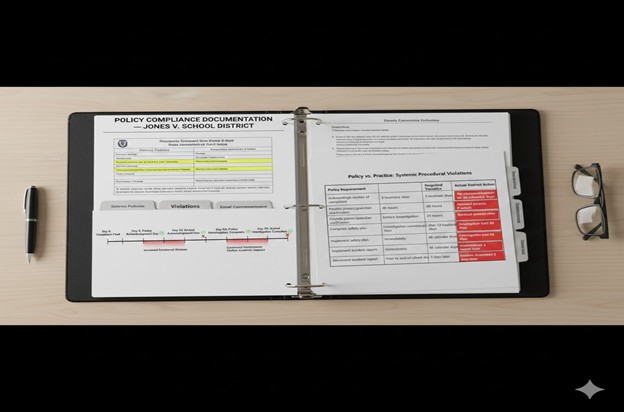
Build a spreadsheet or table with columns: Policy Requirement (exact quote), Policy Citation (BP/AR number and section), Required Timeline (when district must act by), Actual District Action (what they did), Date of Action (when they did it), Violation (yes/no), Evidence (documentation proving violation). Update this matrix after every district communication or inaction. This visual comparison makes violations undeniable and creates powerful exhibit for complaints/litigation.
When district violates procedural requirement, immediately send email: “Your [Board Policy/AR/Handbook] Section [X] requires [specific action] within [timeline]. As of today, [X days] have elapsed without [required action]. This violates your written policy and creates: (1) breach of mandatory duty under Government Code Section 815.6, (2) evidence of deliberate indifference under Title IX, (3) denial of due process. Please immediately [comply with policy requirement] and provide written explanation for violation by [date 48 hours out].”
For each procedural violation, document direct causation: “District’s 60-day delay in completing investigation (violating 30-day policy requirement) allowed harassment to continue for additional 30 days during which [X incidents occurred, student missed Y days of school, student’s grades dropped from A to D].” This proves procedural violations aren’t “harmless technical errors” but substantive failures with direct harmful consequences.
In OCR complaints, California Uniform Complaints, and litigation, include: (1) Separate cause of action for mandatory duty violation under Government Code Section 815.6, (2) Procedural violations as evidence of deliberate indifference in Title VI/IX/504 claims, (3) Due process violations when procedures created legitimate expectations, (4) Request for adverse inference based on systematic procedural violations proving bad faith. Attach policy compliance matrix as exhibit proving violations are documented, not disputed.
Immediately send email or written request to school/district: “I am requesting under California Public Records Act all board policies, administrative regulations, student/parent handbooks, and procedures governing: harassment/bullying investigations, Title IX complaints, safety planning, incident reporting, complaint procedures, and timeline requirements. Please provide within 10 business days per Public Records Act.” Simultaneously download any policies available on district website. This ensures you have written requirements before they can be changed or claimed irrelevant.
Build a simple table or spreadsheet with these columns: What Policy Required, Citation (policy number/section), When District Should Have Acted (specific date based on policy timeline), What District Actually Did, When District Acted (actual date), Days Late/Violation, Evidence. Fill in one row for each policy requirement. Update after every interaction. This visual comparison makes violations obvious to anyone reading it—judges, OCR investigators, juries need no legal expertise to see “policy required action by Day 10, district acted on Day 45.”
The moment a policy deadline passes without district compliance, send email: “Your Board Policy [X] Section [Y] requires [specific action] within [timeline]. Today is [date], [Z] days after the deadline. You have violated your written policy. This violation: (1) creates mandatory duty breach under California Government Code Section 815.6, (2) proves deliberate indifference under Title IX, (3) denies due process. Immediately [comply with requirement] and provide written explanation for violation by [date 48 hours out].”
For every procedural violation, write explicit causation statement: “District’s failure to complete investigation within policy-required 30 days (actual: 67 days) allowed harassment to continue for additional 37 days during which: 5 additional incidents occurred [list dates], student missed 8 school days [dates], student developed anxiety requiring medication [medical records attached], student’s GPA dropped from 3.8 to 2.1 [report cards attached].” This proves violations caused measurable harm, not “harmless error.”
When filing OCR complaints, California Uniform Complaints, or lawsuits, structure to include: (1) “Mandatory Duty Violation (California Government Code Section 815.6)” as separate cause of action listing each policy violation, (2) “Evidence of Deliberate Indifference” section in Title IX/VI/504 claims citing procedural violations as proof of unreasonable response, (3) “Denial of Procedural Due Process” if applicable, (4) Attach policy compliance matrix as Exhibit A. Courts and OCR cannot ignore documented policy violations—they’re the clearest form of proof.
Districts systematically avoid documentation to eliminate evidence that could prove actual knowledge of safety issues, inadequate responses, broken promises, patterns of harassment, civil rights violations, and deliberate indifference. Written records can be subpoenaed, requested under Open Records Acts, and used to establish district liability. By keeping communications verbal and avoiding incident reports, districts later claim “we weren’t aware,” “we never promised that,” or “no pattern exists.”
No law requires schools to provide written confirmation of every statement, but refusal becomes evidence of bad faith when combined with later denials. Parents can create written records unilaterally by sending confirmation emails. When schools fail to correct a parent’s written summary, their silence confirms accuracy. Additionally, Title IX, IDEA, and Section 504 require written notice for specific actions, making refusal to document potential violations of federal law.
Within two hours, send a confirmation email: “This confirms our conversation today at [time]. You stated you would [specific action]. You committed to [timeline]. I requested [your request]. Please confirm this summary or provide corrections by [date].” If they do not respond or correct it, their silence confirms your summary’s accuracy. Preserve the email as proof of notice.
Schools may claim this, but it creates serious legal exposure. Non-documentat
If you want student harm treated like a school safety and civil rights issue—start with SANI at https://saninstitute.net
A Latina student with a disability in Los Angeles Unified School District reports being sexually harassed by a classmate. Her mother files a formal Title IX complaint with the school’s designated coordinator.
LAUSD’s Board Policy 5145.7 states:
“Upon receipt of a complaint alleging sexual harassment, the Title IX Coordinator shall immediately investigate or assign the complaint for investigation. The investigation shall be completed within 60 calendar days unless extended for good cause. The complainant shall receive written notice of the investigation outcome within 10 days of completion.”
LAUSD’s Administrative Regulation 5145.7 further specifies:
“The Title IX Coordinator shall acknowledge receipt of the complaint in writing within 5 business days, provide the complainant with a copy of the complaint procedures, and notify the complainant of the investigator’s name and contact information.”
The mother receives no acknowledgment. After two weeks, she emails requesting an update. No response.
After one month, she calls the Title IX Coordinator, who says: “We’re looking into it. These things take time.”
After 90 days—30 days past the policy deadline—the mother still has no written acknowledgment, no investigator name, no timeline, no updates. The harassment continues daily.
The mother retains an attorney who immediately files a California Uniform Complaint and notifies the district:
“LAUSD has violated its own Board Policy 5145.7 and Administrative Regulation 5145.7 in the following ways:
These procedural violations constitute:
– Independent breach of mandatory duty under California Government Code Section 815.6
– Evidence of deliberate indifference under Title IX (district’s own policy defines what ‘prompt and effective’ response looks like; district failed to meet its own standard)
– Denial of due process under Fourteenth Amendment (policy created legitimate expectation of timely response)
– Estoppel (district cannot claim investigation was adequate when it violated every procedural requirement it established)
Your procedural failures are not ‘harmless technical violations’—they allowed harassment to continue for 90+ days despite your own written commitment to respond within 60 days.”
The district’s attorney reviews the policies and realizes the procedural violations are undeniable—they’re documented in the district’s own timelines. The attorney attempts to argue: “These policies are aspirational, not mandatory.”
The mother’s attorney responds: “California courts have repeatedly held that when districts adopt written policies, they create mandatory duties enforceable under Government Code Section 815.6. Your Board Policy doesn’t say ‘we aspire to investigate within 60 days’—it says ‘shall investigate’ and ‘shall complete within 60 days.’ That’s mandatory language creating binding obligation.”
During settlement negotiations, discovery reveals internal emails showing the Title IX Coordinator received the complaint the day it was filed, assigned it to an investigator within one week, but the investigator never contacted witnesses, never interviewed the accused student, and produced a one-paragraph “summary” concluding “insufficient evidence” after 90 days—violating not just timelines but also the policy’s requirement for “thorough investigation including interviews of complainant, witnesses, and accused.”
The record breaks when the mother’s attorney obtains LAUSD’s investigation files for 50 other Title IX complaints from the same year. The analysis reveals:
Students from affluent zip codes (Pacific Palisades, Brentwood, Manhattan Beach):
Students from low-income zip codes with high populations of color (South LA, East LA, Watts):
This data proves LAUSD’s procedural failures are not resource constraints—they are selective enforcement based on race, ethnicity, and socioeconomic status.
The case settles for significant damages. LAUSD enters into a consent decree requiring: (1) compliance monitoring for Title IX procedures, (2) quarterly reporting on investigation timelines by school demographics, (3) training for all Title IX coordinators, (4) sanctions for staff who violate procedural timelines, and (5) compensatory services for the student.
Table of Contents Click to Expand 1. Audio 2. Definition 3. Video 4. Core Thesis 5. Case Pattern Story 6. SANI Connection 7. Discipline Explanation
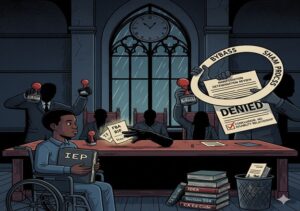
Table of Contents Click to Expand 1. Audio 2. Definition 3. Video 4. Core Thesis 5. Case Pattern Story 6. SANI Connection 7. Discipline Explanation
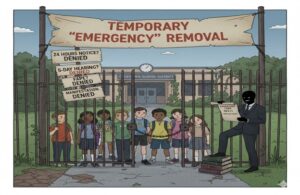
Table of Contents Click to Expand 1. Audio 2. Definition 3. Video 4. Core Thesis 5. Case Pattern Story 6. SANI Connection 7. Discipline Explanation
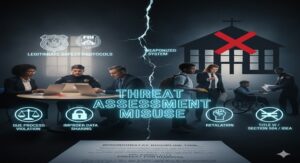
Table of Contents Click to Expand 1. Audio 2. Definition 3. Video 4. Core Thesis 5. Case Pattern Story 6. SANI Connection 7. Discipline Explanation