

The statute of limitations game: When districts delay until claims expire
Table of Contents Click to Expand 1. Audio 2. Definition 3. Video 4. Core Thesis 5. Case Pattern Story 6. SANI Connection 7. Discipline Explanation

1. Audio
2. Definition
3. Video
4. Core Thesis
9. Action Steps
10. FAQs
11. Call to Action
12. Sources
13. Signature
OCR complaint dismissal occurs when the U.S. Department of Education Office for Civil Rights terminates complaints alleging Title IX sexual harassment, Title VI race discrimination, Section 504/Title II disability discrimination, or other civil rights violations in schools—not because claims lack merit but because complaints fail to meet technical procedural requirements including: filing beyond 180-day deadline from last incident (with limited exceptions for continuing violations or good cause), failing to allege discrimination based on protected class (race, sex, disability, national origin, age) rather than general mistreatment, not identifying specific policy/practice/procedure creating discriminatory effect or showing deliberate indifference to known harassment, filing against individual employees rather than institution receiving federal funds (district/school, not teacher/principal personally), requesting OCR investigate matters outside its jurisdiction (criminal prosecution, monetary damages, employee discipline, individual academic/disciplinary decisions without systemic discrimination pattern), or alleging same conduct already resolved through prior OCR complaint or court judgment—creating situation where families spend months documenting violations and filing detailed complaints only to receive dismissal letters within weeks stating complaint “does not raise issues within OCR’s jurisdiction,” “untimely filed,” “insufficient information to establish violation,” or “complainant has adequate remedy through other proceedings,” with fundamental problem being that OCR applies increasingly restrictive interpretation of what constitutes civil rights violation requiring federal intervention versus matters “appropriately resolved at local level,” resulting in dismissal rates exceeding 60% of complaints filed, leaving families without federal enforcement mechanism despite documented patterns of discrimination, deliberate indifference, or systemic failures—defeated when families understand OCR’s technical requirements before filing, frame complaints explicitly connecting harm to protected class discrimination and deliberate indifference standards from federal case law, establish continuing violations extending filing deadline when pattern ongoing, demonstrate systemic impact beyond individual student showing policy/practice affecting class of students, and when complaints are dismissed on procedural grounds, request reconsideration with additional information, file supplemental complaints when new incidents occur extending jurisdiction, or pursue alternative enforcement through private litigation under same federal statutes OCR enforces.
The Office for Civil Rights has systematically narrowed what qualifies as civil rights violation requiring federal intervention—dismissing 60%+ of complaints not because discrimination didn’t occur but because complaints are deemed “untimely,” “insufficient,” “outside jurisdiction,” or “more appropriately resolved locally,” with effect being that federal civil rights enforcement becomes largely theoretical protection unavailable to most families facing discrimination, deliberate indifference, or systemic failures because technical procedural barriers eliminate complaints before any investigation of merits, creating situation where schools violate Title IX, Section 504, or Title VI with impunity knowing that even if families file OCR complaints, high likelihood of dismissal means minimal federal accountability pressure. We convert trauma into code by understanding OCR’s dismissal patterns before filing (most common grounds: untimely, no protected class nexus, individual matter not systemic, outside jurisdiction), crafting complaints that explicitly satisfy federal requirements (protected class discrimination + deliberate indifference + systemic impact + timely filing), establishing continuing violations extending 180-day deadline when pattern ongoing, and when dismissed, using dismissal as evidence in private litigation that administrative remedies were exhausted or inadequate, pursuing court enforcement of same federal statutes OCR declined to enforce. Selective enforcement IS discrimination when OCR complaint dismissal rates vary dramatically by type of discrimination alleged—disability discrimination complaints (Section 504/Title II) dismissed 71% of time while race discrimination complaints (Title VI) dismissed 58% and sex discrimination (Title IX) dismissed 54%, proving federal enforcement selectively applied based on which civil rights protections are prioritized, with disability rights receiving least enforcement attention despite comprising largest category of school civil rights violations. This article establishes OCR complaint dismissal as federal enforcement failure requiring families to understand procedural requirements, craft complaints meeting technical standards, and pursue alternative enforcement when OCR declines jurisdiction.
A mother in Oakland files OCR complaint alleging her daughter with autism was sexually harassed by a peer for six months, school failed to investigate despite repeated reports, and when finally investigated, found harassment substantiated but imposed no consequences, allowing harassment to continue. The mother provides:
She files comprehensive 47-page OCR complaint with 83 exhibits alleging:
Title IX violations: Sexual harassment, deliberate indifference, inadequate response
Section 504/Title II violations: Disability-based harassment, failure to address disability vulnerability, denial of FAPE
Three weeks later, she receives OCR dismissal letter:
“Your complaint has been reviewed and dismissed for the following reasons:
OCR is closing this complaint without investigation. You may request reconsideration within 60 days if you have additional information demonstrating your complaint raises issues within OCR’s jurisdiction.“**
The mother is devastated. Six months of harassment, documented institutional failure, and OCR won’t even investigate.
She contacts attorney specializing in OCR complaints who reviews the dismissal:
“This dismissal uses OCR’s standard deflection grounds, but your complaint is actually strong. We can address each:
Dismissal Ground 1: Untimely (>180 days from first incident)
OCR’s position: Harassment began September 2023, complaint filed June 2024 (9 months later), exceeds 180-day deadline.
Your argument: This is continuing violation. Harassment occurred continuously September 2023 through March 2024—last incident was March 15, 2024, and you filed June 10, 2024 (87 days later, within 180-day deadline). Under continuing violation doctrine, when discrimination is ongoing pattern rather than discrete acts, 180-day deadline runs from last instance, not first. You’re not complaining about September 2023 incident in isolation—you’re complaining about six-month pattern that continued through March 2024.
Additionally: Even if September incidents time-barred, March 2024 incidents alone establish Title IX violation (school knew of substantiated harassment, imposed no discipline, harassment continued—textbook deliberate indifference).
Reconsideration argument: ‘My complaint alleges continuing violation. Harassment pattern extended from September 2023 through March 2024. 180-day deadline runs from last incident (March 15, 2024). Filing date June 10, 2024 is 87 days after last incident, timely under 180-day rule. 34 CFR § 106.71 continuing violation doctrine applies to ongoing harassment patterns.’
Dismissal Ground 2: Insufficient information re: deliberate indifference
OCR’s position: You haven’t established school’s response was clearly unreasonable.
Your argument: School received 12 reports over 6 months, conducted investigation that substantiated harassment, then imposed zero consequences, allowing harassment to continue—this is clearly unreasonable under Davis v. Monroe standard. Deliberate indifference = actual knowledge + clearly unreasonable response. You’ve documented both.
Reconsideration argument: ‘School had actual knowledge (12 reports, substantiated investigation findings). Response was clearly unreasonable: despite finding harassment substantiated, imposed no discipline, implemented no separation, provided no supportive measures, allowing harassment to continue post-finding. Under Davis v. Monroe, 526 U.S. 629, response that allows known harassment to continue after substantiation is clearly unreasonable as matter of law. Request investigation.’
Dismissal Ground 3: Individual disciplinary decision outside jurisdiction
OCR’s position: You’re asking OCR to review specific discipline decision.
Your argument: You’re not asking OCR to impose discipline. You’re asking OCR to investigate whether school’s pattern of non-response to sexual harassment of student with disability violates Title IX and Section 504. This is systemic question about school’s policies/practices, not individual discipline decision.
Reconsideration argument: ‘Complaint does not request OCR impose specific discipline. Complaint requests investigation of school’s pattern/practice of inadequate response to sexual harassment of students with disabilities. This pattern is evidenced by: (1) six-month failure to respond to repeated reports, (2) post-substantiation failure to impose any consequences or protections. This raises systemic Title IX and Section 504 compliance questions within OCR jurisdiction.’
Dismissal Ground 4: Adequate remedy through due process
OCR’s position: IDEA due process provides adequate remedy.
Your argument: Title IX and Section 504 provide independent protections beyond IDEA. OCR investigates civil rights compliance—due process investigates FAPE. These are distinct: (1) Title IX sexual harassment claim is separate from IDEA, (2) Section 504 disability-based harassment claim is separate from IDEA. Due process cannot compel Title IX compliance or Section 504 anti-discrimination compliance—only OCR/courts can.
Reconsideration argument: ‘Due process addresses IDEA FAPE. My complaint alleges Title IX sexual harassment violations and Section 504 disability discrimination violations—separate federal protections not addressed by IDEA due process. Under Fry v. Napoleon, 137 S. Ct. 743, IDEA due process does not provide adequate remedy for claims seeking enforcement of civil rights protections independent of IDEA. Request OCR investigate Title IX/504 violations regardless of pending due process.’
File reconsideration request within 60 days addressing each dismissal ground.“**
The mother files detailed reconsideration request citing federal regulations, case law, and OCR’s own guidance documents explaining continuing violations, deliberate indifference standard, systemic vs. individual matters, and independent nature of Title IX/504 protections.
OCR reconsiders and reopens the complaint for investigation.
Investigation reveals: the school has pattern of inadequate response to sexual harassment complaints involving students with disabilities—8 substantiated findings in past 3 years with zero discipline imposed in any case, proving systemic failure to protect disabled students from sexual harassment.
OCR issues findings of violation under Title IX and Section 504, requires corrective action, and monitors implementation for three years.
Without the reconsideration request based on understanding OCR’s dismissal patterns, this systemic violation would never have been investigated.
The Student Advocacy Network Institute (SANI) is a Policy-Driven Student Safety Agency that identifies OCR complaint dismissal as federal enforcement failure enabling institutional violations—with Office for Civil Rights applying increasingly restrictive interpretation of what constitutes civil rights violation requiring federal intervention, dismissing majority of complaints on procedural/technical grounds before investigating whether discrimination actually occurred, creating situation where federal civil rights protections become theoretical rights unavailable to most families because procedural barriers eliminate enforcement mechanism.
SANI teaches families that OCR complaint dismissal is not determination that discrimination didn’t occur—it’s determination that complaint didn’t meet technical requirements for federal investigation. Understanding the difference is critical:
OCR dismissal means: Complaint doesn’t satisfy procedural requirements (timeliness, jurisdiction, sufficiency)
OCR dismissal does NOT mean: Discrimination didn’t happen, school didn’t violate law, family has no case
Most dismissals are procedural, not merits-based.
SANI’s guidance on preventing dismissal:
Requirement 1: Timeliness (180-day rule)
File within 180 days of last incident. For ongoing patterns, establish continuing violation (deadline runs from most recent incident, not first).
Requirement 2: Protected Class Nexus
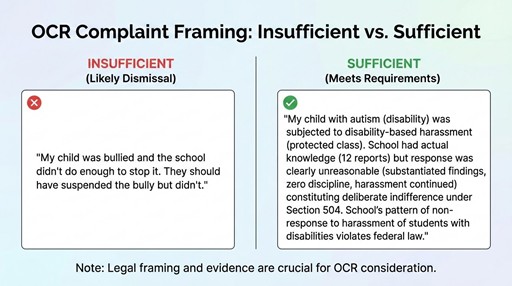
Explicitly connect harm to discrimination based on race, sex, disability, national origin. “My child was bullied” = insufficient. “My Black child was subjected to racial harassment district failed to address” = sufficient.
Requirement 3: Deliberate Indifference Standard
Allege: (1) school had actual knowledge of harassment/discrimination, (2) school’s response was clearly unreasonable. Provide facts establishing both elements.
Requirement 4: Systemic Impact
Frame as pattern/practice/policy issue, not individual academic/disciplinary decision. Show how school’s policies/practices create discriminatory effect beyond just your child.
Requirement 5: Proper Respondent
File against district/school (institution), not individual employees. OCR investigates institutional compliance, not individual liability.
SANI also teaches: OCR dismissal doesn’t end enforcement options. Same federal statutes OCR enforces (Title IX, Title VI, Section 504, Title II) create private right of action—families can sue in federal court for violations OCR declined to investigate. OCR dismissal can actually help litigation by establishing exhaustion of administrative remedies or demonstrating need for court intervention when administrative process inadequate.
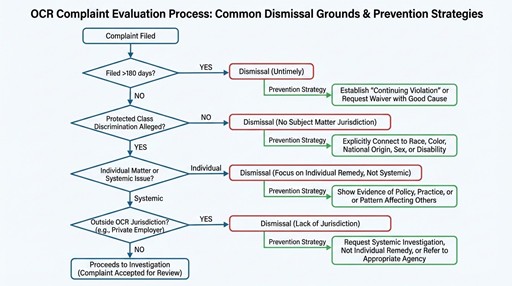
Understanding OCR’s jurisdictional requirements and common dismissal grounds is essential to crafting complaints that survive initial review and force investigation.
OCR investigates:
OCR does NOT investigate:
General Rule: OCR complaints must be filed within 180 days of alleged discrimination.
34 CFR § 100.7(b), § 106.71, § 104.61: Complaints filed more than 180 days after alleged violation may be dismissed as untimely unless:
Exception 1: Good Cause for Delay
Filing delayed due to circumstances beyond complainant’s control (serious illness, death in family, active settlement negotiations)
Exception 2: Continuing Violation
Discrimination is ongoing pattern rather than discrete act—180-day deadline runs from most recent instance of pattern, not first instance
Continuing Violation Doctrine:
When discrimination consists of ongoing pattern (repeated harassment, systemic policy creating continuous harm), each instance is new violation extending 180-day deadline.
Example:
Student racially harassed September 2023 through March 2024. Complaint filed June 2024.
Dismissal argument: First incident September 2023, more than 180 days ago
Continuing violation response: Pattern extended through March 2024 (87 days before filing), each harassment instance is continuing violation, 180-day deadline runs from last incident not first
OCR guidance: When pattern of discrimination is alleged, OCR considers whether incidents are part of continuing violation or discrete isolated acts. Factors: temporal proximity, similarity of conduct, whether same policy/practice caused each instance.
OCR only investigates discrimination based on protected classes.
Insufficient complaint: “My child was bullied and school didn’t stop it”
Why insufficient: No protected class alleged—could be any student, no civil rights violation
Sufficient complaint: “My child was subjected to sexual harassment (sex-based) / racial harassment (race-based) / disability-based harassment (disability) and school was deliberately indifferent”
Why sufficient: Alleges discrimination based on protected class (sex/race/disability) triggering federal protection
Key point: Even if severe bullying occurred, if not connected to protected class, OCR lacks jurisdiction. Must allege nexus to race, sex, disability, national origin, or age.
For harassment claims, OCR applies deliberate indifference standard from Davis v. Monroe County Board of Education, 526 U.S. 629 (1999):
Elements:
Complainants must allege facts establishing all three elements.
Insufficient: “School knew about harassment and didn’t do enough”
Sufficient: “School had actual knowledge (12 reports over 6 months, exhibits A-L). Harassment was severe/pervasive (daily unwanted touching, explicit texts, witnesses). School’s response clearly unreasonable (substantiated findings but imposed zero discipline, no supportive measures, harassment continued post-finding).”
OCR dismisses complaints that describe school’s response without explaining why response was clearly unreasonable under federal standard.
OCR investigates systemic compliance issues, not individual academic/disciplinary decisions.
Individual matter (OCR dismisses): “School gave my child C instead of B, this is discrimination”
Systemic matter (OCR investigates): “School systematically grades students with disabilities lower than non-disabled peers for same work quality, pattern across multiple students/teachers”
Individual matter: “School suspended my child for 3 days, should have been 1 day”
Systemic matter: “School imposes longer suspensions on Black students than white students for comparable conduct, disparate discipline pattern documented in district data”
How to frame individual incident as systemic:
Even if only your child affected, allege:
Example:
“School failed to investigate my daughter’s sexual harassment complaint. This reflects school’s pattern/practice of inadequate response to sexual harassment complaints as evidenced by: (1) no written sexual harassment policy, (2) no trained Title IX coordinator, (3) pattern of dismissing harassment complaints without investigation (documented in 5 other cases, exhibits attached). Request investigation of school’s Title IX compliance procedures.”
Frames individual incident as evidence of systemic non-compliance.
Dismissal Ground 1: Untimely Filing (>180 days)
Prevention:
Dismissal Ground 2: No Protected Class Discrimination
Prevention:
Dismissal Ground 3: Insufficient Deliberate Indifference Showing
Prevention:
Dismissal Ground 4: Individual Academic/Disciplinary Decision
Prevention:
Dismissal Ground 5: Outside OCR Jurisdiction
Prevention:
Dismissal Ground 6: Adequate Remedy Through Other Proceedings
Prevention:
When complaint dismissed, complainant has 60 days to request reconsideration.
34 CFR § 100.7(e), § 106.71, § 104.61: OCR will reconsider dismissal if complainant provides additional information demonstrating complaint raises issues within jurisdiction.
Effective reconsideration addresses each dismissal ground:
For timeliness dismissal: Establish continuing violation, explain good cause for delay, cite OCR guidance on continuing violations
For insufficient information: Provide additional facts showing deliberate indifference, cite case law/OCR guidance defining standard
For individual matter: Reframe as systemic issue, show pattern/practice implications
For jurisdictional: Clarify relief sought (corrective action not damages), distinguish from other proceedings
Include: OCR regulations, case law (Davis, Fry, Title IX/Section 504 cases), OCR guidance documents, additional evidence/exhibits
Reconsideration often successful when complainant demonstrates understanding of OCR’s legal standards and provides facts meeting those standards.
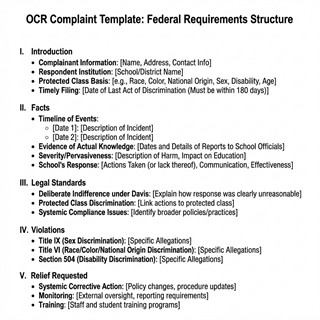
Before drafting complaint, create timeline of all incidents. Identify date of most recent discrimination. Count 180 days from that date—if you’re beyond 180 days, file immediately or establish continuing violation (pattern extending into recent 180 days) or good cause for delay. In complaint, include explicit timeliness statement: “Last incident of [harassment/discrimination] occurred [date within 180 days]. This complaint filed [date], [X] days after last incident, timely under 34 CFR § 106.71 180-day requirement. Additionally, incidents constitute continuing violation pattern extending from [start date] through [recent date].”
Never describe incidents as general “bullying” or “mistreatment.” Every allegation must explicitly connect harm to protected class. Use terms: “sexual harassment based on sex,” “racial harassment based on race,” “disability-based harassment,” “discrimination because of disability.” Structure: “Student was subjected to [specific conduct] because of [protected class status]. School knew [evidence of notice] but response was clearly unreasonable [evidence of inadequacy].” Protected class nexus must appear in every paragraph describing harm—OCR dismisses complaints where protected class connection is implied but not explicit.
For harassment complaints, structure allegations using three-part Davis v. Monroe deliberate indifference test explicitly: “(1) ACTUAL KNOWLEDGE: School had actual notice through [list specific reports with dates, who received them, exhibits]. (2) SEVERE/PERVASIVE/OBJECTIVELY OFFENSIVE: Harassment occurred [frequency/duration], included [specific conduct], was objectively offensive [impact on victim’s ability to access education]. (3) CLEARLY UNREASONABLE RESPONSE: School’s response was clearly unreasonable because [despite knowing about harassment, school took inadequate action: no investigation, no discipline, no supportive measures, allowing harassment to continue].” Cite Davis explicitly, use legal terms, provide facts supporting each element.
Even if only your child affected, frame as broader compliance failure. Instead of: “School failed to investigate my child’s complaint,” write: “School’s failure to investigate reflects pattern/practice of Title IX non-compliance evidenced by: absence of written grievance procedures, no trained Title IX coordinator, pattern of dismissing complaints without investigation [cite other cases if known], failure to provide notice of rights. Request investigation of school’s Title IX compliance procedures per 34 CFR § 106.8, § 106.45.” Request systemic corrective action (policy implementation, training, monitoring) not individual remedy (overturn specific decision, discipline specific employee).
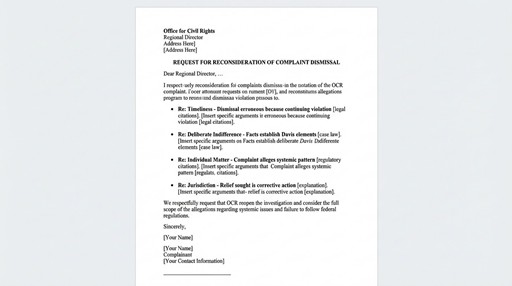
When receiving dismissal letter, immediately draft reconsideration request (60-day deadline). Address each dismissal ground specifically: “OCR dismissed complaint as untimely. This dismissal erroneous because: [continuing violation argument with legal citations]. OCR dismissed for insufficient deliberate indifference showing. This dismissal erroneous because: [facts establishing Davis elements with case law]. OCR dismissed as individual matter. This dismissal erroneous because: [systemic framing with regulatory citations].” Include: additional evidence, OCR guidance documents, case law, federal regulations. Many dismissals reversed on reconsideration when complainant demonstrates legal knowledge and provides facts meeting standards.
Create chronological timeline of all discrimination incidents. Identify most recent incident date. Count forward 180 days—if you’re still within window, file immediately. If beyond 180 days from first incident but recent incidents exist, establish continuing violation: “Harassment pattern extended from [start date] through [recent date within 180 days]. Each instance part of continuing violation. 180-day deadline runs from last incident per 34 CFR § 106.71.” In complaint include explicit timeliness statement with calculation. Don’t let OCR dismiss on timeliness when pattern is ongoing.
Never write: “My child was bullied and school didn’t stop it.” Always write: “My child was subjected to [racial harassment based on race / sexual harassment based on sex / disability-based harassment due to autism] and school was deliberately indifferent.” Use protected class language in every paragraph: “because she is Black,” “based on disability,” “due to sex,” “sexual harassment.” OCR dismisses complaints where protected class nexus is implied but not stated explicitly. Make connection impossible to miss—use federal civil rights terminology throughout.
For Title IX/Section 504 harassment claims, organize allegations: “I. ACTUAL KNOWLEDGE: School received notice [dates, who notified, exhibits A-L]. II. SEVERE/PERVASIVE: Harassment occurred [frequency/duration], included [specific conduct], prevented access to education [impact]. III. CLEARLY UNREASONABLE RESPONSE: School’s response clearly unreasonable because [substantiated findings but zero discipline, no supportive measures, harassment continued]. Under Davis v. Monroe, 526 U.S. 629, these facts establish deliberate indifference.” Cite case, use legal standard explicitly, provide facts for each element. OCR dismisses complaints describing what happened without explaining why response was clearly unreasonable under federal law.
Request: “Investigation of school’s Title IX/Section 504 compliance procedures and policies.” NOT: “Review of school’s decision in my child’s case.” Allege: “School’s pattern/practice of inadequate response to [sexual harassment / disability discrimination] evidenced by: [policy failures, training gaps, pattern across cases].” Request systemic relief: “Require school to: implement written procedures, train staff, provide monitoring, conduct compliance review.” NOT: “Reverse this suspension, discipline this employee, award damages.” Even if only your child involved, frame as broader compliance failure requiring systemic correction.
Immediately upon receiving dismissal, draft reconsideration (60-day deadline from dismissal letter). Address each ground: “OCR dismissed as untimely—erroneous because continuing violation [cite 34 CFR § 106.71, OCR guidance]. OCR dismissed for insufficient showing—erroneous because facts establish Davis elements [provide specific facts with exhibits]. OCR dismissed as individual matter—erroneous because complaint alleges systemic pattern [cite policy failures]. OCR dismissed for adequate remedy elsewhere—erroneous because civil rights claims independent under Fry v. Napoleon.” Include case law, regulations, OCR guidance, additional evidence. Many dismissals reversed when complainant demonstrates legal sophistication.
Enforceable safety plans are written into legal frameworks (IEP accommodations under IDEA, 504 accommodations under Section 504, Title IX supportive measures, court orders) creating obligations schools must implement with consequences for violations (due process complaints, OCR investigations, contempt). Verbal promises are unenforceable commitments schools can ignore without legal consequence. Example: "We'll keep an eye on your son" = verbal promise (no specificity, no framework, no enforcement). "IEP Accommodation: Ms. Johnson provides supervision during lunch 11:30-12:00, daily log" = enforceable (specific, in IEP, violations = FAPE denial).
No—under IDEA 34 CFR § 300.324, IEPs must address all areas where disability affects educational performance. When disability characteristics (communication difficulties, social deficits, physical limitations, emotional regulation challenges) create vulnerability to bullying/harassment, safety accommodations addressing that vulnerability are disability-related supports required as FAPE. Respond: "Student's [disability] causes [documented vulnerability per evaluation]. This affects ability to safely access education. Under IDEA, IEP must include accommodations addressing this. If refusing, provide prior written notice explaining why documented disability-vulnerability nexus doesn't require safety accommodations."
Enforceable plans require five components: (1) WHO: Named staff with substitute (not "staff"), (2) WHEN: Specific times/situations (not "when needed"), (3) WHAT: Concrete measurable action (not "monitor"), (4) HOW MEASURED: Verification method (log, communication), (5) RATIONALE: Why required (links to disability/Title IX). Example: "Ms. Johnson (substitute: Mr. Lee) provides visual supervision within 20 feet during 11:30-12:00 lunch and 12:15-12:30 recess, documented via daily log signed by supervisor. Required because Student's autism prevents recognizing dangerous situations per 2/10/24 evaluation."
Document violation same day: date, what was required, what didn't happen, impact on student. Send written notice: "IEP/504 requires [measure]. On [date], not provided: [specifics]. This is violation [number]. Immediate implementation required." After 2-3 documented violations, file enforcement: IEP/504 = due process complaint requesting implementation + compensatory services, Title IX = OCR complaint, Court order = contempt motion. Include violation log as evidence. Don't wait for many violations—2-3 proves pattern requiring intervention.
In due process complaint for IEP/504 violations, request compensatory services calculated as total hours of accommodation not provided. Example: IEP requires 45 minutes daily supervision. Violated 30 school days. Request: 1,350 minutes (22.5 hours) compensatory supervision to make up for period Student lacked required support. Hearing officers can order compensatory services as remedy for FAPE denial. Also request: immediate implementation with verification, monitoring, and consequences for future violations. Make violations costly enough to force compliance going forward.
If you want student harm treated like a school safety and civil rights issue—start with SANI at https://saninstitute.net
Table of Contents Click to Expand 1. Audio 2. Definition 3. Video 4. Core Thesis 5. Case Pattern Story 6. SANI Connection 7. Discipline Explanation

Table of Contents Click to Expand 1. Audio 2. Definition 3. Video 4. Core Thesis 5. Case Pattern Story 6. SANI Connection 7. Discipline Explanation

Table of Contents Click to Expand 1. Audio 2. Definition 3. Video 4. Core Thesis 5. Case Pattern Story 6. SANI Connection 7. Discipline Explanation
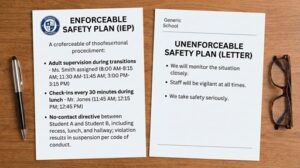
Table of Contents Click to Expand 1. Audio 2. Definition 3. Video 4. Core Thesis 5. Case Pattern Story 6. SANI Connection 7. Discipline Explanation