

The documentation gap: when “no records” becomes the district’s defense
Table of Contents Click to Expand 1. Audio 2. Definition 3. Video 4. Core Thesis 5. Case Pattern Story 6. SANI Connection 7. Discipline Explanation
1. Audio
2. Definition
3. Video
4. Core Thesis
9. Action Steps
10. FAQs
11. Call to Action
12. Sources
13. Signature
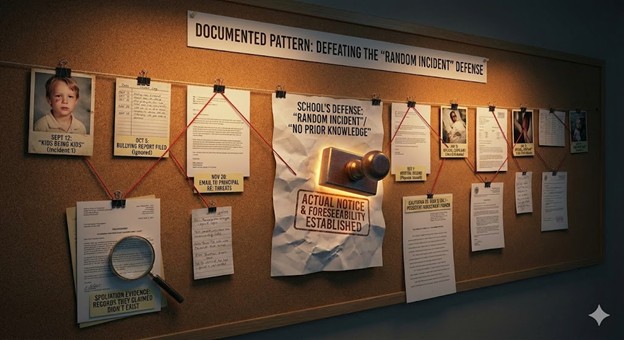
Documenting a timeline that defeats “random incident” claims means creating a chronological, contemporaneously recorded, externally preserved evidentiary record that proves harassment, bullying, or violence was not isolated but part of a pattern the school had actual or constructive notice of—transforming what schools dismiss as “kids having a bad day” into documented evidence of persistent, foreseeable harm the school failed to prevent despite repeated warnings, thereby establishing the school’s duty of care violation, deliberate indifference under Title VI/Title IX, premises liability, and foreseeability for negligence or gross negligence claims.
Under California law, timeline documentation serves multiple legal functions: it proves actual notice to schools (defeating “we didn’t know” defenses), establishes foreseeability (making future harm a predictable consequence of past patterns rather than an unforeseeable accident), demonstrates persistent or pervasive harassment under California Education Code Section 234.1 and federal civil rights laws, creates constructive notice when documented patterns show the school should have known danger existed, and provides spoliation evidence when schools later claim “no prior incidents” despite the parent’s contemporaneous documentation proving otherwise—making timeline documentation the single most powerful tool for defeating schools’ institutional defense that “this was just one random incident we couldn’t have prevented.”
Schools’ primary defense against accountability is the “random incident” narrative—claiming each instance of harm was unforeseeable, isolated, and unrelated to prior events, allowing them to avoid liability by treating systematic failures as unfortunate coincidences. We convert trauma into code by creating timestamped, externally preserved timelines that prove incidents were neither random nor isolated—documenting dates, times, locations, witnesses, what the school was told, what the school promised, and what the school failed to do, transforming “he said/she said” disputes into provable patterns of notice and inaction. Selective enforcement IS discrimination when timeline documentation reveals schools respond immediately to protect certain students (wealthy, white, connected families) while dismissing identical patterns affecting Black, Latino, disabled, or immigrant students as “isolated incidents,” proving the “random” characterization is pretextual and rooted in devaluation of specific students’ safety. This article proves that timeline documentation is not just good record-keeping—it is the evidentiary foundation that establishes foreseeability, notice, pattern, and deliberate indifference, making it impossible for schools to claim ignorance or frame systematic failures as random bad luck.
The Student Advocacy Network Institute (SANI) is a Policy-Driven Student Safety Agency that identifies the “random incident” defense as pattern suppression—a systematic tactic where schools refuse to document, investigate, or connect incidents to create plausible deniability that patterns exist, allowing them to characterize foreseeable, preventable harm as unpredictable accidents.
SANI teaches parents to create parallel documentation systems the school cannot control, erase, or rewrite—contemporaneous timelines with dates, times, witnesses, what was reported to whom, what the school promised, and what the school failed to do. When schools later claim “this was the first we heard of it” or “these incidents weren’t related,” the parent’s timeline—created in real-time and preserved externally—proves the school is lying.
SANI’s enforcement work centers safety and civil rights, not record management. Timeline documentation is not administrative hygiene—it is the evidentiary foundation that establishes actual notice, foreseeability, pattern, deliberate indifference, and gross negligence, transforming schools’ self-serving narratives into provable falsehoods that create liability.
Timeline documentation serves multiple critical legal functions in school safety cases under California law. Understanding these functions helps parents create timelines that survive legal challenges and defeat schools’ defenses.
Legal Standard: Schools have actual notice when a responsible employee knows or should know about harassment, threats, or safety concerns.
Why Timeline Matters: Schools routinely claim “we weren’t aware” or “the parent never told us.” A timeline with dated communications (emails, meeting notes, phone logs) proves the school had notice and cannot claim ignorance.
California Authority: Under California Education Code Section 234.1, schools have duty to investigate harassment reports. Timeline proves when reports were made, triggering the duty.
Legal Standard: Even without explicit reports, schools have constructive notice when incidents are so frequent, widespread, or obvious that school employees should have known.
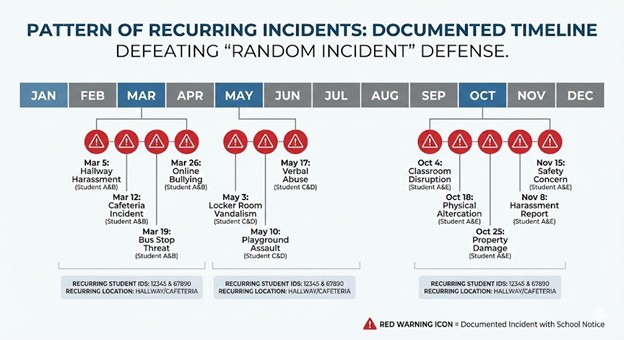
Why Timeline Matters: When a timeline shows multiple incidents in the same location during supervised times (cafeteria, hallways between classes, PE), it proves the school should have known even if parents didn’t report every single incident.
California Authority: Under premises liability doctrine, repeated incidents in the same location create constructive notice of dangerous condition requiring remediation.
Legal Standard: Harm is foreseeable when a reasonable person could anticipate it based on prior circumstances. Foreseeability is essential for negligence and gross negligence claims.
Why Timeline Matters: A timeline showing escalating incidents (verbal harassment → theft → physical intimidation → assault) proves the final injury was foreseeable, not a random accident. Each incident created notice that more serious harm was likely.
California Authority: California Civil Code Section 1714 establishes general duty of care; foreseeability determines whether breach occurred. Timeline evidence makes harm foreseeable as a matter of law.
Legal Standard: Under federal civil rights laws, harassment must be sufficiently severe, persistent, or pervasive to create hostile environment. Single incidents rarely meet this standard unless extremely severe.
Why Timeline Matters: A timeline showing repeated harassment over weeks or months proves the conduct was persistent and pervasive, meeting the hostile environment standard. It transforms what schools characterize as “a few isolated comments” into documented, ongoing civil rights violations.
California Authority: California Education Code Section 234.1 requires schools to address harassment that is “persistent” or creates hostile environment. Timeline proves persistence.
Legal Standard: When schools destroy or fail to preserve evidence, they face sanctions. But schools often claim records “never existed” or were “routinely destroyed.”
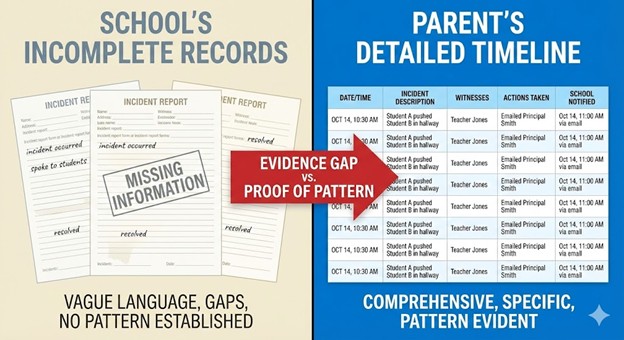
Why Timeline Matters: When the parent’s contemporaneous timeline documents incidents the school later claims “never happened” or “weren’t documented,” it proves the school either failed to document (violating policy) or destroyed records (spoliation).
California Authority: California Code of Civil Procedure Section 2023.030 authorizes sanctions for destroying evidence. Parent’s timeline proves evidence should have existed.
Legal Standard: Schools violate Title VI, Title IX, and Section 504 when they respond with deliberate indifference—clearly unreasonable response given known circumstances.
Why Timeline Matters: A timeline showing repeated reports with inadequate responses (no investigation, sham investigation, promises broken, harassment continues) proves the school’s response was clearly unreasonable, meeting the deliberate indifference standard.
California Authority: Davis v. Monroe (U.S. Supreme Court) established deliberate indifference for Title IX; applies to Title VI and Section 504. Timeline proves actual knowledge and unreasonable response.
Legal Standard: Gross negligence requires proof of reckless disregard, conscious indifference, or extreme departure from reasonable care.
Why Timeline Matters: A timeline showing the school received multiple warnings, documented the danger internally, and consciously chose not to act proves conscious indifference—elevating simple negligence to gross negligence, which pierces governmental immunity and allows punitive damages.
California Authority: California Civil Code Section 3294 allows punitive damages for conscious disregard; timeline proves the school knew and didn’t care.
Definition: Documentation created at or near the time the incident occurred or was reported.
Why It Matters: Contemporaneous documentation has high evidentiary value because it’s created before the outcome is known, reducing bias concerns. Courts trust real-time documentation more than reconstructed timelines created months later.
How to Create: After every incident or report to school, immediately:
Vague entries are useless. Each entry must include:
Date and Time: “October 15, 2024, 11:45 AM” (not “sometime in October”)
Location: “West stairwell, second floor, near Room 204” (not “at school”)
What Happened: Exact words if possible, physical actions, who did what to whom
Witnesses: Names of students or staff who saw or heard the incident
Perpetrators: Names or descriptions if names unknown
Physical Evidence: Photos of injuries, torn clothing, damaged property, graffiti
Every entry must document what the school was told and when:
Who You Reported To: Name and title (“Assistant Principal John Davis”)
When: Date and time of report (“October 15, 2024, 3:30 PM via email”)
Method: Email, phone call, in-person meeting, text
What You Told Them: Summary of what you reported
Their Response: What they said or wrote back
Promised Action: What they promised to do
Actual Action: What they actually did (or failed to do)
Critical Rule: Timeline must be preserved outside the school’s control.
Why: Schools routinely claim parents never told them things, or that prior incidents “weren’t documented.” If the only record is in the school’s possession, they can lose, alter, or deny it.
Methods:
Wherever possible, attach or reference supporting evidence:
Document how each incident affected the student:
This proves the harm’s effect on educational access—critical for hostile environment and FAPE claims.
California Education Code Section 234.1 – Safe Place to Learn Act:
Requires schools to investigate harassment complaints within 60 days. Timeline documentation must include:
California Code of Regulations, Title 5, Section 4621 – Uniform Complaint Procedures:
Requires schools to follow specific timelines for complaints alleging discrimination, harassment, or civil rights violations. Timeline must track:
California Civil Code Section 1714 – Duty of Care:
Timeline must establish foreseeability by showing:
Mistake 1: Waiting to Start
Many parents only begin documenting after a major incident. By then, they’re reconstructing from memory, which has less evidentiary weight.
Solution: Start documenting the first incident or concern, no matter how minor it seems.
Mistake 2: Relying on School to Document
Parents assume the school’s incident reports are sufficient. Then they discover reports were never created, were destroyed, or are one-sided and inaccurate.
Solution: Always create your own parallel documentation immediately after reporting to school.
Mistake 3: Vague Entries
“School said they’d handle it” is useless. Who said it? When? What specifically did they promise?
Solution: Use the specific detail checklist above for every entry.
Mistake 4: Not Preserving Externally
Parents keep handwritten notes at home, which can be lost, damaged, or accused of being backdated.
Solution: Email yourself, save to cloud, create digital timestamps.
Mistake 5: Failing to Document “Minor” Incidents
Parents think “this isn’t serious enough to write down.” Later, when a serious incident occurs, there’s no pattern documentation.
Solution: Document everything. Let attorneys and courts decide what’s minor. Patterns emerge from accumulated “minor” incidents.
Mistake 6: Not Updating After Every Report to School
Parents document the incident but forget to document what the school did (or didn’t do) in response.
Solution: Every time you report, interact with school, or follow up, add an entry documenting the school’s response.
The Contemporaneous Timeline Documentation Protocol
This framework ensures parents create legally enforceable timeline documentation that defeats “random incident” defenses and establishes pattern, notice, and foreseeability.
The moment an incident occurs or you report to the school, open a timestamped document (Google Doc, email to yourself, note-taking app with sync) and create an entry with: Date/Time, Location (specific), What Happened (detailed, exact words if possible), Witnesses (names), What You Reported to Whom (name, title, method, time), Their Response (exact words/promises), Impact on Student (academic, psychological, physical). Save to cloud storage immediately. This contemporaneous creation is critical—courts trust real-time documentation more than reconstructed accounts.
Within 24-48 hours of each incident, gather supporting evidence and attach or reference in the timeline entry: screenshots of texts/emails/social media, photos of injuries or property damage, medical records from doctor visits, school emails or incident reports (if provided), witness statements from other parents or students, audio/video if legally recorded. This corroboration transforms your timeline from “parent’s story” to “documented fact.”
Within 24-48 hours after each report to school, add a follow-up entry documenting their response: Did they investigate? Who did they interview? What timeline did they give? What safety measures did they implement? What did they promise? If they failed to respond, document that too: “Reported to principal October 15. No response received as of October 22 despite follow-up email October 19.” This proves deliberate indifference when schools fail to act.
As your timeline grows, categorize each entry by: Type of Incident (physical, verbal, cyber, exclusion), Location (cafeteria, hallway, bathroom), Perpetrators (same students repeatedly or different), Protected Class Basis (racial slurs = Title VI, disability mocking = 504, sexual harassment = Title IX), School Response Quality (investigated/sham investigation/no response). These categories make patterns visually obvious when presented to attorneys, OCR, or courts.
Keep your master timeline in multiple secure locations: cloud storage, email to yourself/spouse, physical printed copy in safe location. After major incidents or before filing complaints/lawsuits, provide a complete copy to the school in writing: “Attached is a timeline documenting 14 incidents over 4 months that you had actual notice of. Your claim this was ‘unforeseeable’ is false.” This creates an evidentiary record that the school cannot later claim they didn’t understand the pattern.
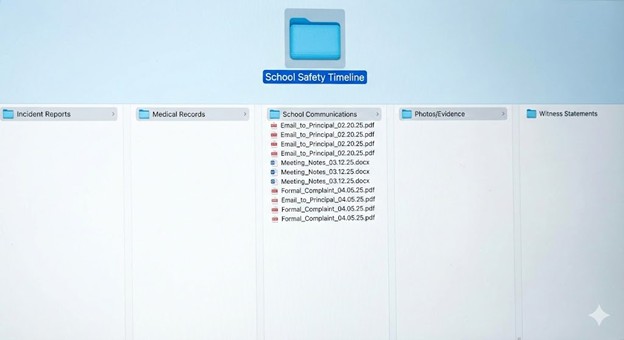
Open a Google Doc, email draft to yourself, or note-taking app and create the first entry immediately. Title it: “[Student Name] School Safety Timeline – Started [Date].” Even if you’re starting after incidents have occurred, write what you remember with dates (or “approximately [month]”) and note “reconstructed from memory [date].” Then document every future incident contemporaneously. The timeline’s value grows with each entry.
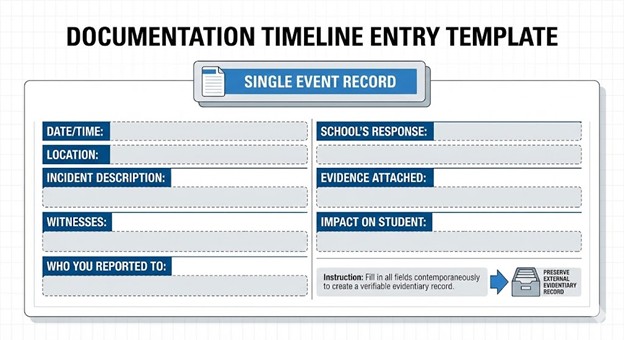
For every incident or communication with school, create an entry with these fields: Date/Time (specific), Location (specific building/room/area), Incident Description (what happened, exact words if possible), Witnesses (names or descriptions), Perpetrators (names or descriptions), Reported To (name, title, date/time, method), School’s Response (what they said/wrote, promises made), Evidence (attached or referenced), Impact (grades, attendance, psychological, physical). Save immediately to cloud storage.
Immediately after calling, emailing, or meeting with school officials, send yourself an email with subject line: “School Report – [Date] – [Brief Description].” In the body, write: “Today at [time] I reported to [name/title] that [summary of incident]. They responded: [exact quote if possible or detailed paraphrase]. They promised to: [specific actions]. I requested: [specific requests].” This creates a timestamped, externally preserved record the school cannot alter or deny.
Within 48 hours of any serious incident (assault, significant harassment, emergency room visit), submit a public records request for: all incident reports from that date/location, all communications between staff about your child, all video footage, all witness statements. When you receive the school’s records, compare them to your timeline. Document discrepancies: “School’s incident report claims only verbal altercation, but my contemporaneous timeline and medical records prove physical assault occurred.”
Before filing OCR complaints, state complaints, or retaining an attorney for litigation, send your complete timeline to the superintendent and school board in a formal letter: “Attached is documentation of 12 incidents over 3 months that school employees had actual notice of. Your characterization of [final incident] as ‘random’ and ‘unforeseeable’ is factually false and contradicted by this contemporaneous documentation.” This forces the school to acknowledge the pattern or commit to false statements you can later prove were lies.
Create contemporaneous documentation within 24 hours of every incident using a timestamped digital format (Google Doc, email to self, or note-taking app). Include the specific date and time, location, what happened, witnesses, who you reported to at the school, their response, and the impact on your student. Attach corroborating evidence such as photos, screenshots, or medical records. Preserve copies externally using cloud storage or email backups. This establishes that incidents were not random or isolated and proves pattern, notice, and foreseeability.
Start immediately after the first incident, no matter how minor it seems. Courts give greater weight to contemporaneous documentation than reconstructed timelines. Minor incidents often escalate into serious harm, and early documentation proves escalation was foreseeable. If you are starting late, document what you remember and label it clearly as “reconstructed from memory,” then document everything going forward in real time.
Each entry should include: (1) specific date and time, (2) exact location, (3) detailed description of what occurred (including exact words when possible), (4) witnesses (names or descriptions), (5) perpetrators (names or descriptions), (6) who you reported to (name, title, method, and date/time), (7) the school’s response or lack of response, (8) corroborating evidence, and (9) impact on the student (academic, psychological, physical, or attendance-related). Vague entries significantly weaken legal value.
Each entry records what was reported, to whom, and when—establishing actual notice. When schools later claim they were unaware, documented reports to administrators defeat that defense. Timelines also establish constructive notice when repeated incidents occur in the same locations during supervised times, showing the school should have known even absent formal reports.
Digital documentation is strongly preferred because it creates verifiable timestamps, preserves records externally, allows attachments, and provides version history. Emailing entries to yourself creates server-verified timestamps that are difficult to dispute. Handwritten journals can be used if dated consistently and photographed or scanned regularly, but they are easier for schools to challenge as backdated. Using both methods provides redundancy.
This is why contemporaneous creation and external preservation matter. Email timestamps, cloud storage metadata, Google Doc version history, and messages sent to an attorney or spouse prove real-time creation. While handwritten notes can be challenged, server-based timestamps and cloud logs are independently verifiable and difficult to refute.
A timeline demonstrates repeated warnings, continued danger, and the school’s failure to act—establishing conscious indifference. When documentation shows multiple reports, promised action, and continued harm, it proves the school knowingly disregarded risk. This elevates the claim from simple negligence to gross negligence, which can defeat immunity defenses and support enhanced remedies.
If you want student harm treated like a school safety and civil rights issue—start with SANI at https://saninstitute.net
The Student Advocacy Network Institute (SANI) is a national research, accountability, and discipline institute founded by Bullying Is A Drug to define, document, and address institutional failure in K–12 education—treating student harm as a school safety and civil rights issue.
Explore the Institute:
https://saninstitute.net
A sixth-grade student with ADHD in Los Angeles is shoved into lockers by the same three students. The parent calls the school counselor, who says, “I’ll talk to them.” No written incident report is created.
Three days later, the same students corner the victim in the bathroom and call him slurs targeting his disability. The parent emails the assistant principal with details. The assistant principal responds: “We’re addressing it. Kids sometimes have conflicts.”
One week later, the three students steal the victim’s backpack during PE and throw his medication in the trash. The parent requests a meeting. The principal says: “These seem like random incidents. Middle school students can be impulsive. We’ve talked to everyone.”
Two weeks later, the three students physically assault the victim in the hallway, causing a concussion. The parent threatens legal action. The school’s attorney responds: “This was an unfortunate, unforeseeable incident. Prior interactions were minor peer conflicts, not a pattern of targeted harassment.”
The parent, devastated but determined, obtains an attorney. During discovery, the parent produces a detailed timeline she had been maintaining from day one:
September 12, 2024, 11:45 AM:
September 15, 2024, 1:20 PM:
September 22, 2024, 2:10 PM:
October 6, 2024, 10:30 AM:
The parent’s attorney presents this timeline to opposing counsel with a cover letter:
“Your claim that the October 6 assault was ‘unforeseeable’ and ‘random’ is factually and legally false. The attached timeline, created contemporaneously by my client, proves:
This is not a ‘random incident.’ This is deliberate indifference under Title VI and Section 504, gross negligence under California tort law, and violation of California Education Code Section 234.1.”
The school’s attorney reviews the timeline and realizes the school cannot defend at trial. Every argument—”we didn’t know,” “it was unforeseeable,” “these were isolated incidents”—is defeated by the parent’s contemporaneous documentation. The case settles for six figures.
The record breaks when the parent’s attorney obtains the school’s internal emails from September 23 (after the third report), showing the principal instructed staff: “Let’s not create formal documentation for every little thing these kids do. It makes us look bad and opens us up to liability.”
Table of Contents Click to Expand 1. Audio 2. Definition 3. Video 4. Core Thesis 5. Case Pattern Story 6. SANI Connection 7. Discipline Explanation
Table of Contents Click to Expand 1. Audio 2. Definition 3. Video 4. Core Thesis 5. Case Pattern Story 6. SANI Connection 7. Discipline Explanation
Table of Contents Click to Expand 1. Audio 2. Definition 3. Video 4. Core Thesis 5. Case Pattern Story 6. SANI Connection 7. Discipline Explanation
Table of Contents Click to Expand 1. Audio 2. Definition 3. Video 4. Core Thesis 5. Case Pattern Story 6. SANI Connection 7. Discipline Explanation