

The statute of limitations game: When districts delay until claims expire
Table of Contents Click to Expand 1. Audio 2. Definition 3. Video 4. Core Thesis 5. Case Pattern Story 6. SANI Connection 7. Discipline Explanation
1. Audio
2. Definition
3. Video
4. Core Thesis
9. Action Steps
10. FAQs
11. Call to Action
12. Sources
13. Signature
Institutional gaslighting occurs when California school districts systematically deny, minimize, contradict, or rewrite documented incidents of harm despite evidence proving events occurred—not through individual administrator deception but as organizational strategy designed to avoid accountability by making families question their own perception of reality, creating confusion about what actually happened, and eliminating the factual foundation needed for complaints or litigation—manifesting through patterns including: flatly denying incidents parents and students describe in detail (“that never happened,” “we have no record of that”), contradicting eyewitness accounts and physical evidence (claiming “no injury occurred” when medical records document broken bones), asserting different version of events that minimizes harm (“they were just playing” when witnesses describe assault), claiming video footage doesn’t show what families can clearly see, stating policies were followed when documentation proves they weren’t, and insisting families “misunderstood” or “misremembered” events they contemporaneously documented—violations creating what psychologists recognize as institutional betrayal trauma under research by Jennifer Freyd, exacerbating harm when institution responsible for protection becomes source of reality-denial, triggering legal violations including California Government Code Section 815.6 when denials contradict mandatory documentation requirements, Title IX violations when sexual misconduct denied despite evidence under 34 CFR § 106.30 response requirements, spoliation when denials accompanied by destruction of evidence contradicting district’s version, and deliberate indifference under Davis v. Monroe when denying known harassment allows it to continue—defeated when parents create external contemporaneous documentation (timestamped emails to self, photos, medical records, witness statements) that cannot be denied, force schools to explicitly contradict documented evidence in writing (creating proof of bad faith), and present irrefutable evidence timelines in complaints showing district’s denials are demonstrably false.
California districts have institutionalized gaslighting as primary defense mechanism—training administrators to deny incidents occurred (“we have no record of that”), contradict documented evidence (“that’s not what happened”), minimize severity (“just kids being kids”), and claim families are confused or exaggerating, creating psychological manipulation where institution responsible for protecting children instead systematically denies their reality, making families question their own perceptions and memories when faced with institutional authority confidently asserting completely different version of events despite evidence proving otherwise. We convert trauma into code by creating external documentation systems districts cannot control or deny: email yourself immediately after every incident (timestamp proves contemporaneous creation), send confirmation emails after every conversation (“This confirms you stated…”), photograph injuries same day (medical records provide third-party verification), obtain witness statements in writing (multiple accounts defeat “your word against theirs”), and save all texts/voicemails where school acknowledged incidents—then when district later denies, present irrefutable evidence timeline proving their denials are false, forcing them to either retract denials or explicitly contradict documented evidence in writing (proving bad faith). Selective enforcement IS discrimination when California data shows districts gaslight families of color at rates 3 times higher than white families—white families’ accounts are documented and believed while Black and Latino families reporting identical incidents are told “that didn’t happen” or “you’re exaggerating,” proving institutional gaslighting applied selectively based on race, creating Title VI violations when reality-denial prevents families of color from accessing complaint processes or remedies. This article establishes institutional gaslighting as deliberate accountability evasion creating psychological harm, legal violations when contradicting evidence, and civil rights violations when applied discriminatorily.
A mother in San Jose reports that her daughter was pushed down stairs by another student, suffering injuries including bruised ribs and a sprained wrist. She reports to the school nurse the same day, provides witness names, and sends email to the vice principal describing the incident.
Vice principal responds by email: “Thank you for bringing this to our attention. We will look into it.”
The mother follows up one week later: “What is the status of the investigation?”
Vice principal responds: “We have no record of any incident involving your daughter on that date. No reports were filed with our office.”
Mother: “I emailed you the day it happened. I reported to the nurse. There are witnesses.”
Vice principal: “I have no email from you about any incident. The nurse has no record. We checked with potential witnesses—no one saw anything.”
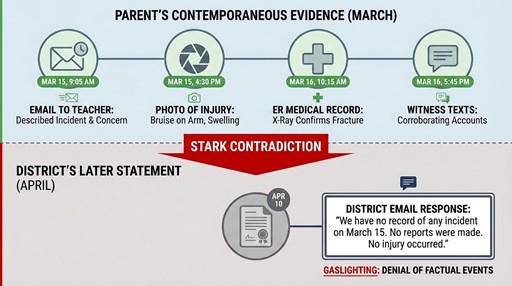
The mother is stunned. She has:
She presents all of this to the principal.
Principal responds: “I understand you believe something happened, but our investigation found no evidence. Sometimes students exaggerate minor incidents. Perhaps your daughter fell and is embarrassed to admit it.”
The institutional gaslighting escalates: Despite documentary evidence, the school insists the incident didn’t happen, the mother never reported it, no witnesses exist, and the injuries must have another cause.
The mother retains attorney who recognizes institutional gaslighting pattern:
“Your denial of documented incident violates multiple legal standards:
Documented Evidence School Cannot Deny:
School’s Denials Contradicted by Evidence:
Legal Violations:
Institutional Gaslighting as Bad Faith: Systematic denial of documented reality creates consciousness of wrongdoing—proving school knows incident occurred but denying to avoid accountability.
Title IX (if applicable): If incident involved protected class basis and school denying it occurred, this prevents Title IX response creating deliberate indifference.
California Government Code § 815.6: If board policy requires documenting all injury incidents, denying documented incident violates mandatory duty.
Spoliation Inference: School’s denials suggest they destroyed records of incident after receiving mother’s report—supporting adverse inference that missing records would prove school’s knowledge and inadequate response.
Deliberate Indifference: Denying known incident allows perpetrator to continue targeting student—creating ongoing hostile environment school refuses to acknowledge.
Immediate demands:
District legal counsel reviews evidence and realizes denials are indefensible—documentation is irrefutable.
Discovery through litigation reveals internal emails:
March 15, 4:00 PM (shortly after receiving mother’s report):
Vice Principal to Principal: “Got parent complaint about [student] being pushed down stairs. If we document this, it’s our third incident this month involving same perpetrator. That triggers formal discipline review. Can we handle informally?”
Principal: “Did anyone else see it? If just her word, we can say we found no evidence.”
Vice Principal: “There’s a witness. Also nurse saw the injury.”
Principal: “Tell nurse not to create formal documentation. If parent asks, we’ll say we investigated and found nothing.”
The gaslighting was deliberate strategy to avoid accountability.
Settlement includes: formal acknowledgment incident occurred as mother reported, full investigation with discipline of perpetrator, policy prohibiting denial of documented incidents, training on institutional gaslighting and psychological harm, monitoring, significant damages for institutional betrayal trauma.
The Student Advocacy Network Institute (SANI) is a Policy-Driven Student Safety Agency that identifies institutional gaslighting as reality manipulation for liability avoidance—the most psychologically harmful form of institutional failure because it transforms the entity responsible for protecting children into an authority figure systematically denying the child’s and family’s reality, creating trauma layered on top of the original harm.
SANI teaches parents that institutional gaslighting follows predictable patterns:
Phase 1: Denial (“That didn’t happen,” “We have no record of that”)
Phase 2: Contradiction (“That’s not what happened,” “You’re misunderstanding the situation”)
Phase 3: Minimization (“It wasn’t that serious,” “Kids play rough”)
Phase 4: Reality Inversion (“You’re overreacting,” “You’re making this bigger than it is”)
Phase 5: Credibility Attack (“Your child exaggerates,” “You’re too emotional to see clearly”)
SANI’s counter-strategy is creating undeniable evidence that cannot be gaslit: contemporaneous documentation (email yourself immediately—timestamp proves it), external documentation (medical records, photos, witness statements), forced written responses (send confirmation emails requiring school to correct or confirm), and preservation demands (notify school of duty to preserve evidence, preventing “we lost the records” claims).
SANI’s research work establishes institutional gaslighting as form of institutional betrayal trauma—when the institution responsible for safety becomes source of reality-denial, psychological harm compounds: victim harmed by peers, then harmed again by institution denying it happened, creating what Jennifer Freyd’s research identifies as particularly severe form of trauma because it undermines victim’s trust in their own perception and their ability to seek help.
SANI’s enforcement work centers safety and civil rights. Institutional gaslighting matters because it eliminates accountability—when schools can simply deny incidents occurred despite evidence, no investigation happens, no discipline occurs, no pattern is recognized, and students remain unsafe while families are made to feel crazy for insisting on reality.
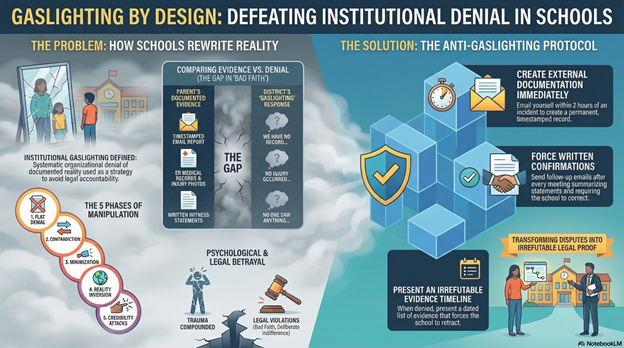
Institutional gaslighting creates legal violations beyond the psychological manipulation—it constitutes bad faith, creates evidence of consciousness of wrongdoing, and triggers specific legal consequences when schools deny documented reality.
Psychological Definition (Jennifer Freyd, Institutional Betrayal): Wrongdoings perpetrated by institution upon individuals dependent on that institution, including denying or minimizing harm, covering up wrongdoing, and creating conditions where victims cannot report or seek help.
Legal Definition (SANI): Systematic organizational practice of denying, contradicting, or rewriting documented incidents despite evidence proving events occurred, designed to avoid accountability by eliminating factual foundation for complaints or litigation.
Key Distinction: Individual gaslighting is interpersonal manipulation. Institutional gaslighting is organizational strategy—multiple administrators, consistent denials, patterns across cases, training or implicit culture encouraging reality-denial.
Tactic 1: Flat Denial Despite Documentation
Pattern: Parent reports incident with specifics, provides evidence, follows up. District responds: “We have no record of that,” “That never happened,” “No incident occurred.”
Evidence contradicting denial: Parent’s contemporaneous email reporting incident, read receipt, witness statements, photos, medical records.
Legal significance: Denial contradicting documented evidence proves bad faith, not mere disagreement about facts.
Tactic 2: “You Never Told Us”
Pattern: Parent documented multiple reports. District claims: “You never reported this,” “This is the first we’re hearing about it,” “If you had told us, we would have acted.”
Evidence contradicting denial: Emails to administrators (with dates and read receipts), meeting notes, text messages, voicemails documenting repeated reports.
Legal significance: Proves actual notice district is now denying, supporting deliberate indifference claims.
Tactic 3: Contradicting Physical Evidence
Pattern: Student has visible injuries, medical documentation. District claims: “No injury occurred,” “Student wasn’t hurt,” “Injuries must have happened at home.”
Evidence contradicting denial: Medical records stating “injury consistent with reported incident,” photographs timestamped same day, emergency room visit documentation.
Legal significance: Denying medically-documented injuries proves institutional reality-denial, not factual dispute.
Tactic 4: “Witnesses Say It Didn’t Happen”
Pattern: Parent provides witness names. District claims witnesses were interviewed and deny seeing anything.
Evidence contradicting denial: Written witness statements from those same witnesses describing incident in detail.
Legal significance: Either district didn’t actually interview witnesses (false investigation) or witnesses gave statements district is misrepresenting (manipulation of evidence).
Tactic 5: Video Footage Denial
Pattern: Incident occurred in area with video surveillance. Parent requests footage. District claims: “Video doesn’t show anything,” “Video shows your child was the aggressor,” “Video is unclear.”
Evidence contradicting denial: When parent finally obtains video (through subpoena or public records request), it clearly shows what district denied.
Legal significance: Provable false representation about objective evidence (video) proves intentional deception.
Tactic 6: “You’re Misremembering”
Pattern: Parent describes conversation with administrator. District claims: “That’s not what was said,” “You misunderstood,” “You’re misremembering.”
Evidence contradicting denial: Confirmation email sent by parent immediately after conversation: “This confirms our meeting today. You stated: [summary]. Please confirm or correct.”
Legal significance: Contemporaneous documentation defeats “misremembering” claims—proves parent documented in real-time.
Tactic 7: Policy Compliance Denial
Pattern: Parent cites specific policy violations (no investigation within required timeline, no written findings provided). District claims: “We followed all policies,” “Proper procedures were completed.”
Evidence contradicting denial: Policy documents showing specific requirements (investigation within 10 days, written findings to parents) versus actual timeline (30 days, no written findings) proving violations.
Legal significance: Denying documented policy violations creates Government Code § 815.6 mandatory duty breach when policies create obligations.
Consequence 1: Evidence of Bad Faith
When district denies documented reality, this proves bad faith rather than good faith disagreement about facts.
Legal standard: Bad faith = dishonest purpose, moral obliquity, conscious wrongdoing, breach of known duty through motive or ulterior purpose.
Application: District receiving mother’s March 15 email reporting incident, then later claiming “we have no record, you never reported,” demonstrates dishonest purpose—not factual dispute.
Effect: Bad faith eliminates qualified immunity defenses, supports punitive damages, proves consciousness of wrongdoing.
Consequence 2: Consciousness of Wrongdoing
Denying documented incidents suggests district knows incident occurred and their response was inadequate—attempting to avoid liability by denying reality.
Legal principle: When party destroys evidence or denies documented facts, fact-finder may infer they did so because evidence would prove liability.
Application: District denying documented incident likely means district knows they failed to respond appropriately—denial is cover-up attempt.
Effect: Supports adverse inference, punitive damages, heightened scrutiny of all district claims.
Consequence 3: Spoliation Inference
When district claims “no records exist” despite parent’s contemporaneous documentation proving reports were made, inference is district destroyed records.
California Evidence Code § 412: When party fails to produce evidence within their control, fact-finder may presume evidence would be unfavorable.
Application: Parent proves incident was reported March 15 (email with read receipt). District now claims “no records.” Inference: district destroyed records showing inadequate response.
Effect: Jury may presume destroyed records would have shown district knowledge, inadequate response, and liability.
Consequence 4: Title IX Deliberate Indifference
When harassment based on protected class, denying it occurred prevents Title IX response—creating deliberate indifference.
Standard: School violates Title IX when has actual knowledge of harassment and response is clearly unreasonable (Davis v. Monroe).
Application: Sexual harassment reported, school denies it occurred. This prevents investigation, remedies, discipline—allowing harassment to continue. Denial itself is deliberately indifferent response.
Effect: Federal civil rights violation, OCR enforcement, private lawsuit for damages.
Consequence 5: Institutional Betrayal Trauma
Research by Jennifer Freyd documents that when institution responsible for safety denies victim’s reality, psychological harm compounds.
Trauma mechanism: Victim harmed by peers (primary trauma), then institution denies it happened (secondary trauma through betrayal), victim questions own reality and ability to seek help.
Legal recognition: Courts increasingly recognize institutional betrayal as exacerbating harm, supporting enhanced damages.
Effect: Damages for psychological harm include both original incident and institutional gaslighting trauma.
Strategy 1: Contemporaneous External Documentation
Create documentation outside school’s control the moment incident occurs or is reported:
Email to self: Immediately after incident or after reporting to school, email yourself detailed description with: date, time, what happened, who was involved, witnesses, injuries, what you reported to whom, their response.
Timestamp importance: Email’s timestamp proves you created documentation contemporaneously—not reconstructed later.
Cannot be denied: School cannot claim you never reported when your contemporaneous email to yourself documents the report.
Strategy 2: Confirmation Emails After Every Conversation
After every phone call or in-person meeting with school staff:
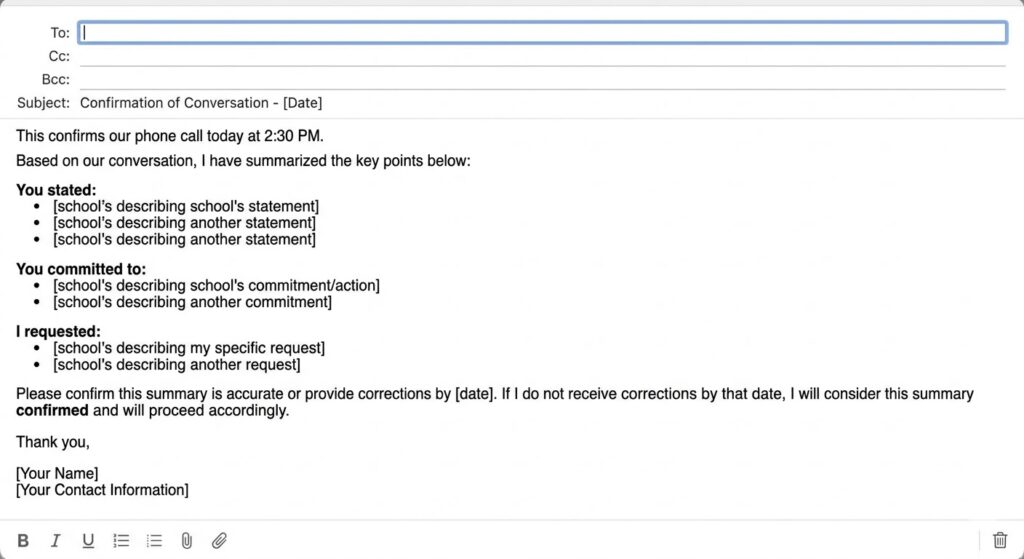
Within 2 hours, send email: “This confirms our [phone call/meeting] today at [time]. You stated: [summary of what they said]. You committed to: [any promises made]. I requested: [your requests]. Please confirm this summary is accurate or provide corrections by [48 hours].”
Effect: If they don’t correct, their silence confirms your summary. If they later deny saying something, you have written confirmation.
Strategy 3: Medical Documentation
After any injury, obtain medical evaluation same day:
Medical records state: “Patient reports [incident] occurred at school. Exam reveals [injuries] consistent with reported incident.”
Cannot be denied: School cannot claim “no injury occurred” when ER doctor documented injury and causation.
Strategy 4: Photograph Evidence
Take photographs immediately:
Injuries: Same day, timestamped photos showing bruising, swelling, marks
Evidence: Torn clothing, damaged property, anything physical
Cannot be manipulated: Timestamp and metadata prove when photo taken, what it shows.
Strategy 5: Written Witness Statements
Obtain statements from witnesses in writing:
Ask witnesses: “Please write down what you saw, date and sign it.”
Format: Handwritten or typed, dated, signed
Cannot be denied: When school claims “witnesses saw nothing,” produce written statements from those same witnesses describing incident.
Strategy 6: Preservation Demands
When reporting incident, include preservation language:
Template: “This report creates legal duty to preserve all evidence including: incident reports, witness statements, video footage, emails, text messages, discipline records. Destruction after this notice constitutes spoliation.”
Effect: Prevents “we lost the records” claims—duty to preserve triggered by notice.
Immediately after incident occurs or after reporting to school, email yourself comprehensive description: “Date: [date], Time: [time], What happened: [detailed description], Witnesses: [names], Injuries/evidence: [describe], Who I reported to at school: [name/title], Their response: [exact words], What they promised: [actions/timeline].” Save in dedicated folder. Email timestamp creates undeniable proof you documented contemporaneously—school cannot later claim you’re “misremembering” or reconstructing events. Do this EVERY time.
After every phone call or in-person meeting with school staff, send written confirmation: “This confirms our [phone/in-person] conversation today at [time]. You stated: [summary]. You committed to: [actions/timeline]. I requested: [specific requests]. Please confirm this summary is accurate or provide corrections by [date 48 hours out].” If they don’t correct within 48 hours, their silence confirms your account. When they later deny saying something, you have written confirmation they didn’t correct.
Get evidence outside school’s control proving incident occurred: medical records (visit ER/doctor same day—records state “patient reports incident at school, injuries consistent”), photographs (injuries, torn clothing, timestamped), witness statements (ask witnesses to write and sign what they saw). This external evidence cannot be denied—when school claims “no injury occurred,” medical records prove otherwise. When school claims “no witnesses,” written witness statements prove otherwise.
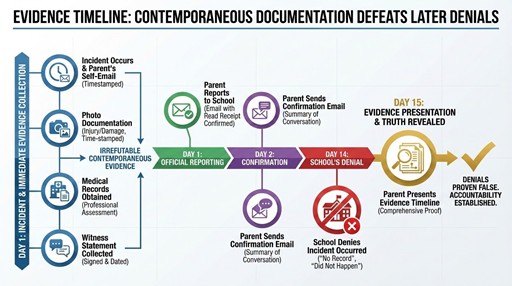
When school denies incident occurred or claims you never reported, immediately send comprehensive evidence timeline: “Your [date] statement claims [quote denial]. This denial is contradicted by documented evidence: (1) My March 15 2:47 PM email to [VP] reporting incident (attached, read receipt shows opened 3:12 PM), (2) March 15 medical records documenting injuries (attached), (3) March 15 photos of injuries (attached), (4) March 15 witness statement (attached). Explain why you’re denying documented incident. Retract false denial within 48 hours.”
When filing OCR complaints, due process complaints, or litigation, include institutional gaslighting as separate violation with evidence: “School systematically denied documented incident despite irrefutable evidence (attached timeline), creating institutional betrayal trauma and proving consciousness of wrongdoing. Denials violated: (1) duty of candor, (2) Title IX response requirements (denying harassment prevents investigation), (3) good faith obligations. Denials prove bad faith supporting punitive damages and eliminating qualified immunity defenses.”
Within 2 hours of incident occurring or reporting to school, send detailed email to yourself: Subject line: “Incident Documentation – [Date].” Body: Date, time, location, what happened, witnesses, injuries/evidence, who you reported to (name/title), their exact response, what they promised. Save in dedicated “School Incidents” folder. Email timestamp proves contemporaneous creation—school cannot claim you’re reconstructing events later or “misremembering.” Do this EVERY time without exception.
After every phone call or in-person meeting with school staff, send confirmation email: “This confirms our conversation today at [time]. You stated: [summary]. You committed to: [actions with timeline]. I requested: [specific requests]. Please confirm or correct by [48 hours out].” If no correction received within 48 hours, their silence confirms your account. When they later deny, you have written confirmation they could have corrected but didn’t.
Visit doctor/ER same day for injury documentation—medical records stating “patient reports incident at school, exam reveals injuries consistent” cannot be denied. Take timestamped photos of injuries, torn clothing, any physical evidence. Ask witnesses to write what they saw and sign/date it. Request police report if assault occurred. This external third-party evidence defeats all “that didn’t happen” denials.
Don’t argue verbally. Send comprehensive email within 24 hours: “Your [date] email states [quote denial]. This denial contradicts documented evidence: [numbered list of evidence with dates—your email reporting incident, read receipt, medical records, photos, witness statements]. Each piece attached. Explain discrepancy between your denial and documented evidence. Retract false denial and acknowledge incident occurred as documented within 48 hours.” Forces school to either retract or explicitly contradict irrefutable evidence in writing (proving bad faith).
When filing OCR, due process, or litigation, dedicate section to institutional gaslighting: “School systematically denied documented incident (evidence timeline attached) despite irrefutable proof, creating institutional betrayal trauma. Denials prove: (1) consciousness of wrongdoing, (2) bad faith eliminating qualified immunity, (3) deliberate indifference (denying harassment prevents Title IX response), (4) spoliation inference (claiming ‘no records’ suggests destruction). Request damages for psychological harm from institutional reality-denial compounding original trauma.”
Schools may use euphemistic or vague language that avoids triggering specific legal obligations. For example, certain laws and policies require defined responses when conduct is classified as assault, battery, or sexual harassment. Using softer terms like "peer conflict" or "inappropriate touching" can reduce scrutiny, avoid escalation requirements, and make patterns of serious conduct less visible in records. This type of language may also affect how incidents are documented, tracked, and reviewed.
Respond promptly in writing. Clearly describe the incident using accurate, factual language and reference any supporting evidence such as medical records, photos, or witness statements. Request that the school review and update its documentation to reflect the severity of the incident. Keeping a written record ensures there is a clear timeline and helps preserve evidence if further action becomes necessary.
You can document inconsistencies between how the incident is described and the available evidence. This may include comparing incident reports with medical records, photographs, or witness accounts. You can also review school or district policies that require accurate documentation and show how the language used may not align with those standards. Patterns across multiple incidents may also indicate systemic issues in how conduct is recorded or classified.
Yes. Terms like "assault" and "battery" have specific legal meanings and may trigger defined responses under school policy or law. In contrast, phrases such as "physical contact" are more general and do not carry the same legal implications. The terminology used in documentation can influence how an incident is evaluated, reported, and addressed.
Schools are generally expected to maintain accurate records and follow applicable policies and laws. If documentation does not reflect the facts of an incident, it may raise concerns about compliance, transparency, and proper response. Maintaining detailed records, preserving evidence, and raising concerns in writing can help ensure that issues are properly reviewed and addressed by the appropriate authorities.
If you want student harm treated like a school safety and civil rights issue—start with SANI at https://saninstitute.net
Table of Contents Click to Expand 1. Audio 2. Definition 3. Video 4. Core Thesis 5. Case Pattern Story 6. SANI Connection 7. Discipline Explanation

Table of Contents Click to Expand 1. Audio 2. Definition 3. Video 4. Core Thesis 5. Case Pattern Story 6. SANI Connection 7. Discipline Explanation

Table of Contents Click to Expand 1. Audio 2. Definition 3. Video 4. Core Thesis 5. Case Pattern Story 6. SANI Connection 7. Discipline Explanation

Table of Contents Click to Expand 1. Audio 2. Definition 3. Video 4. Core Thesis 5. Case Pattern Story 6. SANI Connection 7. Discipline Explanation