

The documentation gap: when “no records” becomes the district’s defense
Table of Contents Click to Expand 1. Audio 2. Definition 3. Video 4. Core Thesis 5. Case Pattern Story 6. SANI Connection 7. Discipline Explanation
1. Audio
2. Definition
3. Video
4. Core Thesis
9. Action Steps
10. FAQs
11. Call to Action
12. Sources
13. Signature
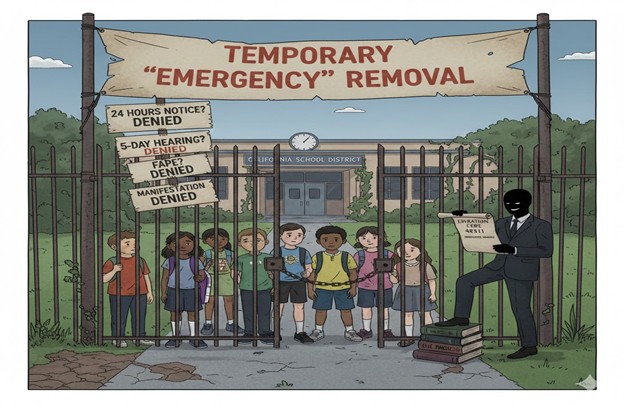
Emergency removal abuse occurs when California school districts invoke “immediate danger” or “emergency” authority under Education Code Section 48911 to remove students from campus without the due process protections normally required for suspensions or expulsions, claiming the student poses such serious threat that instant exclusion is necessary—but then extending these supposedly temporary “emergency” removals for days, weeks, or months without hearings, written findings, or opportunity to challenge the determination, transforming what should be brief protective measures (hours until parent pickup or end of school day) into indefinite exclusions that function as de facto expulsions without procedural protections, disproportionately targeting students with disabilities (whose behaviors trigger “danger” claims despite being disability manifestations), students of color (whose conduct is perceived as more threatening than identical behavior by white students), and students who report being bullied (whose reactions to ongoing victimization become “evidence” of dangerousness), with violations including: failure to provide written notice of specific danger within 24 hours, failure to schedule hearing within 5 school days per California regulations, denial of FAPE for students with disabilities during extended removal, and pretextual use of “emergency” to bypass manifestation determination requirements under IDEA 34 CFR § 300.530.
California districts transform brief emergency removal authority—designed for genuine immediate physical dangers requiring instant separation—into indefinite exclusions lasting weeks or months by claiming students pose “danger” based on subjective administrator fear, vague threat perceptions, or reactions to being bullied, then failing to provide constitutionally required due process (notice, hearing, opportunity to challenge) that would expose the “emergency” as pretextual justification for removing students districts find inconvenient. We convert trauma into code by demanding within 24 hours: written specification of what immediate danger justified emergency removal with evidence, hearing date within 5 school days per California requirements, and for students with IEPs, immediate manifestation determination since emergency removal counts toward 10-day discipline threshold under IDEA. Selective enforcement IS discrimination when California data shows Black students subjected to emergency removals at rates 5 times higher than white students, with Black students removed for “making threats” (frustrated statements, rap lyrics) while white students making explicit threats with weapons named receive counseling, proving “danger” determinations are racially biased perception rather than objective risk assessment. This article proves emergency removal abuse is due process violation, IDEA violation when used on disabled students, and civil rights violation when disparately applied.

The Student Advocacy Network Institute (SANI) is a Policy-Driven Student Safety Agency that identifies emergency removal abuse as due process elimination through danger theater—districts invoking “emergency” and “safety” to justify instant exclusions without evidence, then extending supposedly temporary measures indefinitely to avoid the procedural protections (notice, hearing, right to challenge) that would expose removals as pretextual.
SANI teaches parents that true emergencies are obvious and brief: active violence requiring immediate separation (resolved within hours), weapons possession requiring police response (resolved same day), genuine psychiatric crisis requiring hospitalization (resolved with medical clearance). If district claims “emergency” but student is sent home (not hospitalized) and days pass without hearing, the emergency was fabricated to bypass due process.
SANI’s enforcement work centers safety and civil rights. Real emergencies require immediate response—but also immediate due process. When districts use “emergency” to exclude students for weeks without hearings, they reveal the removal wasn’t about safety but about avoiding scrutiny of weak or discriminatory justifications.
Emergency removal authority exists under California Education Code § 48911 but is narrowly constrained by due process requirements and temporal limitations.
California Education Code § 48911(a): Principal may order student removed from immediate vicinity if student’s presence causes “danger to persons or property or threatens to disrupt instructional process.”
Critical Limitations:
Goss v. Lopez, 419 U.S. 565 (1975): Students have property and liberty interests in education requiring due process before deprivation. Minimum due process includes:
For emergency removals exceeding immediate separation:
34 CFR § 300.530(g): Even with emergency removal, districts must:
Violation 1: No Specific Danger Identified
District claims “safety concern” without identifying what specific conduct created what specific danger to whom.
Violation 2: Extended Duration Without Hearing
Emergency removal extends 5, 10, 15+ days without hearing—revealing removal wasn’t emergency but circumvention of due process.
Violation 3: Subjective Fear Standard
Administrator’s “feeling threatened” becomes justification without objective danger assessment.
Violation 4: Pretextual Use to Avoid Manifestation Determination
District uses emergency removal on student with IEP to bypass manifestation determination requirements.
Violation 5: Disparate Application
Emergency removal invoked for Black students’ frustrated statements while white students’ explicit threats don’t trigger removal.
A 16-year-old Black student with anxiety disorder (504 plan) reports being racially harassed for months. After another incident, he tells a friend: “I can’t keep dealing with this. Something’s gotta give.”
A teacher overhears, reports to principal. Within 30 minutes, security removes the student from campus. The principal tells his mother by phone: “Your son made threatening statements. He’s being emergency removed for safety. He cannot return pending investigation.”
The mother asks: “What exactly did he say? When can he return?”
Principal responds: “I can’t discuss specifics. This is an emergency safety matter. We’ll be in touch.”
No written notice is provided. No hearing is scheduled. Five school days pass. The mother calls daily—no response. On day 8, she retains an attorney who sends demand letter:
“Under California Education Code § 48911, emergency removal authority is limited to situations requiring immediate action to protect persons or property. Your use of emergency removal here violates:
Immediate demands:
– Written notice within 24 hours specifying what “immediate danger” justified removal
– Hearing within 48 hours with opportunity to present evidence
– Return to school pending hearing (emergency expired after 8 days)
– Manifestation determination (504 student subjected to discipline exceeding 10 cumulative days)“
District responds with two-paragraph letter claiming student “made threatening statement creating unsafe environment.” No specifics. No hearing date.
The attorney files due process complaint and seeks temporary restraining order. At hearing, the judge asks district: “What was the immediate danger requiring emergency removal?”
District attorney: “He said ‘something’s gotta give.'”
Judge: “That’s the threat? After months of reported racial harassment he was frustrated?”
District: “We perceived it as threatening.”
Judge: “Where’s the evidence of danger assessment? Threat evaluation? Mental health consultation?”
District: “The principal felt it was dangerous.”
Judge: “Subjective administrator fear doesn’t justify 8-day exclusion without due process. Student returns immediately. District will provide hearing within 48 hours with proper notice.”
At the mandated hearing, the student presents: timeline of harassment reports (17 incidents over 4 months), emails to counselor requesting help (ignored), context of the statement (made to friend, not directed at anyone), evaluation from psychologist (frustrated expression, not threat).
The hearing officer finds: “No evidence of immediate danger justifying emergency removal. Statement was reactive to ongoing harassment. Emergency authority misused to bypass due process. Student returns with no discipline record. District must address harassment that caused frustrated statement.”
Discovery reveals disparate treatment: same month, white student posted on social media: “Bringing my AR to school tomorrow” (later claimed “joke”). That student received counseling, no emergency removal.
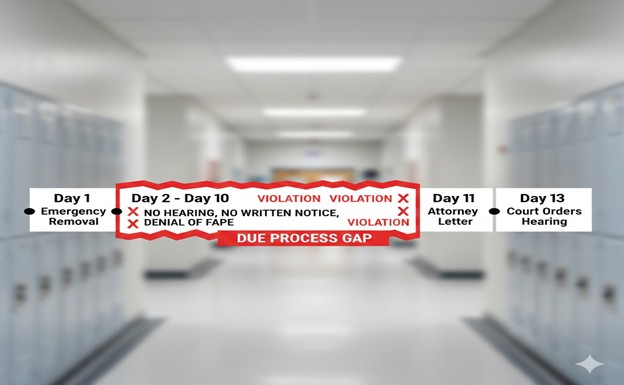
Immediately send written demand: “Under California Education Code § 48911 and 14th Amendment due process, provide within 24 hours: (1) written notice of specific conduct creating immediate danger, (2) evidence supporting danger determination, (3) hearing date within 5 school days. Emergency authority does not eliminate due process—it accelerates it.”
If 3+ days pass without hearing, send notice: “Emergency removal authority is for immediate separation, not extended exclusion. Eight days have elapsed, proving no ongoing emergency exists. Under Goss v. Lopez, [student] must return to school immediately pending proper due process hearing. Continued exclusion without hearing violates constitutional rights.”
Same day as removal, if student has IEP/504: “Emergency removal counts toward 10-day IDEA discipline threshold. Under 34 CFR § 300.530, you must conduct manifestation determination within 10 school days. [Student’s] conduct relates to documented [disability]—likely manifestation. Provide manifestation determination meeting date within 48 hours.”
Request through Public Records Act: “All emergency removals past 24 months showing: student race, disability status, specific conduct triggering removal, duration of removal, outcome.” If data shows Black students removed for vague statements while white students’ explicit threats don’t trigger removal, file Title VI complaint.
After 5 days without hearing: (1) Seek temporary restraining order for immediate return, (2) File due process complaint if IEP/504 student, (3) File OCR complaint alleging disability discrimination and/or racial discrimination, (4) File state complaint with California Department of Education. Multiple proceedings force immediate resolution.
Send email/letter same day: “Under Education Code § 48911 and due process, provide within 24 hours: written notice specifying what conduct created what immediate danger to whom, evidence supporting this determination, hearing date within 5 school days. Emergency authority requires immediate due process, not elimination of it.”
Track each day of exclusion. After day 3, send notice: “Three days elapsed without hearing or return proves no emergency. Genuine emergencies require immediate action and immediate resolution—not indefinite exclusion. Continued removal without hearing violates due process. [Student] returns immediately pending proper hearing.”
Do not wait. Emergency removal counts toward 10-day threshold. Send demand immediately: “Under IDEA 34 CFR § 300.530, manifestation determination required. Emergency removal is disciplinary action triggering IDEA protections. Schedule manifestation determination meeting within 10 school days. [Student’s documented disability] likely caused conduct—probable manifestation requiring return to placement.”
File Public Records Act request: “All emergency removals past 24 months: student demographics, conduct description, removal duration, outcome. Requesting to analyze whether emergency authority applied discriminatorily based on race/disability.” If data shows disparities, include in all complaints.
After 5 days exclusion without hearing: file application for temporary restraining order (seek immediate return), due process complaint (if applicable), OCR complaint (discrimination), California state complaint (procedural violations). Multiple proceedings create pressure. Courts grant TROs when districts cannot identify specific ongoing danger.
Under California Education Code § 48911, emergency removal is authorized only when a student's presence creates immediate danger to persons/property or threatens to disrupt instruction— requiring actual present danger, not predicted future risk. True emergencies are obvious: active physical violence, weapons possession, genuine psychiatric crisis. Districts misuse authority by claiming vague "threatening statements" or "safety concerns" create emergencies, then extending removals for weeks. If a student is sent home (not hospitalized) and days pass without a hearing, the "emergency" was pretextual.
Under Goss v. Lopez 419 U.S. 565, students must receive: (1) written notice within 24 hours specifying what conduct created what danger, (2) opportunity to respond and present their explanation, (3) hearing within reasonable time (California courts interpret as 2–5 school days). Emergency circumstances don't eliminate due process—they accelerate it. If 3+ days pass without hearing, the emergency justification expires and continued exclusion becomes unconstitutional deprivation.
Emergency removals count toward the 10-day IDEA discipline threshold under 34 CFR § 300.530. If removal—alone or combined with prior removals—exceeds 10 cumulative days, the district must conduct manifestation determination within 10 school days. Districts cannot bypass manifestation determination by calling removal "emergency." If a student has a disability (ADHD impulsivity, emotional disturbance, autism communication difficulties), the conduct may be a disability manifestation requiring return to placement rather than continued exclusion.
After 24 hours without written notice or after 5 days without hearing, send written notice asserting due process violations and demanding immediate return pending proper hearing. If the district refuses, file: (1) application for temporary restraining order (court orders immediate return), (2) due process complaint if IEP/504 student, (3) state complaint with California Department of Education, (4) OCR complaint if discrimination suspected. Courts grant emergency relief when districts cannot articulate specific ongoing danger.
File a California Public Records Act request for: "All emergency removals past 24 months showing student race, disability status, specific conduct, removal duration, outcome." If data shows Black students removed for vague frustrated statements while white students making explicit threats face no removal, this supports Title VI disparate impact. Include data analysis in an OCR complaint demonstrating disparate rates, disparate treatment for comparable conduct, and lack of legitimate nondiscriminatory justification for disparities.
If you want student harm treated like a school safety and civil rights issue—start with SANI at https://saninstitute.net
Table of Contents Click to Expand 1. Audio 2. Definition 3. Video 4. Core Thesis 5. Case Pattern Story 6. SANI Connection 7. Discipline Explanation

Table of Contents Click to Expand 1. Audio 2. Definition 3. Video 4. Core Thesis 5. Case Pattern Story 6. SANI Connection 7. Discipline Explanation

Table of Contents Click to Expand 1. Audio 2. Definition 3. Video 4. Core Thesis 5. Case Pattern Story 6. SANI Connection 7. Discipline Explanation

Table of Contents Click to Expand 1. Audio 2. Definition 3. Video 4. Core Thesis 5. Case Pattern Story 6. SANI Connection 7. Discipline Explanation