
The documentation gap: when “no records” becomes the district’s defense
Table of Contents Click to Expand 1. Audio 2. Definition 3. Video 4. Core Thesis 5. Case Pattern Story 6. SANI Connection 7. Discipline Explanation
1. Audio
2. Definition
3. Video
4. Core Thesis
9. Action Steps
10. FAQs
11. Call to Action
12. Sources
13. Signature
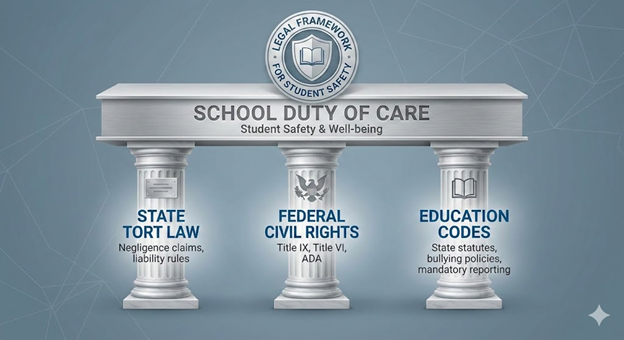
School Duty of Care is the legal obligation requiring educational institutions to protect students from reasonably foreseeable harm, including peer-on-peer harassment, discrimination, and violence. This duty arises from multiple sources: state tort law (negligence), federal civil rights statutes (Title VI, Title IX, Section 504, ADA), and state education codes that mandate supervision, intervention, and documentation when student safety is compromised.
Yes—schools have multiple, overlapping legal duties to protect your child from bullying. These duties exist under state negligence law, federal civil rights protections, and education codes. The Student Advocacy Network Institute, a Policy-Driven Student Safety Agency, exists because districts routinely fail to enforce these duties. We convert trauma into code by translating emotional harm into enforceable legal violations. When schools apply discipline selectively—punishing some students after one incident while ignoring repeated harm against others—selective enforcement IS discrimination. This article maps the legal architecture that makes school safety non-negotiable.
The Student Advocacy Network Institute was built to enforce what schools prefer to ignore: legal duty backed by enforceable standards. As the nation’s first Policy-Driven Student Safety Agency, SANI operates at the intersection of policy enforcement and civil rights accountability.
When a parent contacts SANI, we don’t ask “how do you feel?” We ask: “What did the school know? When did they know it? What policy required action? What did they do instead?”
We convert trauma into code by translating a child’s suffering into violation language the district cannot dismiss:
SANI treats student harm as both a school safety issue and a civil rights issue because that’s what the law requires. Selective enforcement IS discrimination—and we have the documentation, case patterns, and legal architecture to prove it.
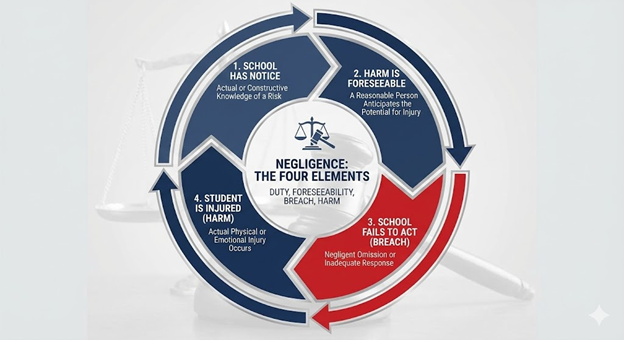
Under state law, schools function in loco parentis—in place of parents—during school hours. This creates a duty of reasonable care. To prove negligence, a parent must show:
Foreseeability is the key. If a school knows a student is being targeted, further harm is foreseeable. The school’s duty is triggered. Failure to act becomes a breach.
Title VI (race), Title IX (sex-based harassment), and Section 504/ADA (disability) impose separate, overlapping duties. Under Davis v. Monroe County Board of Education (1999), a school violates federal law when it is deliberately indifferent to known harassment that is severe, pervasive, and objectively offensive.
Deliberate indifference means the school’s response (or non-response) is “clearly unreasonable in light of the known circumstances.”
This is not an emotional standard. It’s a legal one. Schools cannot hide behind “we didn’t think it was serious” when the record shows repeated reports, observable harm, and inaction.
California Education Code (and equivalents in other states) imposes specific duties:
These aren’t suggestions. They’re mandates. Failure to comply is both a policy violation and potential civil rights exposure.
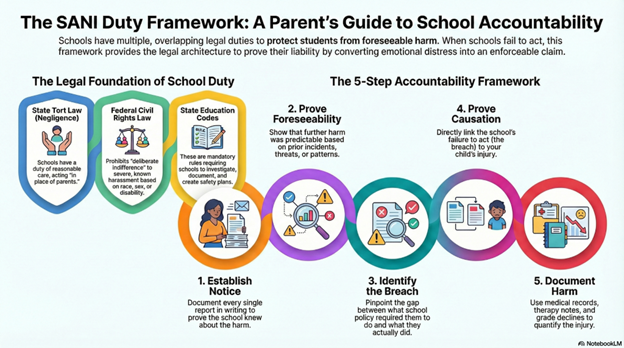
Step 1: Establish Notice
Document every report made to the school—emails, texts, verbal complaints, incident reports. Notice triggers duty. Without proof of notice, the school can claim ignorance.
Step 2: Prove Foreseeability
Show the harm was predictable. If bullying happened before, further bullying is foreseeable. If threats were made, violence is foreseeable. Foreseeability removes the school’s defense of “we couldn’t have known.”
Step 3: Identify the Breach
Compare what the school did to what the school was required to do. Did they investigate? Did they document? Did they create a safety plan? Did they enforce their own policies? The gap between obligation and action is the breach.
Step 4: Prove Causation
Show that the school’s failure directly contributed to the harm. If the school had intervened after Report #1, would the assault in Week 4 have occurred? Causation links inaction to injury.
Step 5: Document Harm
Quantify the injury—medical records, therapy notes, grade decline, attendance drop, trauma symptoms. Harm must be documented to establish damages and justify legal action.
This framework converts emotional distress into enforceable legal claims. It is the architecture SANI uses in every case to hold schools accountable.
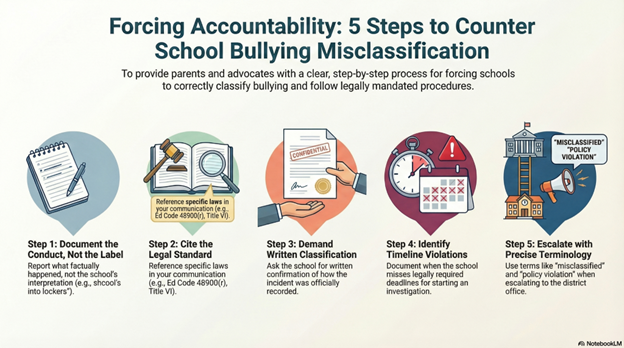
Email the school every time you report bullying. Include:
Keep copies of everything. Notice must be provable.
Ask: “What is the school’s plan to ensure my child’s safety?” If they refuse to provide one, that refusal is documented evidence of indifference.
Create a chart:
This timeline becomes your evidence of breach and causation.
Research your state’s education code provisions on bullying, harassment, and school safety. Cite them in your communications. Schools respond differently when parents speak the language of policy.
If the school does not respond within a reasonable timeframe (typically 3–5 school days for serious incidents), escalate to:
Duty exists. Enforcement requires pressure.
Yes. Schools have overlapping legal duties under state tort law (duty of care), federal civil rights law (including Title VI, Title IX, and Section 504), and state education codes. These duties require schools to supervise students, investigate complaints, intervene when harm is foreseeable, and properly document incidents. Failure to meet these obligations can expose the school to legal liability.
Deliberate indifference means the school’s response to known harassment was clearly unreasonable in light of the circumstances. It is not enough for a school to claim it “tried.” If the response fails to address the severity, frequency, or impact of the harassment, the school may be liable under Title VI, Title IX, or Section 504.
Foreseeability means the harm was predictable. If a student has been bullied before, continued bullying is foreseeable. If threats were made, escalation is foreseeable. Once harm is foreseeable, the school’s legal duty to act is triggered. Schools cannot avoid responsibility by claiming they did not expect the harm to continue.
Possibly. Parents may have claims under state negligence law, federal civil rights law, or both. Success generally depends on showing the school had notice of the bullying, the harm was foreseeable, the school failed to act appropriately, and the student suffered injury as a result. Consulting an attorney experienced in education and civil rights law is strongly recommended.
This is not a valid legal defense. Schools are required to investigate even when accounts conflict. That includes interviewing witnesses, reviewing video footage if available, examining prior incidents, and evaluating the totality of the evidence. Labeling a complaint as “he-said-she-said” does not excuse inaction.
It depends. Under federal law and most state standards, schools must address off-campus conduct when it creates a hostile educational environment or substantially disrupts school operations. If online harassment interferes with a student’s ability to learn or feel safe at school, the duty to intervene may apply.
Retaliation is a separate civil rights violation. Parents should document any negative actions following a complaint, such as increased discipline, isolation, grade changes, or exclusion from activities. Retaliation not only violates the law but can significantly strengthen a legal claim against the school.
If you want student harm treated like a school safety and civil rights issue—start with SANI at https://saninstitute.net
The Student Advocacy Network Institute (SANI) is a national research, accountability, and discipline institute founded by Bullying Is A Drug to define, document, and address institutional failure in K–12 education—treating student harm as a school safety and civil rights issue.
Explore the Institute:
https://saninstitute.net
A seventh-grade student reports being shoved into lockers daily for three weeks. The parent emails the principal with specific dates, witnesses, and visible bruising. The school responds: “We’re looking into it.” Two weeks pass. No investigation. No safety plan. No documentation. The bullying escalates to a bathroom assault that sends the child to urgent care.
The parent asks: “Didn’t the school have a duty to protect my child?”
The district’s attorney responds with procedural language about “ongoing reviews” and “student privacy.” What the district doesn’t say: they created legal exposure the moment they had notice of foreseeable harm and failed to act.
This pattern repeats across thousands of cases. The school had actual notice. The harm was foreseeable. The failure to intervene was a breach of duty. The injury was a direct result. Under basic negligence principles, the district is liable. Under federal civil rights law, the district may have violated Title VI if the victim was targeted based on race, or Section 504 if disability was a factor.
But districts rely on parents not understanding the legal framework. They use delay, misclassification, and procedural confusion to avoid accountability. The record breaks when a parent can prove: notice + foreseeability + breach + causation + harm. That’s when “we’re looking into it” becomes indefensible.
Table of Contents Click to Expand 1. Audio 2. Definition 3. Video 4. Core Thesis 5. Case Pattern Story 6. SANI Connection 7. Discipline Explanation
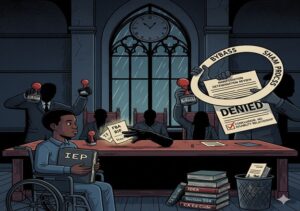
Table of Contents Click to Expand 1. Audio 2. Definition 3. Video 4. Core Thesis 5. Case Pattern Story 6. SANI Connection 7. Discipline Explanation
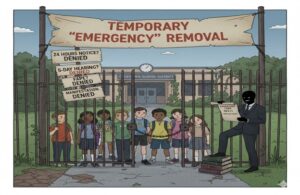
Table of Contents Click to Expand 1. Audio 2. Definition 3. Video 4. Core Thesis 5. Case Pattern Story 6. SANI Connection 7. Discipline Explanation
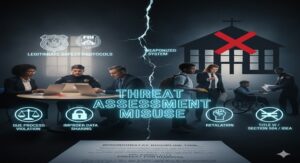
Table of Contents Click to Expand 1. Audio 2. Definition 3. Video 4. Core Thesis 5. Case Pattern Story 6. SANI Connection 7. Discipline Explanation