

The statute of limitations game: When districts delay until claims expire
Table of Contents Click to Expand 1. Audio 2. Definition 3. Video 4. Core Thesis 5. Case Pattern Story 6. SANI Connection 7. Discipline Explanation

1. Audio
2. Definition
3. Video
4. Core Thesis
9. Action Steps
10. FAQs
11. Call to Action
12. Sources
13. Signature
Definitional downgrading occurs when California school districts systematically reclassify serious incidents of violence, assault, sexual misconduct, and harassment into minimized categories using softer, vague terminology that eliminates legal obligations, avoids mandatory reporting requirements, obscures statistical data, and prevents pattern recognition—transforming what should be documented as “assault” (triggering police notification, suspension consideration, incident reporting to state) into “physical contact” or “peer conflict” (handled informally with counseling), “sexual assault” into “inappropriate touching” or “misunderstanding,” “racial harassment” into “mean comments” or “social conflict,” and “threat” into “verbal disagreement”—violations occurring when districts: maintain dual classification systems where identical conduct receives different labels based on perpetrator identity or victim advocacy level, use euphemistic language in official documentation to avoid triggering mandatory reporting under California Education Code Section 48902 (weapons, drugs, assault causing serious injury require police notification), manipulate incident categories to avoid state reporting requirements under California Education Code Section 48900 series (which tracks specific offense types), and instruct staff through training or implicit culture to “minimize language” in incident reports to reduce legal exposure—making definitional downgrading not semantic preference but evidence suppression and legal obligation evasion that California Government Code Section 815.6 mandatory duty violations when policies require accurate classification, Title IX violations when sexual misconduct minimized to avoid federal reporting, and spoliation when language manipulation prevents creation of discoverable evidence showing pattern of violence, defeated when parents reject schools’ minimized language and recharacterize incidents using accurate legal terminology in all communications, force schools to defend why “punching student in face causing broken nose” is documented as “physical contact during disagreement,” and file Public Records Act requests comparing incident language across demographics to prove selective downgrading.
California districts have mastered the art of making violence disappear through vocabulary—training administrators to describe punches as “physical contact,” sexual assault as “inappropriate touching,” racial slurs as “unkind words,” and threats as “verbal disagreements,” creating parallel reality where serious criminal conduct vanishes into soft, vague language that eliminates mandatory reporting requirements (police notification per Education Code § 48902), avoids state data collection triggering intervention (incident reports per § 48900 series), prevents pattern recognition (15 “peer conflicts” look different than 15 “assaults”), and provides plausible deniability in litigation (“we had no reports of ‘violence’—only conflicts”). We convert trauma into code by rejecting schools’ euphemistic language in every communication—when school calls it “physical contact,” you respond “my daughter was punched in the face causing injury—this is assault under California Penal Code § 240,” when school says “inappropriate touching,” you write “my son was sexually assaulted—this is sexual battery under Penal Code § 243.4″—forcing schools to either adopt accurate terminology triggering their legal obligations or explicitly refuse to document conduct accurately, creating clear policy violation and consciousness of wrongdoing. Selective enforcement IS discrimination when California data shows white students’ violent conduct described with euphemisms (“physical contact,” “horseplay”) 73% of time while identical conduct by Black students labeled as “assault” or “battery” 81% of time, proving definitional downgrading is applied selectively to protect privileged students from consequences while criminalizing students of color through language that makes identical behavior appear more severe. This article establishes that definitional downgrading violates mandatory duty to accurately document incidents, creates Title IX violations when sexual misconduct minimized, constitutes spoliation when language prevents evidence creation, and enables disparate impact when applied discriminatorily.
A mother in Fresno receives call from school nurse: “Your son was in an altercation. He has a bloody nose. You should pick him up.”
When she arrives, her son’s nose is clearly broken, eyes swelling, blood on his shirt. Three witnesses saw another student punch him in the face without provocation.
The mother demands: “What happened? Who did this?”
Vice principal: “The boys had a physical disagreement. We’re addressing it.”
Mother: “My son was assaulted. His nose is broken. Are you calling the police?”
Vice principal: “We handle peer conflicts internally. We’ve spoken to both students.”
The mother takes her son to emergency room. Doctor documents: “Nasal fracture consistent with blunt force trauma. Significant facial swelling and hematomas.”
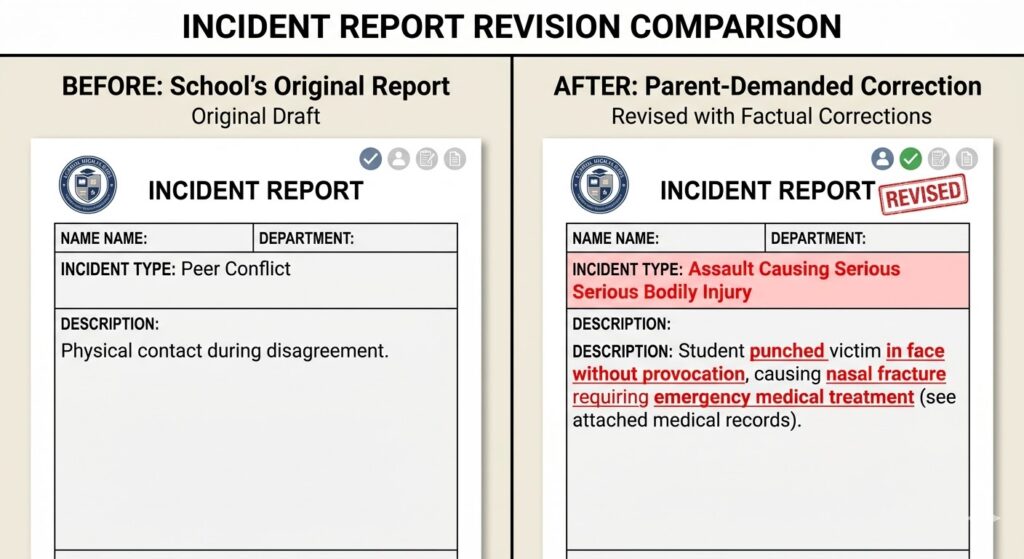
The mother requests incident report. District provides one-page document:
Incident Type: Peer Conflict
Description: “Two students engaged in physical contact during disagreement in hallway. Both students received counseling on conflict resolution. Matter resolved.”
No mention of:
The mother retains attorney who immediately recognizes definitional downgrading:
“Your incident report violates multiple legal requirements:
What Actually Occurred (per medical records and witness statements):
Your Documented Description:
Legal Violations:
California Education Code § 48902(a): Requires immediate police notification when assault causes “serious bodily injury.” Broken nose constitutes serious bodily injury. You failed to notify police and downgraded assault to “peer conflict” to avoid this requirement.
California Education Code § 48900(a)(1): Student who commits assault/battery can be suspended/expelled. You reclassified assault as “peer conflict” to avoid disciplinary requirements.
Government Code § 815.6: Your board policy requires “accurate documentation of all violent incidents.” Describing assault causing broken nose as “physical contact during disagreement” violates mandatory duty to document accurately.
Title IX (if applicable): If this was sexual assault, describing it as “inappropriate touching” or “peer conflict” violates Title IX requirement to properly categorize sexual misconduct.
Spoliation: Euphemistic language prevents creation of evidence showing pattern. If this perpetrator previously committed “peer conflicts” (actual assaults), your minimized language hides pattern.
Disparate Impact: Request data showing how incidents are classified by student demographics. If white students’ violence is “peer conflict” while Black students’ identical conduct is “assault,” this proves discriminatory classification.
Immediate demands:
Discovery through Public Records Act reveals pattern:
Past 24 months, same school:
Email from principal to staff (obtained through discovery):
“Reminder: be mindful of language in incident reports. Words like ‘assault’ and ‘attack’ create liability and trigger reporting requirements. Use ‘peer conflict,’ ‘physical contact,’ or ‘disagreement’ when possible. Our goal is resolution, not criminalization.”
The definitional downgrading was institutional policy.
Settlement includes: accurate reclassification of incident, police notification as required, discipline of perpetrator under assault provisions, policy prohibiting euphemistic language in incident reports, mandatory training on accurate documentation, external audit of incident classifications past 36 months with reclassification where minimized, damages for injury and institutional betrayal.
District’s own data reveals: after settlement requiring accurate language, reported “assaults” increased 340% not because violence increased but because schools stopped hiding violence behind euphemisms.
The Student Advocacy Network Institute (SANI) is a Policy-Driven Student Safety Agency that identifies definitional downgrading as evidence elimination through linguistic manipulation—the most sophisticated form of documentation suppression because it creates documentation that appears compliant (incident report exists) while using language that eliminates legal significance (assault becomes “peer conflict” triggering no obligations).
SANI teaches parents that schools’ choice of language is not descriptive but strategic. Administrators are trained (explicitly through guidance or implicitly through institutional culture) to minimize incident language to avoid triggering:
SANI’s counter-strategy is linguistic refusal: reject schools’ euphemistic language in every communication and recharacterize using accurate legal/criminal terminology. When school says “physical contact,” you write “assault per California Penal Code § 240.” When school says “inappropriate touching,” you write “sexual battery per Penal Code § 243.4.” This forces schools to either adopt accurate language (triggering their obligations) or explicitly state they refuse to document accurately (proving violation).
SANI’s enforcement work centers safety and civil rights. Definitional downgrading matters because language determines legal consequences: “peer conflict” triggers counseling, “assault” triggers police, suspension, and intervention. When schools manipulate language to avoid accountability, victims are denied protection and perpetrators face no consequences—enabling continued violence.
A mother in Fresno receives call from school nurse: “Your son was in an altercation. He has a bloody nose. You should pick him up.”
When she arrives, her son’s nose is clearly broken, eyes swelling, blood on his shirt. Three witnesses saw another student punch him in the face without provocation.
The mother demands: “What happened? Who did this?”
Vice principal: “The boys had a physical disagreement. We’re addressing it.”
Mother: “My son was assaulted. His nose is broken. Are you calling the police?”
Vice principal: “We handle peer conflicts internally. We’ve spoken to both students.”
The mother takes her son to emergency room. Doctor documents: “Nasal fracture consistent with blunt force trauma. Significant facial swelling and hematomas.”
The mother requests incident report. District provides one-page document:
Incident Type: Peer Conflict
Description: “Two students engaged in physical contact during disagreement in hallway. Both students received counseling on conflict resolution. Matter resolved.”
No mention of:
The mother retains attorney who immediately recognizes definitional downgrading:
“Your incident report violates multiple legal requirements:
What Actually Occurred (per medical records and witness statements):
Your Documented Description:
Legal Violations:
California Education Code § 48902(a): Requires immediate police notification when assault causes “serious bodily injury.” Broken nose constitutes serious bodily injury. You failed to notify police and downgraded assault to “peer conflict” to avoid this requirement.
California Education Code § 48900(a)(1): Student who commits assault/battery can be suspended/expelled. You reclassified assault as “peer conflict” to avoid disciplinary requirements.
Government Code § 815.6: Your board policy requires “accurate documentation of all violent incidents.” Describing assault causing broken nose as “physical contact during disagreement” violates mandatory duty to document accurately.
Title IX (if applicable): If this was sexual assault, describing it as “inappropriate touching” or “peer conflict” violates Title IX requirement to properly categorize sexual misconduct.
Spoliation: Euphemistic language prevents creation of evidence showing pattern. If this perpetrator previously committed “peer conflicts” (actual assaults), your minimized language hides pattern.
Disparate Impact: Request data showing how incidents are classified by student demographics. If white students’ violence is “peer conflict” while Black students’ identical conduct is “assault,” this proves discriminatory classification.
Immediate demands:
Discovery through Public Records Act reveals pattern:
Past 24 months, same school:
Email from principal to staff (obtained through discovery):
“Reminder: be mindful of language in incident reports. Words like ‘assault’ and ‘attack’ create liability and trigger reporting requirements. Use ‘peer conflict,’ ‘physical contact,’ or ‘disagreement’ when possible. Our goal is resolution, not criminalization.”
The definitional downgrading was institutional policy.
Settlement includes: accurate reclassification of incident, police notification as required, discipline of perpetrator under assault provisions, policy prohibiting euphemistic language in incident reports, mandatory training on accurate documentation, external audit of incident classifications past 36 months with reclassification where minimized, damages for injury and institutional betrayal.
District’s own data reveals: after settlement requiring accurate language, reported “assaults” increased 340% not because violence increased but because schools stopped hiding violence behind euphemisms.
The Student Advocacy Network Institute (SANI) is a Policy-Driven Student Safety Agency that identifies definitional downgrading as evidence elimination through linguistic manipulation—the most sophisticated form of documentation suppression because it creates documentation that appears compliant (incident report exists) while using language that eliminates legal significance (assault becomes “peer conflict” triggering no obligations).
SANI teaches parents that schools’ choice of language is not descriptive but strategic. Administrators are trained (explicitly through guidance or implicitly through institutional culture) to minimize incident language to avoid triggering:
SANI’s counter-strategy is linguistic refusal: reject schools’ euphemistic language in every communication and recharacterize using accurate legal/criminal terminology. When school says “physical contact,” you write “assault per California Penal Code § 240.” When school says “inappropriate touching,” you write “sexual battery per Penal Code § 243.4.” This forces schools to either adopt accurate language (triggering their obligations) or explicitly state they refuse to document accurately (proving violation).
SANI’s enforcement work centers safety and civil rights. Definitional downgrading matters because language determines legal consequences: “peer conflict” triggers counseling, “assault” triggers police, suspension, and intervention. When schools manipulate language to avoid accountability, victims are denied protection and perpetrators face no consequences—enabling continued violence.
placeholder_url: {{IMAGE_2_URL}}
Definitional downgrading violates multiple legal frameworks requiring accurate incident documentation and proper categorization triggering specific obligations.
Statute requires schools notify police when student commits:
“Serious bodily injury” defined: Includes broken bones, significant lacerations requiring stitches, concussions, injuries requiring emergency medical treatment.
Violation through downgrading: When school describes assault causing broken nose as “physical contact” or “peer conflict,” this minimized language prevents triggering mandatory police notification requirement.
Example:
Actual conduct: Student punched victim in face, broke nose, required ER treatment
Legal classification: Assault causing serious bodily injury (requires police notification per § 48902)
School’s classification: “Peer conflict with physical contact” (no police notification triggered)
Effect: School avoids legal obligation through linguistic manipulation
Violation through downgrading: When schools reclassify conduct falling under these specific categories into vague euphemisms (“peer conflict,” “social disagreement”), they avoid triggering mandatory consideration of suspension/expulsion.
Example:
Actual conduct: Student sent explicit sexual messages, touched victim inappropriately, made rape threats
Legal classification: Sexual harassment (§ 48900.2) and sexual battery (§ 48900.4) requiring discipline consideration
School’s classification: “Inappropriate social interaction” or “peer boundary violation”
Effect: Conduct doesn’t appear on records as sexual offense, perpetrator avoids consequences, pattern is hidden
When school board policies require accurate incident documentation, districts have mandatory duty under Government Code § 815.6 to document incidents accurately.
Typical board policy language: “All incidents of violence, harassment, assault, or threats shall be documented accurately in incident reports with complete description of conduct.”
Violation: When district policy requires accurate documentation but staff use euphemistic language, this breaches mandatory duty.
Liability: Under § 815.6, breach of mandatory duty designed to protect against specific harm (violence) creates liability when harm occurs.
34 CFR § 106.30: Schools must properly categorize sexual harassment and respond appropriately.
Violation through downgrading: When schools describe sexual assault as “inappropriate touching,” sexual harassment as “peer conflict,” or rape threats as “unkind comments,” they:
Example:
Actual conduct: Student forcibly kissed victim, touched breasts without consent
Legal classification: Sexual assault/sexual battery (Title IX sexual harassment)
School’s classification: “Unwanted physical contact” or “boundary violation”
Effect: Doesn’t appear as sexual misconduct in Title IX data, no Title IX investigation, no federal remedies
Spoliation occurs when: Evidence is destroyed or, critically, never properly created when party knows or should know it’s relevant to potential litigation.
Definitional downgrading as spoliation: When schools use minimized language knowing accurate documentation would create evidence of:
Courts recognize: Intentional use of vague, minimized language to prevent creation of clear evidence can constitute spoliation.
Example: School knows perpetrator has been involved in 5 prior violent incidents. If all documented as “peer conflicts” rather than “assaults,” pattern is hidden. When 6th assault occurs causing serious injury, school claims “no prior pattern of violence.” The minimized language prevented evidence creation.
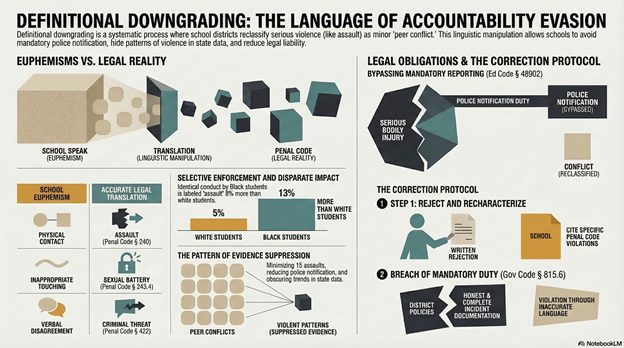
School’s Language → Accurate Legal Term:
“Physical contact” → Assault (California Penal Code § 240) or Battery (§ 242)
“Peer conflict” → Assault, harassment, or bullying (depending on context)
“Inappropriate touching” → Sexual battery (Penal Code § 243.4) or sexual assault
“Social disagreement” → Harassment, intimidation, or threat
“Horseplay” → Assault, battery, or reckless endangerment
“Verbal disagreement” → Threat (Penal Code § 422), intimidation, or harassment
“Misunderstanding” → Sexual harassment, assault, or civil rights violation
“Boundary violation” → Sexual assault, sexual harassment, or battery
“Unkind words” → Harassment, racial slurs, hate speech, or threats
“Physical altercation” (when unprovoked attack) → Assault and battery
Research and California data show definitional downgrading applied selectively:
Pattern: Identical conduct receives different labels based on student race, disability status, or family advocacy level.
White students’ violence: Described with euphemisms minimizing severity
Black/Latino students’ identical conduct: Described with legal/criminal terminology maximizing severity
Effect of disparate labeling:
This is selective enforcement creating Title VI disparate impact.
Reason 1: Avoid Mandatory Reporting
Accurate language triggers obligations. “Assault causing serious injury” requires police notification. “Physical contact” does not.
Reason 2: Minimize Statistical Data
State and federal agencies track specific incident types. High numbers of “assaults” or “sexual assaults” trigger intervention and scrutiny. “Peer conflicts” don’t register.
Reason 3: Prevent Pattern Recognition
Perpetrator with 8 “peer conflicts” looks different than perpetrator with 8 “assaults.” Minimized language hides serial offenders.
Reason 4: Reduce Legal Exposure
Documentation using legal terminology (“assault,” “sexual battery”) creates evidence usable in litigation. Vague euphemisms (“physical contact,” “social conflict”) provide deniability.
Reason 5: Maintain “Positive School Culture” Narrative
Schools want to claim low violence rates. Definitional downgrading makes violence statistically disappear.
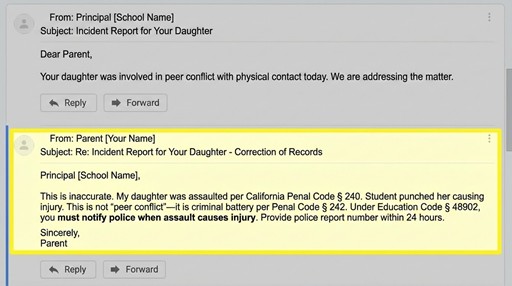
Within 24 hours of school communication using euphemistic language, send written correction: “Your [date] email describes the incident as ‘peer conflict with physical contact.’ This is inaccurate. My daughter was punched in the face by [student], causing broken nose requiring emergency medical treatment. This is assault per California Penal Code § 240 causing serious bodily injury. Your incident report must use accurate legal terminology, not euphemisms. Provide corrected incident report within 48 hours documenting this as assault with injury.”
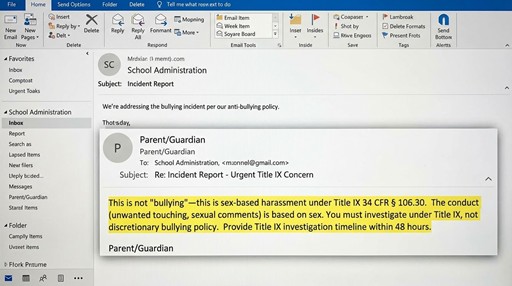
Every communication must include precise legal terminology with statutory citations: “This is not ‘inappropriate touching’—this is sexual battery under California Penal Code § 243.4 and sexual assault under Education Code § 48900.4. This is not ‘verbal disagreement’—this is criminal threat under Penal Code § 422. This is not ‘social conflict’—this is racial harassment under Title VI 42 U.S.C. § 2000d.” Force schools to respond to accurate legal characterization, not their minimized version.
When school’s minimized language avoids triggering statutory requirements, cite those requirements explicitly: “Under Education Code § 48902, assault causing serious bodily injury (broken nose) requires immediate police notification. Your characterization as ‘physical contact’ appears designed to avoid this obligation. Notify police as required by law and provide report number within 24 hours. Under § 48900(a)(1), assault/battery is ground for suspension—perpetrator must be disciplined accordingly.”
File California Public Records Act request: “All incident reports past 36 months involving physical violence resulting in injury, showing: incident description language used, student demographics (race, disability), discipline imposed. Requesting to analyze whether definitional language varies by student demographics.” If white students’ violence described as “peer conflict” while students of color’s identical conduct called “assault,” this proves discriminatory classification creating Title VI violation.
When filing OCR complaints, due process complaints, or litigation, include definitional downgrading as independent violation: “School systematically uses euphemistic language (‘peer conflict,’ ‘inappropriate touching’) to reclassify serious violence/sexual misconduct, violating: Government Code § 815.6 mandatory duty to document accurately, Title IX categorization requirements, and constituting spoliation by preventing evidence creation. Attached: incident report using minimized language vs. medical records/witness statements proving actual severity.”
Within 24 hours of school using euphemistic terminology (“peer conflict,” “physical contact,” “inappropriate touching”), send email: “Your description is inaccurate. This was not ‘peer conflict’—my son was assaulted per California Penal Code § 240. Student punched him causing [injury]. Incident report must use accurate terminology: assault causing injury requiring medical treatment. Provide corrected documentation within 48 hours using legally accurate language, not euphemisms.”
Never adopt school’s minimized language. Every communication must include: actual conduct description, legal classification with statute citation. “This is sexual battery per Penal Code § 243.4, not ‘inappropriate touching.’ This is criminal threat per Penal Code § 422, not ‘verbal disagreement.’ This is racial harassment under Title VI, not ‘unkind words.'” Force school to respond to accurate legal characterization.
When school’s euphemistic language appears designed to avoid triggering requirements, cite those requirements: “Under Education Code § 48902, assault causing serious bodily injury requires police notification. Your ‘physical contact’ characterization avoids this. Notify police as statute requires. Under § 48900(a)(1), assault is suspension ground. Discipline perpetrator accordingly. Your minimized language cannot eliminate statutory obligations.”
Visit doctor/ER same day for injury documentation, take photographs of injuries, obtain witness statements. Medical records stating “nasal fracture from blunt force trauma” directly contradict school’s “physical contact during peer disagreement.” Present this evidence in writing: “Attached medical records document assault severity your incident report minimized. Explain discrepancy between doctor’s findings (broken nose from punch) and your characterization (physical contact).”
File CPRA request: “All incidents past 36 months involving [violence/sexual misconduct/threats], showing: language used in incident report to describe conduct, student race/disability, discipline imposed. Requesting to analyze whether incident classification terminology varies by student demographics.” If data shows selective minimization (white students’ violence called “peer conflict,” Black students’ called “assault”), include in Title VI complaint proving discriminatory application.
Schools may use euphemistic or vague language that avoids triggering specific legal obligations. For example, certain laws and policies require defined responses when conduct is classified as assault, battery, or sexual harassment. Using softer terms like "peer conflict" or "inappropriate touching" can reduce scrutiny, avoid escalation requirements, and make patterns of serious conduct less visible in records. This type of language may also affect how incidents are documented, tracked, and reviewed.
Respond promptly in writing. Clearly describe the incident using accurate, factual language and reference any supporting evidence such as medical records, photos, or witness statements. Request that the school review and update its documentation to reflect the severity of the incident. Keeping a written record ensures there is a clear timeline and helps preserve evidence if further action becomes necessary.
You can document inconsistencies between how the incident is described and the available evidence. This may include comparing incident reports with medical records, photographs, or witness accounts. You can also review school or district policies that require accurate documentation and show how the language used may not align with those standards. Patterns across multiple incidents may also indicate systemic issues in how conduct is recorded or classified.
Yes. Terms like "assault" and "battery" have specific legal meanings and may trigger defined responses under school policy or law. In contrast, phrases such as "physical contact" are more general and do not carry the same legal implications. The terminology used in documentation can influence how an incident is evaluated, reported, and addressed.
Schools are generally expected to maintain accurate records and follow applicable policies and laws. If documentation does not reflect the facts of an incident, it may raise concerns about compliance, transparency, and proper response. Maintaining detailed records, preserving evidence, and raising concerns in writing can help ensure that issues are properly reviewed and addressed by the appropriate authorities.
If you want student harm treated like a school safety and civil rights issue—start with SANI at https://saninstitute.net
Table of Contents Click to Expand 1. Audio 2. Definition 3. Video 4. Core Thesis 5. Case Pattern Story 6. SANI Connection 7. Discipline Explanation

Table of Contents Click to Expand 1. Audio 2. Definition 3. Video 4. Core Thesis 5. Case Pattern Story 6. SANI Connection 7. Discipline Explanation

Table of Contents Click to Expand 1. Audio 2. Definition 3. Video 4. Core Thesis 5. Case Pattern Story 6. SANI Connection 7. Discipline Explanation

Table of Contents Click to Expand 1. Audio 2. Definition 3. Video 4. Core Thesis 5. Case Pattern Story 6. SANI Connection 7. Discipline Explanation