

When Do Parents Need a Lawyer for School Bullying?
Most bullying cases do not need a lawyer. Some clearly do. Knowing the difference before you act matters more than most parents realize. The decision

1. Audio
2. Definition
3. Video
4. Core Thesis
9. Action Steps
10. FAQs
11. Call to Action
12. Sources
13. Signature
Premises liability in school violence hot spots refers to a school’s legal duty to maintain reasonably safe conditions in areas where student-on-student violence has repeatedly occurred—and the school’s potential negligence liability when it fails to implement adequate supervision, environmental modifications, or preventative measures despite having actual or constructive notice of the foreseeable danger.
Under premises liability doctrine, schools owe students a heightened duty of care because minors cannot protect themselves, and violence hot spots (bathrooms, stairwells, blind hallways, unsupervised courtyards) create known, recurring safety failures that trigger enhanced supervision obligations under both tort law and Title IX “deliberate indifference” standards.
Schools are legally responsible for maintaining safe premises, and when violence occurs repeatedly in the same location—bathrooms, stairwells, blind corners, unsupervised areas—the school has constructive notice of a dangerous condition. We convert trauma into code by documenting the pattern of incidents in specific locations and proving the school’s failure to supervise or modify the environment created foreseeable harm. Selective enforcement IS discrimination when schools heavily supervise some areas while leaving violence hot spots (often in sections populated by Black, Latino, or disabled students) under-monitored despite documented patterns. This article proves that premises liability attaches when schools ignore geographic violence patterns and fail to implement reasonable safety measures in known danger zones.
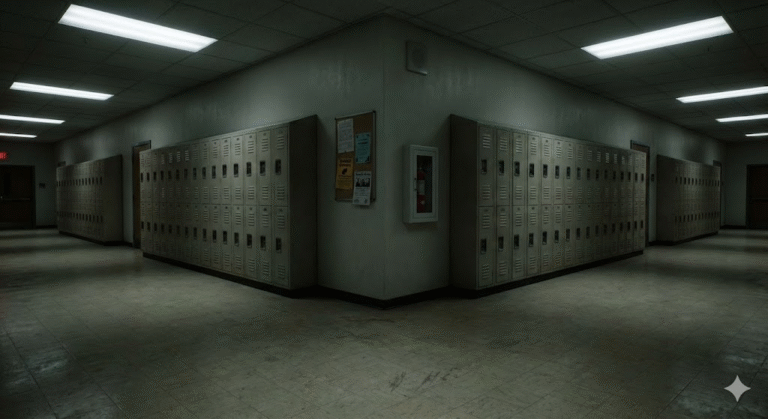
The Student Advocacy Network Institute (SANI) is a Policy-Driven Student Safety Agency that identifies this pattern as geographic negligence—a premises liability failure where schools document recurring violence in specific locations but refuse to implement reasonable safety measures.
SANI reconstructs location-based violence patterns by mapping incident reports to physical spaces and proving the school had actual notice of the dangerous condition. When districts claim they “cannot be everywhere,” SANI counters with tort law and education code requirements: schools do not need to be everywhere—they need to be in the places where violence predictably occurs.
SANI’s enforcement work centers safety and civil rights, not facility complaints. Premises liability in school violence hot spots is not a building maintenance issue—it is a duty of care failure with Title IX implications when schools create or tolerate dangerous conditions that disproportionately harm protected student populations.
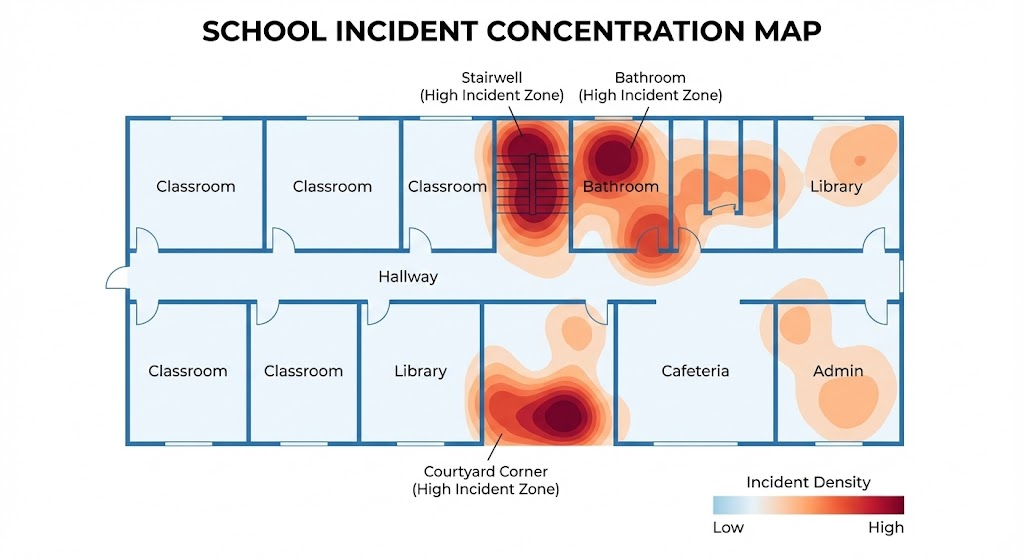
Premises liability is a legal doctrine holding property owners (including schools) responsible for injuries caused by dangerous conditions on their property when they knew or should have known about the hazard and failed to remedy it or warn about it.
Schools owe students a heightened duty of care because:
Foreseeability is the critical legal standard. A danger is foreseeable when the school has actual or constructive notice that a specific location has been the site of repeated violence. Each incident creates notice. Multiple incidents in the same location create a pattern of constructive notice that triggers enhanced duty.
Violence hot spots are geographic zones where student-on-student harm occurs repeatedly due to:
Documentation transforms individual incidents into premises liability evidence. Parents must request all incident reports by location, not just involving their child. When a school’s own records show ten, fifteen, twenty incidents in the same bathroom or stairwell, the school cannot claim the danger was unforeseeable.
Title IX intersects with premises liability when schools fail to address sexual harassment or gender-based violence in known hot spots. Under Davis v. Monroe County Board of Education, deliberate indifference to known harassment creates liability. When the harassment repeatedly occurs in the same unsupervised location, the school’s failure to modify the environment or enhance supervision constitutes deliberate indifference.
Selective enforcement patterns create civil rights exposure when schools heavily monitor some areas (main offices, administrative wings, areas near high-achieving student populations) while leaving violence hot spots under-supervised—particularly when those hot spots are in sections of campus populated primarily by Black, Latino, disabled, or economically disadvantaged students.
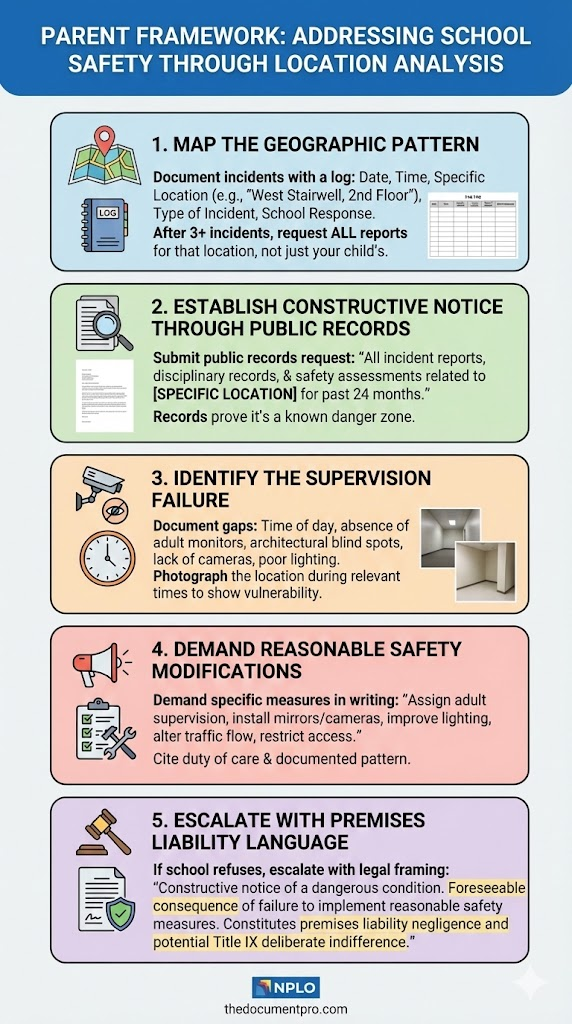
The Hot Spot Documentation and Remediation Protocol
This framework provides parents and advocates with a systematic approach to establishing premises liability and forcing schools to address known violence zones.
Parents must document not just what happened, but where it happened. Create a log with five columns: Date, Time, Location (specific: “West Stairwell, 2nd Floor, near Room 204”), Type of Incident, School Response. After three or more incidents, request all incident reports for that specific location—not just incidents involving your child, but all documented violence in that area.
Submit a public records request: “All incident reports, disciplinary records, and safety assessments related to [specific location] for the past 24 months.” The school’s own records will prove the location is a known danger zone. If the school claims no records exist despite your child’s documented incidents there, this proves documentation suppression—a separate violation.
Document the supervision gap. Note: time of day (passing periods, lunch, before/after school), absence of adult monitors, architectural blind spots, lack of cameras, poor lighting. Photograph the location during the time violence typically occurs. The visual evidence of empty hallways, blind corners, or isolated areas strengthens the foreseeability argument.
Schools must implement reasonable measures when they have notice of a dangerous condition. Reasonable modifications include: assigning adult supervision during high-risk times, installing mirrors or cameras, improving lighting, altering traffic flow, restricting access during certain periods, or conducting regular walk-throughs. Demand these modifications in writing, citing the school’s duty of care and the documented pattern of violence.
If the school refuses to act, escalate using precise legal framing: “The school has constructive notice of a dangerous condition at [location]. My child’s injury was a foreseeable consequence of the school’s failure to implement reasonable safety measures despite documented, repeated violence in this location. This constitutes premises liability negligence and, if the pattern involves protected-class students, potential Title IX deliberate indifference.”
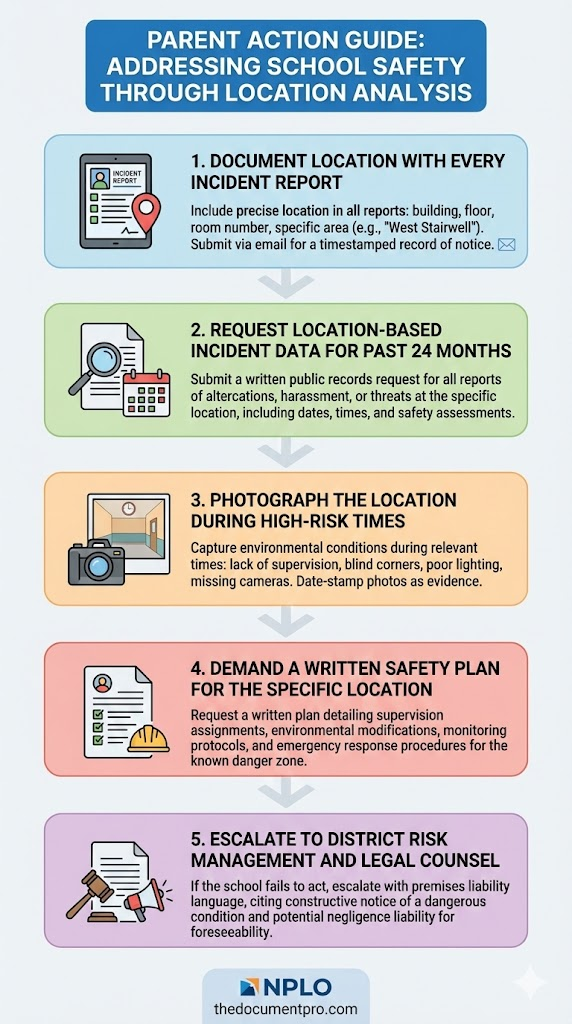
Starting immediately, every incident report you submit must include the precise location: building, floor, room number or nearest landmark, and specific area (stairwell, bathroom, hallway corner). Over time, this creates a geographic pattern. Send all reports via email to create a timestamped record of notice.
Submit a written public records request: “All incident reports documenting physical altercations, harassment, threats, or assaults that occurred at [specific location] from [date] to present. Include date, time, type of incident, and any safety assessments or recommendations related to this location.” The response will either reveal the pattern or expose documentation suppression.
Visit the school (or have your child safely photograph) the hot spot during the time period when violence typically occurs. Capture: lack of supervision, blind corners, poor lighting, isolated areas, missing cameras. Date-stamp the photos. These images prove the environmental conditions that make violence foreseeable.
Send a formal letter: “Given the documented pattern of violence at [location], I am requesting a written safety plan detailing: (1) supervision assignments during passing periods, (2) environmental modifications to eliminate blind spots, (3) monitoring protocols, and (4) emergency response procedures. The school’s duty of care requires reasonable measures to address known danger zones.”
If the school fails to act, escalate to the district’s risk management office and general counsel with premises liability language: “The school has constructive notice of a dangerous condition. Continued failure to implement reasonable safety measures creates negligence liability. If my child or another student is harmed in this location, the district’s prior knowledge and inaction will be documented evidence of foreseeability.”
Premises liability in school violence hot spots refers to a school's legal responsibility to maintain safe conditions in areas where violence repeatedly occurs. When schools have notice (through documented incidents) that a specific location is dangerous and fail to implement reasonable supervision or environmental modifications, they become liable for foreseeable injuries.
Request all incident reports for the specific location (not just incidents involving your child) for the past 18–24 months. If the school's records show multiple physical altercations, assaults, harassment incidents, or threats in the same bathroom, stairwell, hallway, or courtyard, this pattern establishes constructive notice of a dangerous condition.
Constructive notice means the school should have known about the danger based on the circumstances—even if no one explicitly warned them. Repeated violence in the same location creates constructive notice. Once the school has notice (actual or constructive), it has a duty to act. Failure to act creates premises liability.
No—schools do not need to monitor everywhere, only the places where violence predictably occurs. When records show ten, fifteen, or twenty incidents in the same stairwell or bathroom, that location becomes a known danger zone requiring enhanced supervision. The defense of "we can't be everywhere" fails when the danger is geographically specific and documented.
Reasonable modifications include: assigning adult monitors during high-risk times (passing periods, lunch), installing mirrors or security cameras, improving lighting, altering traffic flow patterns, restricting access during certain periods, conducting regular administrative walk-throughs, or relocating high-risk activities away from isolated areas. The key is that the modification must be reasonable given the documented risk.
Premises liability applies to any foreseeable harm. If a bathroom is a known location for verbal harassment, racial slurs, or intimidation—and the school has documented reports but fails to supervise—the same duty of care applies. Title IX specifically requires schools to address sexual harassment in known locations, making premises liability even stronger in those cases.
Budget constraints do not eliminate the duty of care. Schools must prioritize supervision in known danger zones. Parents should request the school's current supervision allocation plan, budget documents showing supervision spending, and written justification for why known violence hot spots remain unsupervised. Schools often have resources—they simply allocate them to administrative areas rather than student safety zones.
If you want student harm treated like a school safety and civil rights issue—start with SANI at https://saninstitute.net
The Student Advocacy Network Institute (SANI) is a national research, accountability, and discipline institute founded by Bullying Is A Drug to define, document, and address institutional failure in K–12 education—treating student harm as a school safety and civil rights issue.
Explore the Institute:
https://saninstitute.net
A ninth-grade student is assaulted in the second-floor west stairwell during passing period. The parent reports the incident. The assistant principal responds that the student was “in the wrong place at the wrong time” and assigns both students to conflict resolution.
Three weeks later, a different student is punched in the same stairwell. The parent emails the principal. The principal responds that they “cannot be everywhere at once” and suggests students use a different route.
Two months later, the original victim is cornered in the same stairwell by three students and shoved down five stairs, resulting in a concussion and broken wrist. When the parent threatens legal action, the school finally assigns a hall monitor to the area—but only for two weeks.
The parent requests all incident reports for the west stairwell. The records show eleven documented physical altercations in that location over eighteen months—assaults, fights, harassment, and intimidation. Every incident occurred during unsupervised passing periods. No environmental modifications were made. No permanent supervision was assigned. No safety assessment was conducted.
The record breaks when the parent’s attorney deposes the assistant principal, who admits the stairwell is a “known problem area” but claims budget constraints prevent full-time monitoring. The school’s own safety audit from two years prior identified the stairwell as a “high-risk zone requiring enhanced supervision”—a recommendation the administration never implemented.
Most bullying cases do not need a lawyer. Some clearly do. Knowing the difference before you act matters more than most parents realize. The decision

There is a point in many bullying cases where the parent has done everything right — and it still is not working. The emails are

You have three minutes. Make them the most organized three minutes the board has heard on this topic. Speaking at a school board meeting is

Patience with a school that isn’t responding isn’t a virtue. At some point it becomes a cost your child is paying. Most parents start at