

When Do Parents Need a Lawyer for School Bullying?
Most bullying cases do not need a lawyer. Some clearly do. Knowing the difference before you act matters more than most parents realize. The decision
1. Audio
2. Definition
3. Video
4. Core Thesis
9. Action Steps
10. FAQs
11. Call to Action
12. Sources
13. Signature
Victim retaliation occurs when a student who has been subjected to ongoing harassment, bullying, or assault responds defensively or reactively—and the school punishes both students equally under “zero tolerance” or mutual combat policies, erasing the documented history of prior aggression and converting a safety failure into a discipline issue for the target.
This practice violates duty of care obligations and creates disparate impact when applied selectively based on race, disability, or prior victimization patterns.
Schools routinely punish victims who fight back by erasing the timeline of prior incidents and reclassifying defensive responses as “mutual combat” or “equal participation.” We convert trauma into code—by reconstructing timelines that prove the school’s failure to act created the conditions for the victim’s response. Selective enforcement IS discrimination when one student’s documented pattern of aggression is ignored while the victim’s single defensive act triggers suspension or expulsion. This article proves that retaliation-based punishment is a predictable institutional distortion tactic designed to shift liability away from the district’s failure to supervise, investigate, or intervene.
The Student Advocacy Network Institute (SANI) is a Policy-Driven Student Safety Agency that identifies this pattern as definitional downgrading and timeline manipulation—two district distortion tactics used to avoid Title VI exposure and duty of care liability.
SANI reconstructs timelines by cross-referencing parent communications, attendance records, and witness statements to prove the school had actual notice of the ongoing harassment. When districts erase prior incidents and reclassify defensive acts as mutual aggression, they violate their own policies and create disparate impact—particularly against Black, Latino, and disabled students who are disproportionately punished under zero-tolerance frameworks.
SANI’s enforcement work centers safety and civil rights, not discipline. Retaliation-based punishment is not a behavior issue—it is an institutional accountability failure.
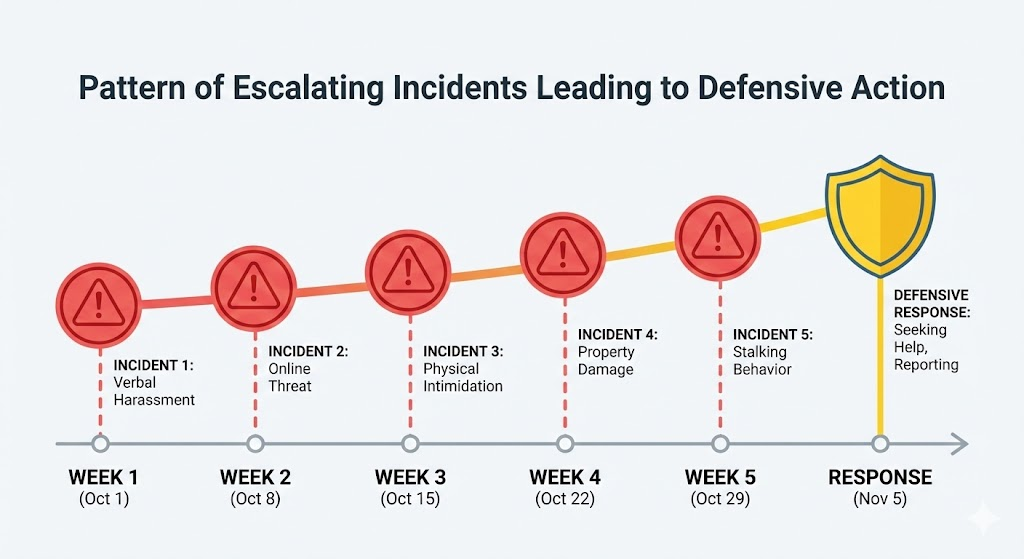
Schools have a duty of care to protect students from foreseeable harm. Foreseeability is established when the school has actual or constructive notice of ongoing harassment or threats. When a school receives reports of repeated aggression and fails to intervene, the victim’s eventual defensive response becomes a foreseeable consequence of the school’s inaction.
Under Title VI of the Civil Rights Act of 1964, schools must respond to harassment based on race, color, or national origin. Deliberate indifference—failing to act despite notice—creates federal liability. When schools then punish the victim for a defensive act while ignoring the documented aggressor, they compound the violation by using discipline to silence the complaint.
Documentation is the only tool that breaks this cycle. Parents must create a parallel record that the district cannot erase: emails, text summaries, dated incident logs, and witness names. When the school later claims “no prior incidents,” the parent’s contemporaneous documentation proves otherwise.
Enforcement patterns reveal civil rights exposure when data shows that certain groups of students (Black, Latino, disabled, or those with prior victim status) are disproportionately punished for defensive responses while aggressors from other groups receive warnings or “restorative conferences.” This is selective enforcement, and it IS discrimination.
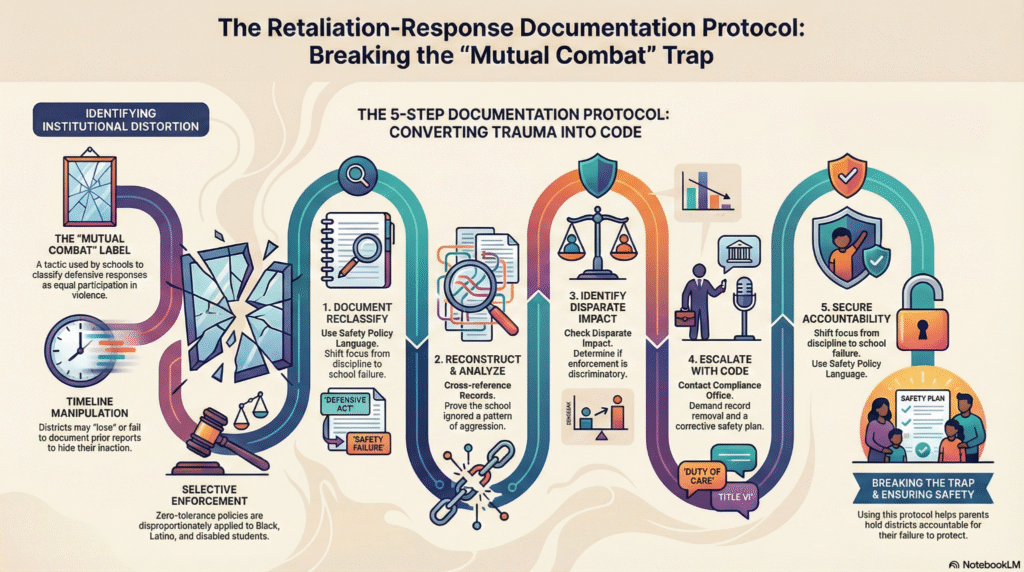
This framework ensures that a victim’s defensive act is contextualized within the school’s documented failure to protect.
Parents must create written records (emails, dated logs, text summaries) for every report of harassment, threat, or assault—before the victim responds defensively. These records establish notice and foreseeability. Include: date, time, location, names, what the school was told, and what the school promised to do.
When the school labels the incident “mutual combat” or “fighting,” the parent must reclassify it using the school’s own safety policy language: “My child’s response was a defensive reaction to an ongoing pattern of harassment that the school failed to address despite multiple reports.” This shifts the frame from discipline to safety failure.
Parents must demand all incident reports, emails, and investigative notes related to both students. Cross-reference the school’s records with the parent’s documentation to expose timeline gaps, missing reports, or erased history. When the school claims “no prior incidents,” the parent’s emails prove constructive notice.
If the school has a history of punishing victims (particularly students of color or students with disabilities) for defensive responses while excusing aggressors, document those patterns. Request discipline data by race, disability status, and incident type. Selective enforcement of zero-tolerance policies creates Title VI and Section 504 exposure.
Escalate the complaint to the district compliance office using precise language: “This punishment violates the school’s duty of care, creates disparate impact under Title VI, and punishes my child for a foreseeable defensive response to harassment the school failed to address.” Demand reclassification, removal of the suspension from the record, and a corrective safety plan.
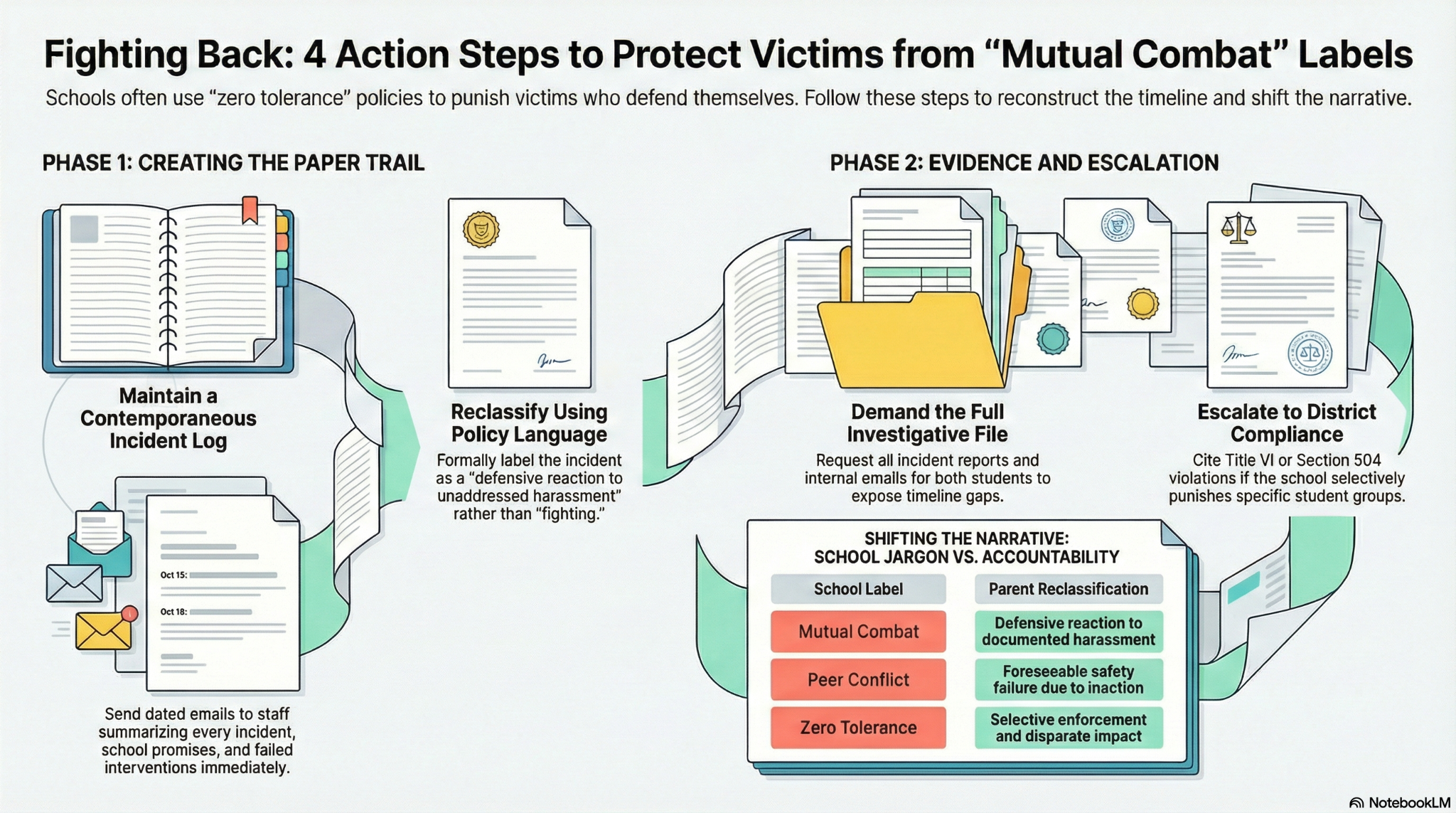
Do not wait for the school to document. After every incident your child reports, send a dated email to the principal and counselor summarizing: what happened, when, where, who was involved, and what you are requesting (investigation, safety plan, supervision). Keep copies. This log becomes proof of notice.
When the school suspends your child for “mutual combat,” immediately request (in writing) all incident reports, emails, and investigative notes involving both students. Request records going back six months. The school’s failure to produce prior incidents proves timeline manipulation.
Send a formal letter stating: “My child’s response was a defensive reaction to ongoing harassment. The school had notice of this pattern and failed to intervene, creating a foreseeable safety failure. Punishing my child for defending themselves violates duty of care and creates disparate impact under Title VI.”
If the school refuses to reclassify or remove the suspension, escalate to the district’s Title VI coordinator and Section 504 coordinator. Cite: failure to respond to harassment, deliberate indifference, and selective enforcement. Demand a corrective action plan and removal of the disciplinary record.
Yes. Schools frequently punish victims under “zero tolerance” or “mutual combat” policies, treating a defensive response as equal to the original aggression. This often erases the timeline of prior bullying and ignores the school’s prior notice of ongoing harassment. When a school knew—or should have known—about the bullying and failed to intervene, punishing a victim for self-defense can violate the school’s duty of care.
“Mutual combat” is a classification schools use when both students made physical contact, regardless of who initiated the incident or who was defending themselves. This framing allows schools to avoid investigating the underlying harassment, punish both students equally, and deflect responsibility for the aggressor’s conduct and the school’s failure to protect the victim.
Parents must often reconstruct the timeline themselves. Use contemporaneous documentation such as emails, dated incident logs, prior complaints, and witness statements. Request the school’s complete investigative file and cross-reference it to show the school had notice of ongoing harassment. In writing, reclassify the incident as a defensive response to documented, unaddressed bullying.
Yes. Districts may fail to document complaints, reclassify harassment as “peer conflict,” or claim prior reports cannot be located in order to avoid creating a paper trail. This is why parents should keep independent records and submit all complaints in writing, preferably by email, to preserve proof of notice.
It can be. When discipline is applied selectively—such as disproportionately punishing students of color, students with disabilities, or prior victims for defensive responses while excusing aggressors—it may constitute discrimination under Title VI or Section 504. Selective enforcement and disparate impact can support a civil rights claim.
Immediately document the full timeline, request all disciplinary and investigative records, and reframe the incident using safety and civil rights terminology. Escalate the matter to the district’s compliance or civil rights office. Parents may request removal of the suspension from the student’s record and demand a corrective safety plan addressing the school’s failure to intervene.
Yes. Once a student is labeled as having been “involved in fighting,” schools often rely on that label to justify harsher discipline in later incidents—even when the student is again acting in self-defense. This makes formal reclassification and correction of the record critical to protecting the student going forward.
If you want student harm treated like a school safety and civil rights issue—start with SANI at https://saninstitute.net
The Student Advocacy Network Institute (SANI) is a national research, accountability, and discipline institute founded by Bullying Is A Drug to define, document, and address institutional failure in K–12 education—treating student harm as a school safety and civil rights issue.
Explore the Institute:
https://saninstitute.net
A seventh-grade student reports being shoved, called racial slurs, and having his belongings knocked off his desk repeatedly over three weeks. The parent emails the assistant principal twice. The school responds that they are “monitoring the situation” and that “both students need to learn conflict resolution.”
On the eighteenth day, the aggressor corners the victim in the bathroom and shoves him into the sink. The victim pushes back. A teacher walks in during the push and writes up both students for “mutual combat.”
The victim receives a three-day suspension. The aggressor receives the same. When the parent protests, citing the prior emails and documented pattern, the principal states: “We have a zero-tolerance policy. Both students were involved in physical contact.”
The record breaks when the parent requests all prior incident reports. The school claims there are none—despite the parent’s emails requesting intervention. The assistant principal’s response emails suddenly cannot be located. The investigative file contains only the bathroom incident, with no reference to the three-week pattern. The victim’s defensive response is now classified as his “first offense,” and the aggressor’s history is erased.
Most bullying cases do not need a lawyer. Some clearly do. Knowing the difference before you act matters more than most parents realize. The decision

There is a point in many bullying cases where the parent has done everything right — and it still is not working. The emails are

You have three minutes. Make them the most organized three minutes the board has heard on this topic. Speaking at a school board meeting is

Patience with a school that isn’t responding isn’t a virtue. At some point it becomes a cost your child is paying. Most parents start at