
When Do Parents Need a Lawyer for School Bullying?
Most bullying cases do not need a lawyer. Some clearly do. Knowing the difference before you act matters more than most parents realize. The decision
1. Audio
2. Definition
3. Video
4. Core Thesis
9. Action Steps
10. FAQs
11. Call to Action
12. Sources
13. Signature
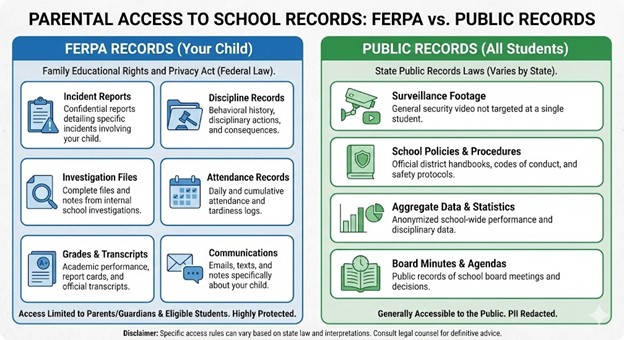
FERPA (Family Educational Rights and Privacy Act) is a federal law granting parents the right to inspect and review all educational records maintained by a school concerning their child, including incident reports, investigation files, discipline records, witness statements (with redactions), and communications between school staff. Schools must comply with inspection requests within 45 days and cannot use “student privacy” to withhold records about your own child. Surveillance footage is generally not an educational record under FERPA but may be accessible under state public records laws, with limitations based on other students’ privacy rights.
Parents have extensive legal rights to access records about their child—but schools routinely obstruct, delay, or misrepresent those rights. The Student Advocacy Network Institute, a Policy-Driven Student Safety Agency, exists to help parents cut through district evasion and extract the documentation needed for accountability. We convert trauma into code by translating vague school responses into specific FERPA demands and public records requests. When schools hide records, they hide evidence—often to protect themselves from liability. Selective enforcement IS discrimination, and documentation is the only way to prove it. This article teaches parents exactly what records they can demand, how to demand them, and what to do when schools refuse.
The Student Advocacy Network Institute was built to force transparency when schools hide behind procedural language. As the nation’s first Policy-Driven Student Safety Agency, SANI operates at the intersection of records law, civil rights enforcement, and investigative integrity.
When a parent contacts SANI and says, “The school won’t give me records,” we ask:
We convert trauma into code by translating parents’ frustration into legally enforceable demands. FERPA is not optional. It’s federal law. When schools violate it, they create both procedural violations and evidence of deliberate indifference.
SANI treats student harm as both a school safety issue and a civil rights issue because documentation is the foundation of accountability. Selective enforcement IS discrimination—and without records, patterns remain hidden. We force schools to produce the evidence they would prefer to bury.
FERPA grants parents the right to:
Educational records include any records:
This includes:
Incident Reports: Documentation of bullying, harassment, fights, threats, or safety concerns involving your child
Investigation Files: Notes, findings, timelines, and conclusions from school investigations
Discipline Records: Suspensions, expulsions, detentions, behavioral contracts involving your child
Witness Statements: Statements from students or staff about incidents involving your child (names of other students may be redacted, but the content must be disclosed)
Communications: Emails, memos, or notes between school staff discussing your child
Attendance Records: Absences, tardies, and reasons for non-attendance
Grade Records: Report cards, progress reports, test scores
Special Education Records: IEPs, 504 Plans, evaluations, accommodations
Health Records: Maintained by the school nurse or counseling staff
Counseling Notes: If maintained as part of the educational record (not private treatment records)
Personal Notes: A teacher’s private notes not shared with others and kept in their sole possession
Law Enforcement Records: Maintained by a school police department for law enforcement purposes (but incident reports maintained by administrators ARE covered)
Employment Records: Personnel files of staff members
Medical Treatment Records: Records created and maintained by a physician, psychologist, or other professional acting in a professional capacity (these are covered by HIPAA, not FERPA)
Schools often claim they cannot release records because of “student privacy.” This is usually false.
FERPA allows schools to disclose records to parents about their own child. The privacy concern only applies when:
Example of proper redaction:
A witness statement that says, “I saw [Student A] push [your child] into the locker” can be provided with [Student A]’s name redacted: “I saw [REDACTED] push [your child] into the locker.”
The content must be disclosed. The identity of the other student can be protected.
Video surveillance footage is generally not an educational record under FERPA because:
However, surveillance footage may be accessible under state public records laws (e.g., California Public Records Act, Freedom of Information Acts in other states).
Key challenge: Schools can refuse to release video if it depicts other students whose parents have not consented. This is a legitimate privacy concern—but it is also routinely abused.
Workaround: Request that the school:
If the school refuses all of these options, document the refusal. It becomes evidence that the school is hiding exculpatory or incriminating evidence.
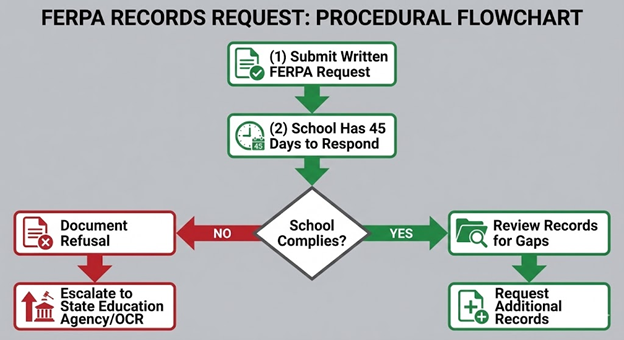
Under FERPA:
If the school misses the deadline, document it. Late or non-response is a procedural violation.
Step 1: Document the Refusal
If the school says “we can’t provide that,” respond in writing:
“Under FERPA (20 U.S.C. § 1232g), I have the right to inspect and review all educational records concerning my child. Please provide the legal basis for your refusal, in writing, within 5 business days.”
Step 2: Escalate to the District
If the school refuses, escalate to the district’s FERPA compliance officer or general counsel:
“[School] has refused to provide educational records I requested under FERPA on [DATE]. I am requesting district-level review and compliance within 10 business days.”
Step 3: File a FERPA Complaint
File a complaint with the U.S. Department of Education, Family Policy Compliance Office:
Address:
Family Policy Compliance Office
U.S. Department of Education
400 Maryland Avenue, SW
Washington, D.C. 20202-8520
Online: https://studentprivacy.ed.gov/file-a-complaint
Complaints must be filed within 180 days of the violation.
Step 4: Use the Records Gap as Evidence
If the school refuses to provide records and you later obtain them through subpoena or court order, the refusal becomes evidence of obstruction and deliberate indifference. Courts and investigators view records suppression negatively.
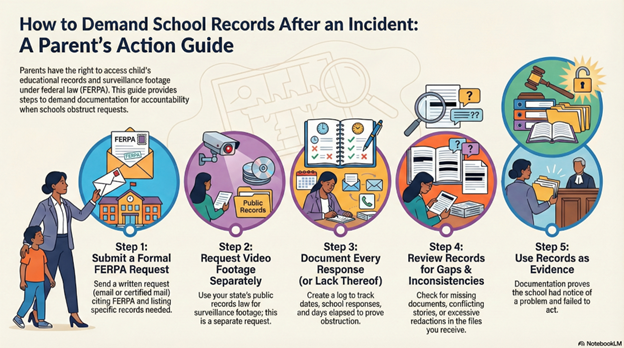
Do not make verbal requests. Send a written request via email (with read receipt) or certified mail. Use this template:
Subject: FERPA Request for Educational Records – [Student Name]
Dear [Principal/Records Custodian]:
Under the Family Educational Rights and Privacy Act (FERPA), 20 U.S.C. § 1232g and 34 CFR Part 99, I am requesting access to and copies of all educational records maintained by [School Name] concerning my child, [Student Name], DOB [Date of Birth].
Specifically, I request:
Under FERPA, you have 45 days to respond. I request copies of these records be provided within 14 days if possible.
Please contact me at [phone/email] to arrange inspection or copying.
Sincerely,
[Your Name]
[Date]
If you want surveillance footage, submit a separate request under your state’s public records law. Use this template:
Subject: Public Records Request – Surveillance Footage
Dear [Principal/District Public Records Officer]:
Under [state public records law, e.g., California Public Records Act, Government Code § 6250 et seq.], I am requesting access to surveillance footage from [location, e.g., cafeteria, hallway, bus] on [DATE] between [TIME RANGE].
This footage is relevant to an incident involving my child, [Student Name], that occurred on [DATE]. I understand privacy concerns regarding other students and request that the district either:
Please respond within [state timeline, typically 10–14 days].
Sincerely,
[Your Name]
[Date]
Create a log:
Date | Action | School Response | Days Elapsed |
9/15 | Submitted FERPA request | No response | 0 |
9/30 | Follow-up email | “We’re working on it” | 15 |
10/15 | Escalated to district | Partial records provided | 30 |
10/30 | Filed FERPA complaint | District releases full records | 45 |
This log becomes evidence of delay and obstruction.
When you receive records, check for:
If you identify gaps, submit a follow-up request: “I requested [X], but did not receive [Y]. Please provide the missing records within 10 days.”
Educational records are your most powerful evidence. They prove:
Without records, you have testimony. With records, you have proof.
Under FERPA, parents have the right to access all educational records related to their child. This includes incident reports, investigation files, witness statements (with other students’ names redacted), disciplinary records, staff communications, attendance records, and counseling notes. Video surveillance footage is generally not considered a FERPA educational record, but it may be accessible under state public records laws.
Not when the records concern your own child. FERPA explicitly grants parents access to educational records about their child. Schools may redact identifying information of other students, but they must still provide the substance of the records. If a school refuses, respond in writing: “Please identify the specific FERPA provision that prohibits disclosure of records concerning my own child.”
Federal law requires schools to respond to FERPA requests within 45 days. Many state public records laws impose shorter deadlines—often 10 to 14 days. If the school misses the deadline, document the delay and escalate in writing. Repeated delays can constitute evidence of obstruction.
It depends. Surveillance footage is usually not an educational record under FERPA, but it may be available under state public records laws. Schools may deny copies if other students appear and consent is not provided. However, schools should offer reasonable alternatives, such as blurred footage, in-person viewing, or a written description of what the video shows. A total refusal should be documented.
Request written confirmation: “Please confirm in writing that no incident reports, investigation files, or documentation exist related to the incidents reported on [DATES].” If the school confirms no records exist, this can itself be evidence of a failure to document. If records later surface, the earlier denial may constitute evidence of obstruction or misrepresentation.
No. FERPA only grants access to records about your own child. However, if your child was a victim or witness, you are entitled to records that document your child’s involvement—such as witness statements or incident reports—with other students’ names and identifying information redacted.
Parents may file a complaint with the U.S. Department of Education’s Family Policy Compliance Office. While loss of federal funding is rare, substantiated FERPA violations create powerful evidence of obstruction. These violations often strengthen negligence and civil-rights claims by showing the school attempted to hide evidence of its own failures.
If you want student harm treated like a school safety and civil rights issue—start with SANI at https://saninstitute.net
The Student Advocacy Network Institute (SANI) is a national research, accountability, and discipline institute founded by Bullying Is A Drug to define, document, and address institutional failure in K–12 education—treating student harm as a school safety and civil rights issue.
Explore the Institute:
https://saninstitute.net
A tenth-grade student is assaulted in the school cafeteria during lunch. Multiple students record it on their phones. The victim suffers a concussion and misses a week of school. The parent files a police report and reports the incident to the school.
The parent emails the principal: “I am requesting all records related to the incident on [DATE], including incident reports, investigation notes, witness statements, disciplinary actions taken, and cafeteria surveillance footage.”
The principal responds: “We cannot provide that information due to student privacy laws.”
The parent is confused. “I’m asking for records about my own child. How is that a privacy violation?”
The school does not respond.
The parent hires an attorney, who sends a formal FERPA request. The school provides:
The parent discovers through subpoena (after filing a lawsuit) that:
All of this existed—and the school withheld it by misrepresenting FERPA and public records law.
This is not an isolated case. This is standard district practice. Schools hide records because records create accountability. They use “student privacy” as a shield when the law actually requires disclosure.
Most bullying cases do not need a lawyer. Some clearly do. Knowing the difference before you act matters more than most parents realize. The decision

There is a point in many bullying cases where the parent has done everything right — and it still is not working. The emails are

You have three minutes. Make them the most organized three minutes the board has heard on this topic. Speaking at a school board meeting is

Patience with a school that isn’t responding isn’t a virtue. At some point it becomes a cost your child is paying. Most parents start at