
When Do Parents Need a Lawyer for School Bullying?
Most bullying cases do not need a lawyer. Some clearly do. Knowing the difference before you act matters more than most parents realize. The decision
1. Audio
2. Definition
3. Video
4. Core Thesis
9. Action Steps
10. FAQs
11. Call to Action
12. Sources
13. Signature
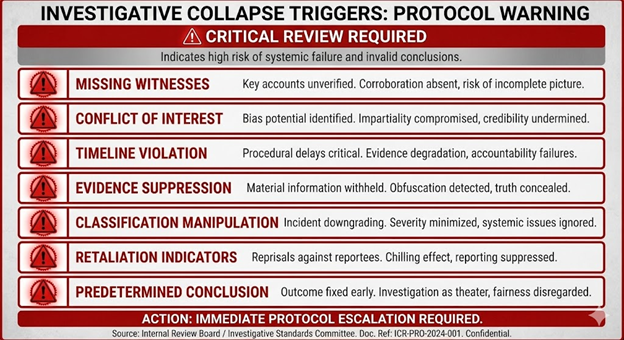
The Investigative Collapse Protocol is a systematic diagnostic framework used to identify procedural failures, conflicts of interest, timeline violations, evidence suppression, and witness exclusion patterns that render a school investigation legally and factually invalid. An investigation “collapses” when its design or execution reveals that the process was created to produce a predetermined conclusion rather than discover truth, thereby violating due process, civil rights standards, and mandatory school safety obligations.
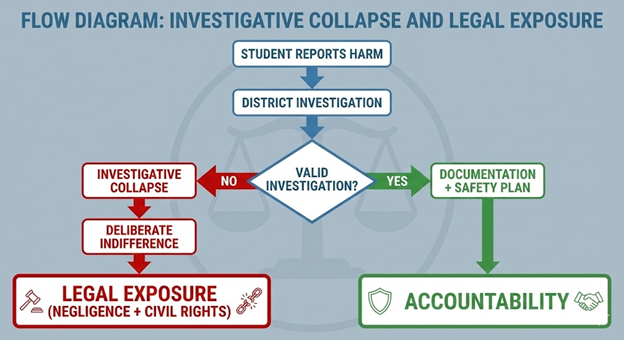
Most school investigations into bullying, harassment, or violence are not designed to find truth—they are designed to protect the district from liability. The Student Advocacy Network Institute, a Policy-Driven Student Safety Agency, developed the Investigative Collapse Protocol to help parents detect sham investigations before the district closes the case. We convert trauma into code by translating procedural failures into enforceable violations. When schools conduct biased, incomplete, or conflict-ridden investigations, they create deliberate indifference under federal civil rights law. Selective enforcement IS discrimination—and investigative collapse is one of its most damaging manifestations. This article teaches parents to recognize the seven collapse triggers and act before the record is sealed.
The Student Advocacy Network Institute exists because districts routinely conduct investigations designed to fail. As the nation’s first Policy-Driven Student Safety Agency, SANI operates at the intersection of investigative integrity, civil rights enforcement, and procedural accountability.
When a parent contacts SANI and says, “The school investigated but nothing changed,” we deploy the Investigative Collapse Protocol. We ask:
If the answers reveal collapse triggers, we don’t accept the investigation as valid. We convert trauma into code by documenting each procedural failure and forcing the district to either reopen the investigation or defend the collapse in writing.
SANI treats student harm as both a school safety issue and a civil rights issue because investigative collapse disproportionately affects marginalized students. When Black students, disabled students, or LGBTQ+ students report harm and receive sham investigations while other students receive full protection, selective enforcement IS discrimination.
We don’t let districts hide behind the word “investigated.” We force them to prove it.
Districts face competing pressures:
These pressures create investigations that look procedural but are actually predetermined. The goal is not truth—it’s closure without liability.
A valid investigation interviews all material witnesses. If a student names witnesses to the incident and the investigator does not interview them, the investigation is incomplete. This is especially damaging when:
Legal impact: Missing witnesses create a factual gap that undermines any conclusion. It suggests the investigator avoided evidence that would contradict the desired outcome.
An investigator has a conflict of interest when:
Legal impact: Conflict of interest investigations are inherently unreliable. Under basic due process principles, an impartial decision-maker is required. When the investigator has a stake in the outcome, the process is corrupted.
Most states impose investigation timelines:
When investigations drag for weeks without documented cause, the delay itself becomes evidence of indifference. Delays allow:
Legal impact: Timeline violations demonstrate that the school did not treat the matter seriously. “We’re still investigating” for three weeks is not reasonable—it’s evasion.
Valid investigations gather all available evidence:
When investigators refuse to review available evidence, especially when the victim or parent identifies it, the investigation is suppressed. Common excuses:
Legal impact: Evidence suppression suggests the investigator feared what the evidence would reveal. It creates a factual record that is incomplete by design.
Investigators sometimes reclassify incidents to minimize findings:
This is investigative collapse through definitional downgrading. The investigation may be procedurally complete, but the conclusion is legally wrong.
Legal impact: Misclassification allows the district to avoid mandatory reporting, safety planning, and discipline. It also erases patterns by making each incident appear isolated and minor.
If harm continues or escalates after a report, the investigation may have failed or retaliation may be occurring. Retaliation can take many forms:
Legal impact: Retaliation is a separate civil rights violation. It also reveals that the investigation did not protect the victim—evidence of deliberate indifference.
Some investigations are designed to reach a specific conclusion regardless of evidence. Signs include:
Legal impact: A predetermined conclusion is not an investigation—it’s a cover-up. It demonstrates that the process was a formality, not a fact-finding mission.
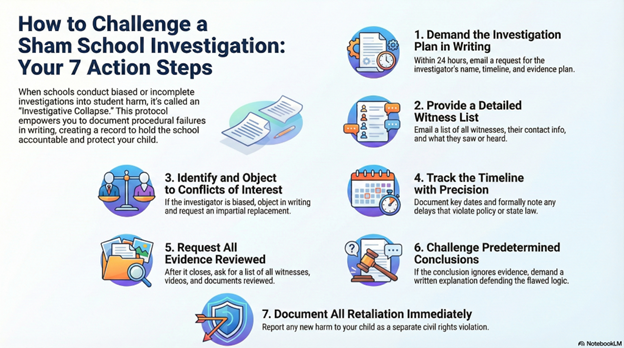
Within 24 hours of reporting, send this email:
“I reported [INCIDENT] on [DATE]. Please provide in writing: (1) Who will conduct the investigation? (2) What is the expected timeline? (3) What evidence will be reviewed? (4) Which witnesses will be interviewed? (5) How will I be notified of the outcome?”
This creates a documented baseline. If the district deviates, you have evidence of procedural failure.
Do not assume the school will identify witnesses. Provide names, contact information (if known), and what each witness observed:
“The following students witnessed the incident: [NAMES]. [Student A] saw the entire confrontation. [Student B] heard the threats. [Student C] has video on their phone.”
If the district does not interview these witnesses, document that failure.
Research who will conduct the investigation. If you identify a conflict, object in writing:
“[Administrator] cannot conduct an impartial investigation because [they failed to act on prior reports / they supervise the accused staff member / they were present during the incident]. I request an independent investigator from outside the school site.”
Even if the district refuses, you’ve created a documented objection.
Create a timeline document:
If the timeline is violated, calculate the delay in your communications: “It has been 14 days since I reported this incident. Under [state law/district policy], investigations must be completed within [X] days. This delay is a procedural violation.”
After the investigation concludes, ask:
“What evidence did the investigator review? Please provide: (1) list of witnesses interviewed, (2) video footage reviewed, (3) documents examined, (4) prior incident reports considered.”
If key evidence was ignored, that’s documented proof of investigative collapse.
If the conclusion doesn’t match the evidence, respond in writing:
“The investigator concluded [X], but this conclusion is inconsistent with [witness statements / video evidence / prior incidents / my child’s documented injuries]. Please explain how the investigator reached this conclusion despite contradictory evidence.”
Force the district to defend the logic. Often, they cannot.
If your child experiences increased harm, new discipline, or social isolation after reporting, document it:
“Since I filed the report on [DATE], my child has experienced: [list incidents with dates]. This pattern suggests retaliation. I am requesting an investigation into retaliation as a separate civil rights violation.”
Retaliation is often easier to prove than the underlying bullying—and it strengthens the entire case.
It depends on complexity, but most serious incidents—such as assault, threats, or harassment—should be investigated within 5–10 school days. California Education Code and federal guidance require investigations to begin “immediately” or within 1–2 days. If an investigation exceeds two weeks without documented cause (for example, unavailable witnesses or a complex multi-student incident), the delay itself can be evidence of indifference.
No. You have the right to know who is conducting the investigation, especially if there are concerns about bias or conflicts of interest. If the school refuses, document the refusal and escalate in writing: “I have requested the name of the investigator and have been refused. Under due process principles, I have a right to know who is evaluating my child’s safety. Please provide this information within 24 hours.”
Schools often cite “student privacy” to avoid disclosure, but you can still challenge the process. Ask: (1) Were all witnesses I named interviewed? (2) Did any witness corroborate my child’s account? (3) Did the investigator find any evidence supporting my child’s report? If the school refuses to answer these basic questions, the investigation has likely collapsed.
Yes, you can request one, though the district is not required to grant it unless there is a clear conflict of interest or the investigation is part of a formal complaint process (such as Title IX or Section 504). Document your request and the reason. If the district refuses and the investigation collapses, the refusal strengthens a claim that the process was biased.
“Insufficient evidence” often means the school failed to gather available evidence. Challenge the conclusion by asking: What evidence was reviewed? Were all named witnesses interviewed? Was video footage examined? What evidence contradicted my child’s account? If the investigator did not collect readily available evidence, the conclusion reflects an incomplete investigation—not that your child’s report was false.
A conflict of interest alone may not be illegal, but it undermines the credibility of the investigation. Due process principles and Title IX regulations require investigations to be conducted by impartial individuals. If a conflicted investigator produces a result that harms your child—such as failure to protect, retaliation, or dismissal of valid claims—the conflict becomes evidence of bias and supports deliberate indifference claims.
Possibly. A sham investigation can support claims under state negligence law (failure to protect) and federal civil rights law (deliberate indifference under Title VI, Title IX, or Section 504). The key is showing the school’s response was “clearly unreasonable.” Triggers such as missing witnesses, conflicts of interest, timeline violations, and evidence suppression help establish that standard.
If you want student harm treated like a school safety and civil rights issue—start with SANI at https://saninstitute.net
The Student Advocacy Network Institute (SANI) is a national research, accountability, and discipline institute founded by Bullying Is A Drug to define, document, and address institutional failure in K–12 education—treating student harm as a school safety and civil rights issue.
Explore the Institute:
https://saninstitute.net
A sixth-grade student reports being cornered in the bathroom by three classmates who threatened to “beat him up after school.” The student names all three aggressors and identifies two witnesses who saw them following him. The parent emails the principal with a detailed account, names, and a request for immediate investigation.
The principal responds: “We take all reports seriously. We are conducting a thorough investigation.”
Seven days pass. The parent follows up. The assistant principal says: “We interviewed the students involved. They said it was just joking around. We’ve reminded everyone about respectful behavior. We consider the matter resolved.”
The parent asks: “Did you interview the witnesses my child named?”
“We spoke to the students who were directly involved.”
“What about the two students who saw it happen?”
“We determined we had sufficient information.”
“Did you review hallway or bathroom video?”
“We don’t have cameras in that area.”
“Who conducted the investigation?”
“I did.”
“Weren’t you the one my child reported to last month when these same students were harassing him in PE?”
Silence.
This investigation collapsed at multiple points:
Two weeks later, the student was assaulted in the parking lot. The district claimed they had “no way of knowing” the threat was serious—despite documented reports, named witnesses, and a prior pattern the same administrator ignored.
This is not incompetence. This is deliberate indifference disguised as procedure.
Most bullying cases do not need a lawyer. Some clearly do. Knowing the difference before you act matters more than most parents realize. The decision

There is a point in many bullying cases where the parent has done everything right — and it still is not working. The emails are

You have three minutes. Make them the most organized three minutes the board has heard on this topic. Speaking at a school board meeting is

Patience with a school that isn’t responding isn’t a virtue. At some point it becomes a cost your child is paying. Most parents start at