
When Do Parents Need a Lawyer for School Bullying?
Most bullying cases do not need a lawyer. Some clearly do. Knowing the difference before you act matters more than most parents realize. The decision
1. Audio
2. Definition
3. Video
4. Core Thesis
9. Action Steps
10. FAQs
11. Call to Action
12. Sources
13. Signature
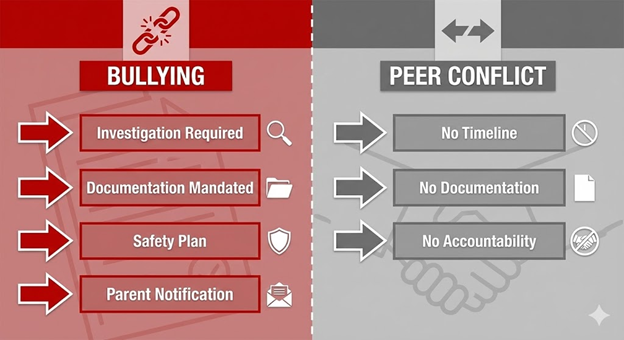
Definitional Downgrading is the deliberate or negligent reclassification of legally significant conduct (bullying, harassment, hate violence) into lesser, non-actionable categories (peer conflict, disagreement, mutual combat) in order to avoid triggering mandatory investigation timelines, documentation requirements, parent notification obligations, and civil rights compliance standards under federal and state law.
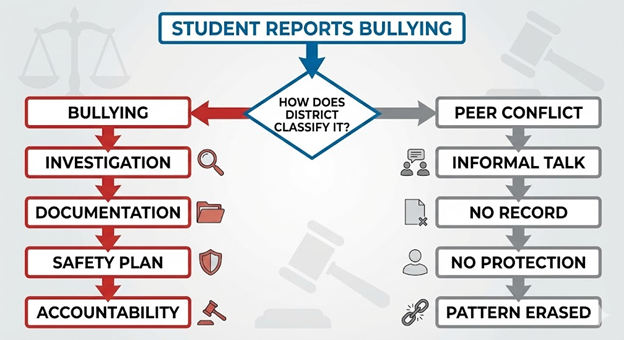
When a district calls bullying “peer conflict,” it’s not a neutral observation—it’s a strategic reclassification that erases legal obligations. Bullying triggers mandatory timelines, investigations, safety plans, and documentation under state education codes and federal civil rights law. “Peer conflict” triggers nothing. The Student Advocacy Network Institute, a Policy-Driven Student Safety Agency, exists to expose and reverse this manipulation. We convert trauma into code by forcing districts to apply the correct legal definitions. When schools downgrade incidents to avoid accountability, they create both a safety failure and a civil rights violation. Selective enforcement IS discrimination—and definitional downgrading is one of its most insidious forms.
The Student Advocacy Network Institute was built to confront linguistic manipulation that protects institutions instead of students. As the nation’s first Policy-Driven Student Safety Agency, SANI operates at the intersection of policy enforcement, civil rights compliance, and behavioral pattern recognition.
When a parent contacts SANI and says, “The school called it a peer conflict,” we ask:
If the answers reveal bullying, we reclassify the incident using the correct legal framework. We convert trauma into code by forcing the district to apply Ed Code 48900, Title VI, or Section 504 standards—not the district’s preferred euphemism.
SANI treats student harm as both a school safety issue and a civil rights issue because definitional downgrading often masks selective enforcement. When Black students, disabled students, or LGBTQ+ students are told their harassment is “just conflict,” while other students receive full investigations and protections, selective enforcement IS discrimination.
We don’t accept the district’s language. We impose the law’s language.
Districts face pressure from multiple directions:
Downgrading incidents to “peer conflict” serves all these interests—but violates the law.
California Ed Code 48900(r): Bullying is defined as “severe or pervasive physical or verbal act or conduct” including threats, intimidation, or harassment that has the effect of causing a reasonable student to fear harm or substantially interfere with academic performance or ability to participate in school.
Federal Civil Rights Framework: Under Title VI, harassment based on race, color, or national origin creates a hostile environment when it is severe, pervasive, or persistent. Schools must investigate and respond even if they would not label it “bullying” under state law.
Section 504/ADA: Disability-based harassment—including targeting a student because of perceived disability—triggers federal protection and investigation requirements.
These definitions are not optional. They are legal standards. When a district substitutes “peer conflict” for legally defined bullying or harassment, they are not exercising discretion—they are evading duty.
Most state education codes impose investigation timelines:
“Peer conflict” has no timeline. By reclassifying the incident, the district eliminates the clock. This is why definitional downgrading is strategic—not semantic.
Bullying is rarely a single event. It is a pattern. When each incident is downgraded to “peer conflict,” the pattern disappears from the record. The district can claim:
All of these statements may be technically true in the district’s system—because they never documented the behavior correctly. This is why SANI insists on reclassification. Without it, accountability is impossible.
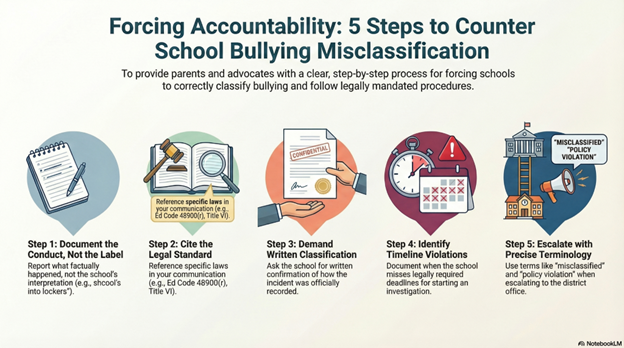
When you report an incident, describe what happened in factual terms:
Do not accept the district’s reframing. If they call it “peer conflict,” respond in writing: “I am reporting bullying under Ed Code 48900(r). Please classify and investigate accordingly.”
In your communication, reference the law:
This forces the district to respond to the legal framework, not their preferred euphemism.
Ask: “How has this incident been classified in the school’s records? Please provide written confirmation.”
If the district refuses or provides an oral-only response, document that refusal. It becomes evidence of evasion.
If the school delays or fails to investigate, calculate the violation:
Timeline violations are easier to prove than most other claims. They are objective, measurable, and hard to defend.
When escalating to the district office, state:
“The school misclassified bullying as ‘peer conflict,’ which eliminated mandatory investigation timelines and documentation requirements. This is a policy violation and creates civil rights exposure. I am requesting reclassification and immediate investigation under the correct legal framework.”
This language signals that you understand the manipulation—and that you will hold the district accountable.
Schools downgrade bullying to avoid triggering mandatory investigation timelines, documentation requirements, parent notifications, and safety plan obligations. "Peer conflict" has no legal definition and no enforcement mechanism. It allows schools to respond informally—or not at all—without violating written policy.
It depends. If the conduct meets the legal definition of bullying under state education code or harassment under federal civil rights law, the school has a duty to classify and investigate it correctly. Misclassification that results in failure to investigate, protect, or document can constitute negligence, deliberate indifference, or policy violation.
Peer conflict typically refers to disagreements between students of relatively equal power—arguments, social friction, or one-time disputes. Bullying involves a power imbalance, intent to harm or intimidate, and repeated or severe conduct. The key distinctions are: power differential, intent, repetition, and impact on the victim's safety or ability to learn.
You cannot unilaterally force reclassification, but you can create pressure and a documented record. Cite the legal definition in writing, describe the conduct factually, request written classification, and escalate if the school refuses. If the school's misclassification results in harm, it strengthens a negligence or civil rights claim.
Ask for the investigation report. Request: "What evidence supports the conclusion that this was mutual? Were witnesses interviewed? Was video reviewed? What did my child say versus the other student?" If the school cannot produce evidence of a real investigation, the classification is unsupported. "Mutual combat" is another downgrading tactic—and often inaccurate.
Yes and no. It affects the school's internal record, but not the underlying facts. If you have evidence the conduct was actually bullying, you can use that evidence in a legal claim regardless of how the school classified it. However, misclassification can delay your ability to prove notice, pattern, and foreseeability—so early reclassification is strategic.
This is a common selective enforcement pattern. Document: (1) the history of bullying leading up to the incident, (2) evidence your child acted in self-defense, (3) the school's failure to intervene earlier, (4) disparate discipline (if the aggressor received lesser or no discipline). Self-defense misclassified as mutual combat is both a safety failure and a due process violation.
If you want student harm treated like a school safety and civil rights issue—start with SANI at https://saninstitute.net
The Student Advocacy Network Institute (SANI) is a national research, accountability, and discipline institute founded by Bullying Is A Drug to define, document, and address institutional failure in K–12 education—treating student harm as a school safety and civil rights issue.
Explore the Institute:
https://saninstitute.net
A ninth-grade student is shoved into lockers daily for two weeks. Other students record it on their phones. The victim reports it to a counselor, naming witnesses and showing bruises. The counselor says, “We’ll talk to everyone involved.”
Three days later, the parent follows up. The assistant principal says: “We looked into it. It appears to be a peer conflict. Both students have been counseled about resolving disagreements respectfully.”
The parent is confused. “My child didn’t fight back. How is this mutual?”
The assistant principal responds: “Sometimes teens have trouble communicating. We’re treating this as a learning opportunity.”
No incident report was filed. No safety plan was created. No investigation was documented. No timeline was followed.
Two weeks later, the bullying escalates to a bathroom assault. The parent discovers the school never classified the initial reports as bullying—so no mandatory procedures were triggered.
This is not an accident. This is definitional downgrading—a distortion tactic designed to protect the district from accountability. By relabeling bullying as “peer conflict,” the school avoided:
The record shows the school knew. The record shows they reclassified. The record shows harm continued. That’s deliberate indifference disguised as conflict resolution.
Most bullying cases do not need a lawyer. Some clearly do. Knowing the difference before you act matters more than most parents realize. The decision

There is a point in many bullying cases where the parent has done everything right — and it still is not working. The emails are

You have three minutes. Make them the most organized three minutes the board has heard on this topic. Speaking at a school board meeting is

Patience with a school that isn’t responding isn’t a virtue. At some point it becomes a cost your child is paying. Most parents start at